The Trauma Code: Heroes on Call (Korean: 중증외상센터, Jungjeung Oesang Senteo) is the rare medical drama that moves like an action movie. The 2025 South Korean series landed all eight episodes on Netflix at once on January 24, 2025, and within ten days it was sitting at No. 1 on the platform’s global non-English TV chart. Pulpy, fast, and funnier than its grim subject suggests, it became one of the year’s breakout K-dramas.

What it is
The show comes from the web novel Trauma Center: Golden Hour by Hansanleega (한산이가) and Hongbichira (홍비라), which Naver later turned into a webtoon in 2019. Director Lee Do-yoon (이도윤) squeezes all of it into eight tight episodes that feel closer to an action-comedy than to the usual somber hospital drama. You can finish the whole thing in a long evening, and the pacing wants you to.
The premise (no big spoilers)
Baek Kang-hyuk (백강혁) is a surgeon sharpened to an almost superhuman edge by years of operating in war zones and disaster sites overseas. He’s brought in to run the neglected, chronically under-funded severe-trauma center of a big university hospital, a department the rest of the building writes off as a money pit. He arrives with battlefield instincts, blunt confidence, and no tolerance for hospital politics, and starts hauling a skeleton crew of burned-out staff into something resembling a real team. The fun is in watching reluctant junior doctors and nurses get pulled into his gravity and find out what they can actually do, all of it framed by rescue sequences that earn their tension. At heart it’s a workplace underdog story.
The cast and characters
Ju Ji-hoon (주지훈) carries the whole thing as Baek Kang-hyuk, the genius trauma surgeon, and the performance won him Best Actor at the 61st Baeksang Arts Awards. Across from him, Choo Young-woo (추영우) plays Yang Jae-won (양재원), a colorectal-surgery fellow yanked onto the trauma team against his will and serving as the audience’s wide-eyed way in. Ha Young (하영) is Cheon Jang-mi (천장미), a sharp, no-nonsense trauma nurse; Yoon Kyung-ho (윤경호) turns up as anesthesiologist Han Yu-rim (한유림), and Jung Jae-kwang (정재광) fills out the core team. The group chemistry — bickering, exhausted, stubbornly loyal — is what keeps you watching between the emergencies.

Why it matters
The numbers were big, but the show landed harder than that in Korea, where the strain on real emergency and trauma medicine keeps making headlines. It puts the chronic under-resourcing of trauma centers and the brutal hours of the people staffing them right on screen, and somehow stays entertaining instead of turning into a lecture. Most of the credit goes to Ju Ji-hoon’s deadpan, magnetic lead and to a tempo this genre rarely allows itself. It clicked well enough that Netflix ordered more seasons, which doesn’t happen often for Korean originals.
Real filming locations for your K-tour
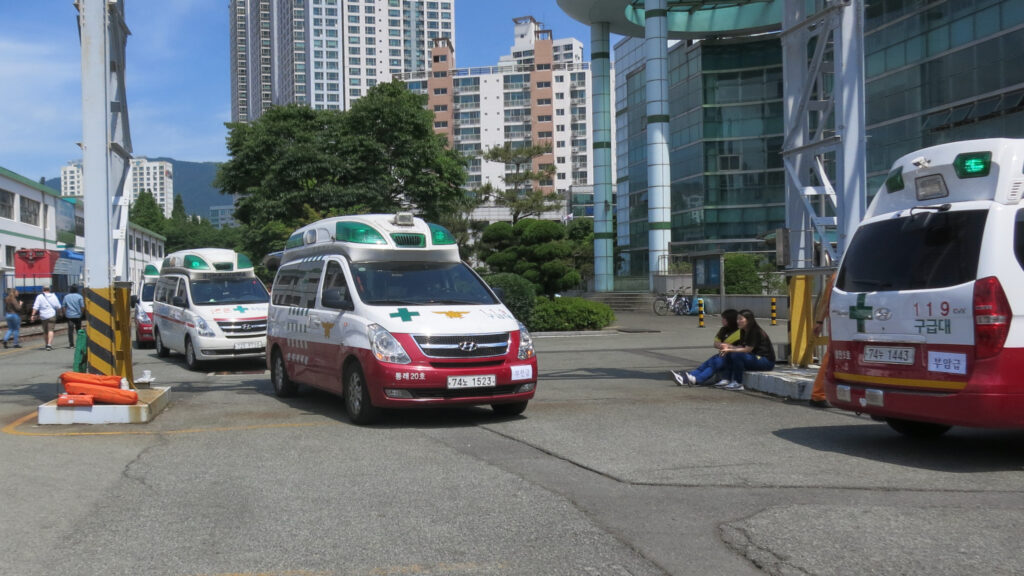
The main place to visit is Ewha Womans University Seoul Hospital (이화여자대학교 서울병원) in Magok, Gangseo-gu — yes, the same sleek modern hospital that stood in for tvN’s Hospital Playlist. The crew shot exteriors and public areas here across roughly six months, taking in the lobby, the emergency-center entrance, the outpatient corridors, and the open 4th-floor healing garden. One honest caveat: the operating rooms, trauma bays, and ambulance interiors were all purpose-built sets, so what you can actually stand in front of is the building’s exterior and atrium.
Other Korean shoots filled out the rest. Seoul Bumin Hospital (서울부민병원), also in Gangseo-gu, supplied the VIP patient rooms and the director’s-office scenes, while the helicopter sequences used the helipad at Bestian Osan Hospital (베스티안 오산병원), with related facilities tied to Bestian Hospital in Cheongju (청주 베스티안병원). The overseas combat-zone flashbacks were shot in Morocco, so don’t go hunting for those in Korea. If you’re picking one stop, make it Magok: it’s a clean, easy-to-reach pocket of western Seoul right on the subway, and it doubles neatly as a Hospital Playlist pilgrimage.
Korean food in the show
Set your expectations here — this is a trauma center, not a food drama. Meals get inhaled between cases, and there’s no signature dish the series builds itself around. Skip the jjajangmyeon-moment hopes; the craving this one feeds is for adrenaline, not a table full of banchan.
Sources: Wikipedia, Netflix Tudum, South China Morning Post, Marie Claire, IMDb, and Korean coverage from Wikitree, DocDocDoc and MedicalTimes.




Leave a Reply