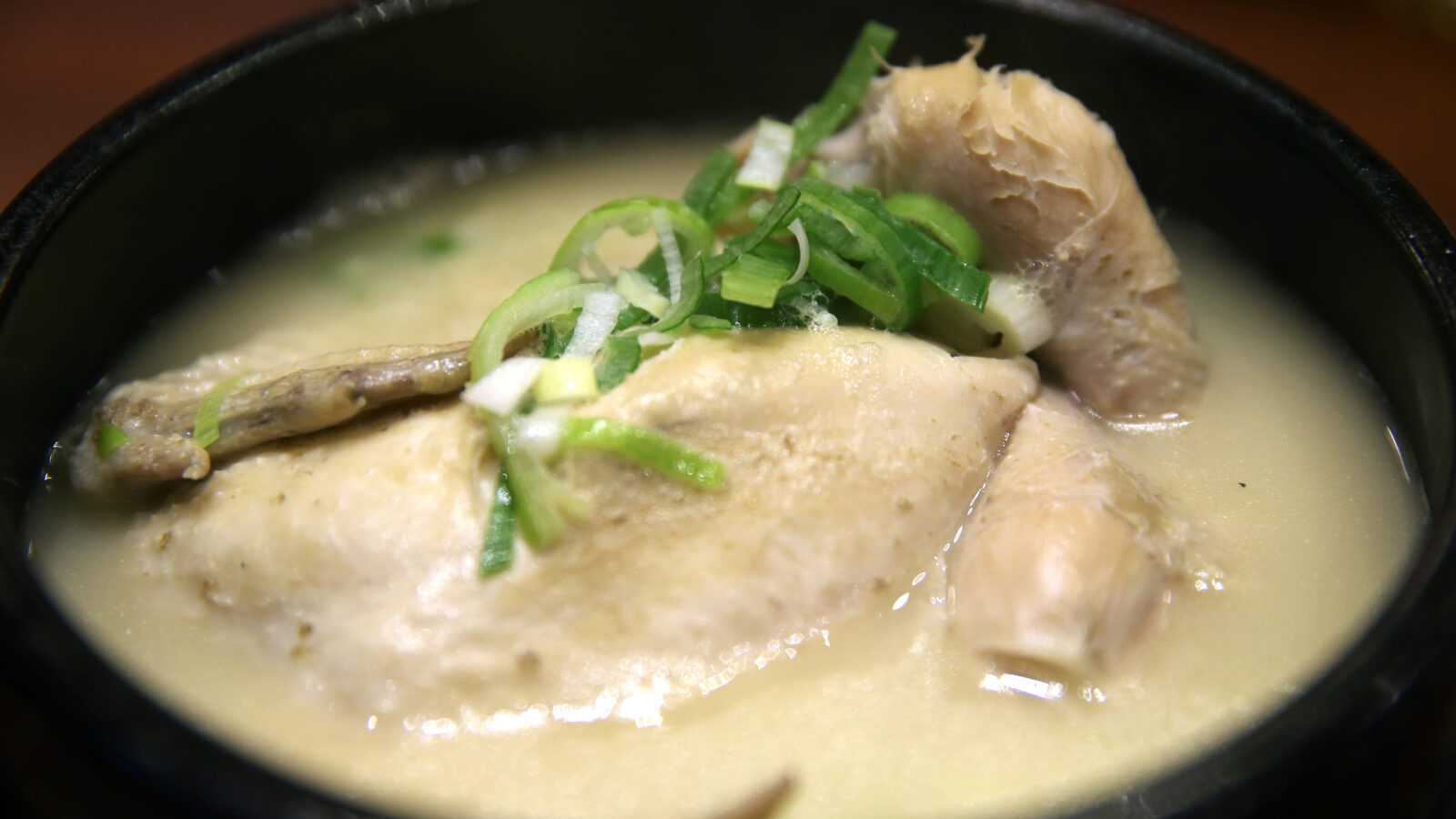
On the three hottest days of the Korean summer, restaurants across the country fill up with people lining up for a bowl of soup so hot it makes you sweat. That is not a mistake. Samgyetang (삼계탕, 蔘鷄湯), Korea’s beloved ginseng chicken soup, is a boyangsik (보양식) tonic dish built on the old idea of iyeolchiyeol (이열치열) — “fight heat with heat.” When the body sweats out its energy and the stomach turns cold and sluggish in the humidity, Koreans answer not with something chilled but with a steaming, restorative bowl that warms you from the inside and rebuilds your stamina.
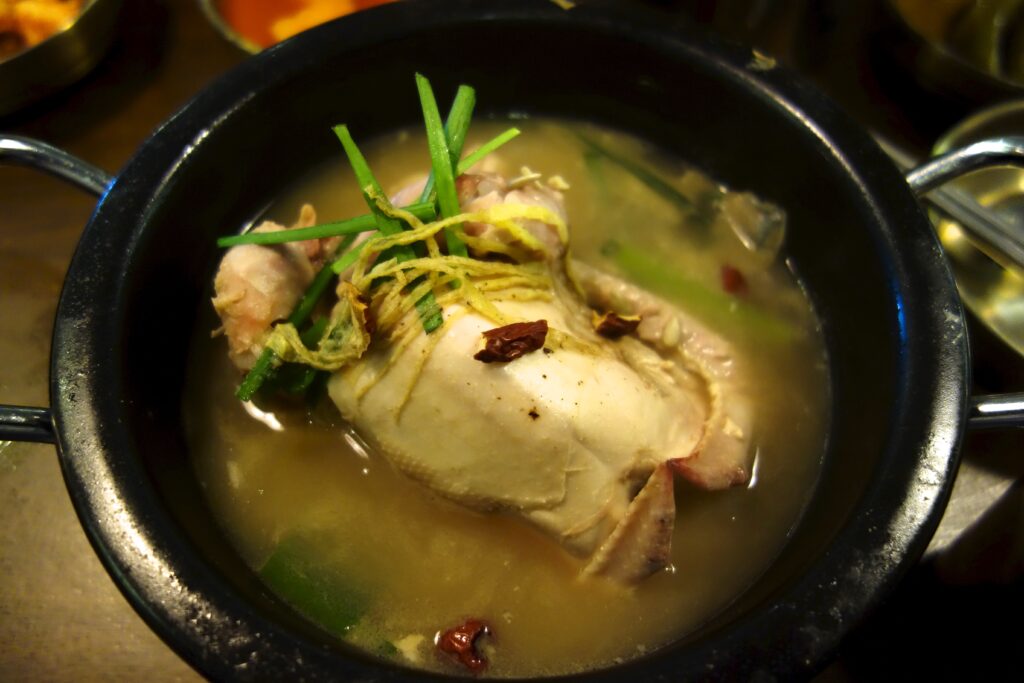
The dish is wonderfully simple in concept and deeply nourishing in practice. You take a whole young chicken — a yeonggye (영계), a tender poussin sized for one person — and pack its cavity with soaked sweet rice, fresh ginseng, garlic and jujube. Then you simmer the whole bird in a milky broth scented with astragalus and herbs until the meat slips from the bone and the rice inside swells into a soft porridge. It arrives one bird to a stone pot, bubbling, just for you.
The star is the ginseng. Sam (蔘) means ginseng, and that is the whole point: without ginseng it is not samgyetang at all, just baeksuk (백숙), plain boiled chicken. The name and the dish as we know it took shape after Korea’s liberation — powdered-ginseng “gyesamtang” shops appeared in the 1950s, and once refrigeration spread in the 1960s, whole roots could be used and “samgyetang,” ginseng front and center, was born.
Ingredients
- 1 young chicken (Cornish hen, about 1.5 lb / 680 g), cleaned
- 3 Tbsp to 1/4 cup glutinous (sweet) rice, soaked 1–2 hours or overnight
- 1–2 fresh ginseng roots (or about 15 g dried Korean/American ginseng)
- 4–6 cloves garlic, whole
- 2–5 dried jujubes (Korean dates), rinsed
- A few slices of astragalus (hwanggi) for the broth — optional but the heart of a tonic soup
- Optional: 3–4 peeled chestnuts, a few ginkgo nuts, 1–2 slices fresh ginger
- 5–6 cups water or chicken stock (about 1.5 L)
- To finish: chopped scallions, salt, ground black pepper
How to Make Samgyetang
- Soak the sweet rice in cold water for 1–2 hours (or overnight); it will swell as it absorbs water. Drain before using.
- Clean the chicken well, removing any fat and innards from the cavity and rinsing inside and out.
- Stuff the cavity with the soaked rice, garlic, a jujube or two and some of the ginseng. Leave about a quarter of the space empty — the rice expands as it cooks, and an over-packed bird will burst.
- Truss the legs to keep the filling in: make a small slit in the skin of one thigh and tuck the opposite drumstick through it, crossing the legs into an X, or simply tie them with cotton string. Pin the opening shut with a toothpick if needed.
- Place the chicken in a large pot and add 5–6 cups water, the astragalus, and the remaining ginseng, garlic and jujube (plus ginger and chestnuts if using).
- Bring to a boil over high to medium-high heat, skimming off the foam and fat that rise for about 15–20 minutes.
- Cover, lower to medium-low, and simmer 25–30 minutes more, until the meat pulls easily from the bone and the rice inside is fully cooked — about 40 minutes to 1 hour total.
- Turn off the heat and let it rest about 10 minutes. For restaurant-style service, transfer the chicken and broth to a stone pot (ttukbaegi) and return it to a hard boil so it reaches the table bubbling. Do not season the soup while cooking — keep the broth clean and let each person salt it at the table.
Eating It on Boknal, and a Few Variations
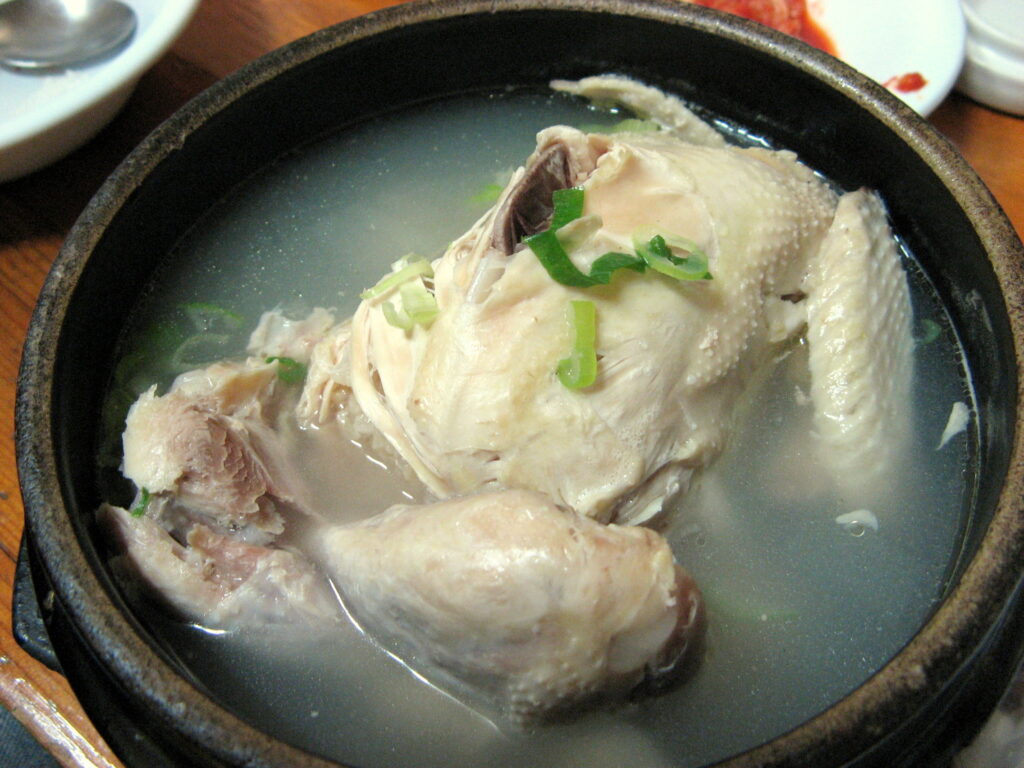
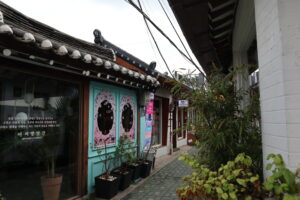
Samgyetang belongs above all to sambok (삼복), the three dog days of summer — chobok, jungbok and malbok, collectively called boknal (복날). On these days the famous samgyetang houses overflow; the queues outside Tosokchon in Seochon (서촌) on chobok are long enough to make the news. If you would rather taste the real thing than cook it, Seochon — just west of Gyeongbokgung — is the place, and koroute’s Seochon walking tour includes exactly this kind of old-house ginseng-chicken spot.
Once you have the basic bowl down, the variations are easy and rewarding. Jeonbok samgyetang adds abalone for a richer, cleaner broth; deulkkae samgyetang stirs in ground perilla seeds for a nutty, thicker soup; and nurungji samgyetang layers in scorched-rice crust for a toasty, comforting finish. Drop the ginseng entirely and you are simply back to baeksuk — that one root is the whole dividing line.
How to Eat It
The broth comes out deliberately under-seasoned, so reach for the small dish of salt and pepper and season it yourself, to taste. Many people mix salt and pepper on a little plate and dip the pulled meat into it. Eat the tender chicken first, picking it off the bone, then save the best for last: the sweet rice from inside the bird, now soaked in broth and spread soft like porridge — this filling is the soul of the dish. Eat the ginseng, jujube and garlic that cooked alongside, scatter chopped scallion over the top, grind on fresh pepper, and have it hot. A small cup of ginseng wine (insamju) on the side is traditional — Tosokchon famously serves it — and crisp kkakdugi radish kimchi and cabbage kimchi round out the table.
Where to eat 삼계탕 (samgyetang) in Seoul
When summer’s dog days hit, Koreans line up for 삼계탕 — a whole young chicken stuffed with glutinous rice, ginseng, garlic, and jujube, simmered into a milky, restorative broth. Seoul’s long-running specialists do it best, and the city’s famous “big three” houses are all still going strong. Here are a few classics worth the trip.
- 토속촌삼계탕 (Tosokchon Samgyetang) — Seochon, Jongno-gu, just steps from Gyeongbokgung Palace (Gyeongbokgung Stn, Line 3). Seoul’s single most famous samgyetang house, set in an atmospheric old hanok. The broth is thick with ginseng and glutinous rice — exactly what people queue 30-plus minutes at lunch to get.
- 고려삼계탕 (Goryeo Samgyetang) — Seosomun, Jung-gu, near City Hall (Sicheong Stn, Lines 1/2). Open since 1960 and now second-generation, this is one of Seoul’s oldest samgyetang restaurants and a Michelin Guide regular. A benchmark old-school bowl, convenient if you’re downtown.
- 원조호수삼계탕 (Wonjo Hosu Samgyetang) — Singil-dong, Yeongdeungpo-gu, near Singil/Sinpung Stations (Lines 1/7). The third of the “big three,” but the draw here is its distinctive nutty 들깨삼계탕 (perilla-seed version) — a TV-famous twist that’s worth the slightly off-the-tourist-path location.
A quick honest note: hours, weekly closing days, and waits change, so verify the latest before you go (a quick call or map check saves a wasted trip). These popular spots draw long lines — especially at lunch and on hot summer days — so arriving early or off-peak helps.


Leave a Reply