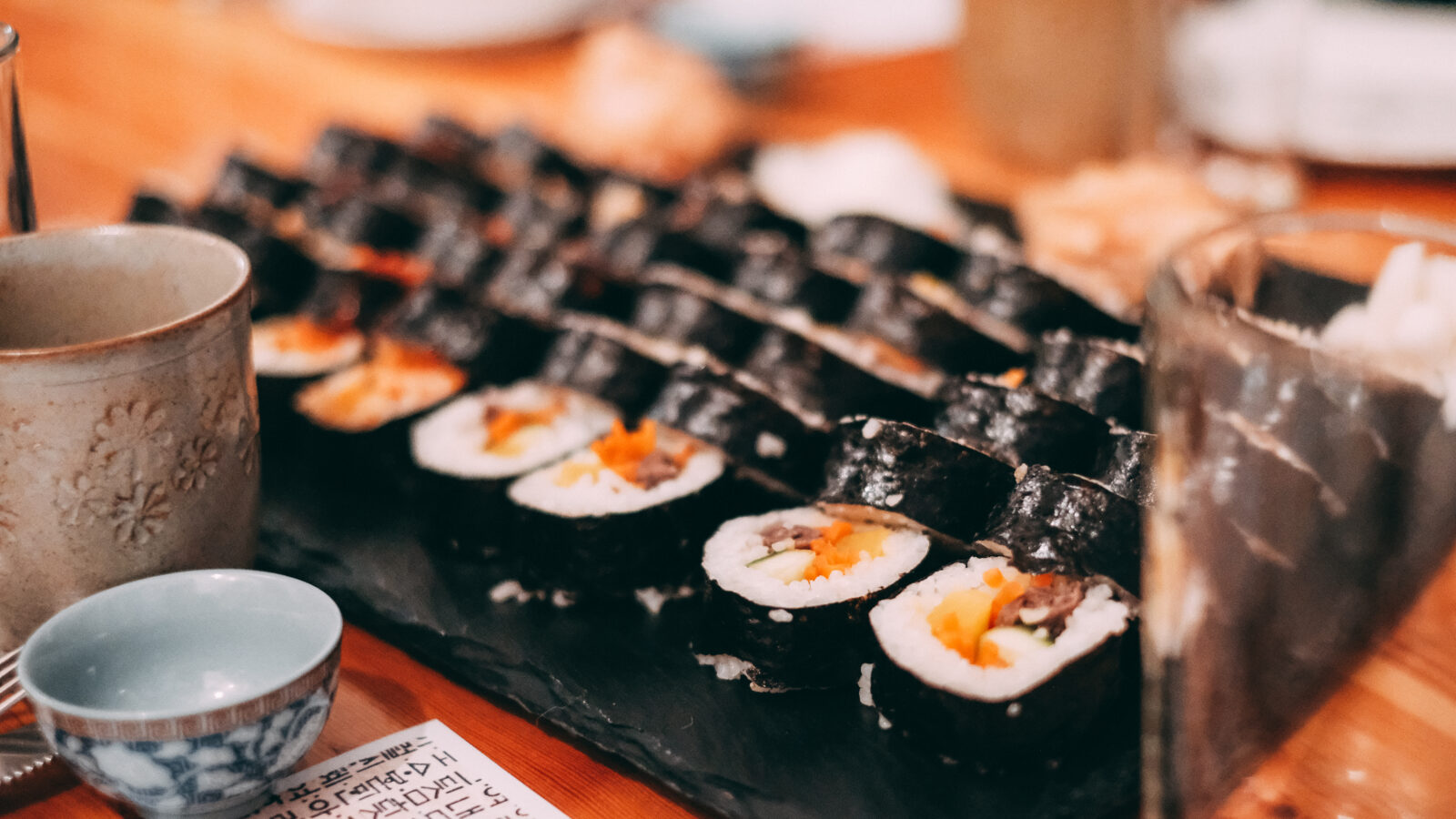
If there is one food that says “let’s go on a picnic” to a Korean, it is 김밥 (gimbap) — the iconic seaweed-rice roll that travels in every lunchbox, hiking backpack, and school-trip (소풍) bag in the country. Seasoned rice and a neat row of colorful fillings are spread across a sheet of 김 (gim, dried laver), rolled tight with a bamboo mat (김발), brushed with fragrant sesame oil, and sliced into bite-size rounds. The name is wonderfully literal: 김 (gim/laver) plus 밥 (bap/rice).
People often call it “Korean sushi,” but the two are cousins, not twins. Gimbap rice is seasoned with sesame oil and salt — never vinegar, and the fillings are always cooked or pickled, never raw fish. The result is a savory, portable, endlessly customizable roll that ranges from a full eight-filling masterpiece down to the bare-bones 충무김밥 and the addictive mini 마약김밥. One rule above all: gimbap is best eaten the same day it is made.
The classic fillings are all cut into long matchsticks or strips that span the whole roll: 단무지 (danmuji, the sweet-crunchy yellow pickled radish that is the backbone of any roll), 시금치 (sigeumchi, blanched seasoned spinach), 당근 (danggeun, lightly sautéed carrot), 계란지단 (gyeran-jidan, a thin egg sheet sliced into strips), 우엉 (ueong, burdock root braised in soy and sugar), and one savory protein strip — 맛살 (imitation crab stick), 햄 (ham), 어묵 (fish cake), or seasoned 소고기 (bulgogi-style beef). 오이 (cucumber) can stand in for or join the spinach.
Ingredients
Makes about 4–5 rolls.
- Rice: 1.5 cups uncooked short-grain rice, cooked slightly firm (a little less water than usual), tossed with 2 tsp toasted sesame oil and about 1/2 tsp salt
- 김 (gim/laver): 4–5 sheets dried gimbap-grade laver
- 계란 (egg): 2–3 large eggs + a pinch of salt, for the 지단 (egg sheet)
- 시금치 (spinach): 1 bunch (about 8 oz), blanched, with 1–2 tsp sesame oil, 1/2 tsp salt, and 1–2 minced garlic cloves
- 당근 (carrot): 2 medium, julienned, with 1/4 tsp salt
- 단무지 (danmuji): 4–5 long strips (store-bought yellow pickled radish)
- 우엉 (ueong/burdock): 4–5 strips, braised in soy sauce + sugar (or use pre-seasoned)
- Savory strip: 8 oz beef seasoned with soy sauce, rice wine, sugar, sesame oil, and garlic — OR 맛살 (crab stick) / 햄 (ham) / 어묵 (fish cake) strips
- Finishing: toasted sesame oil, toasted sesame seeds, and a little cooking oil for the pan
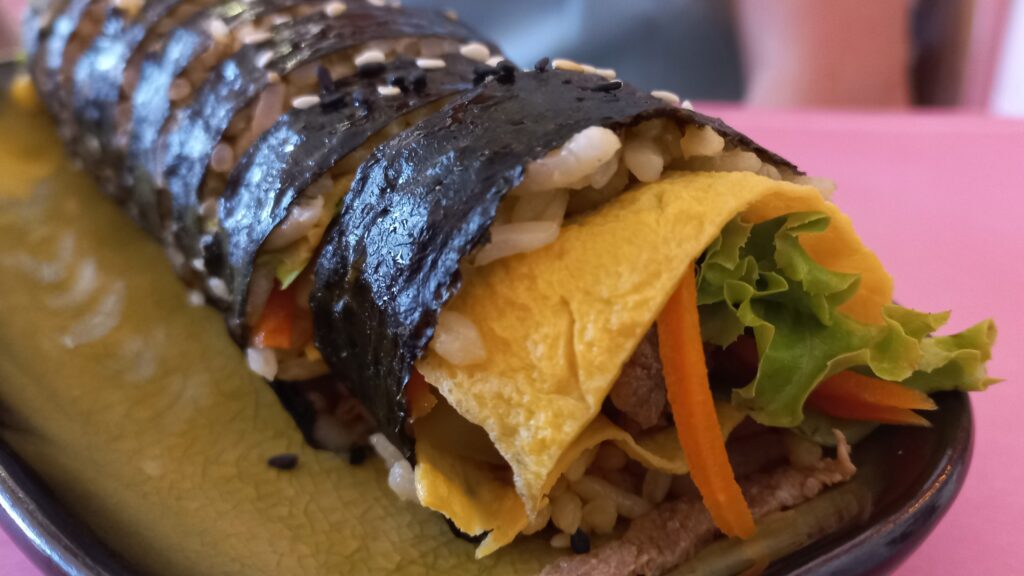
How to Make Gimbap
- Cook and season the rice. Cook the rice slightly firm and keep it warm. While still warm, fold in the sesame oil and salt with a rice scoop until every grain is glossy. Let it cool to just-warm (steam gone) so it won’t tear the gim.
- Make the egg sheet (지단). Beat the eggs with a pinch of salt, pour into a lightly oiled pan, and cook over low heat into a thick, flat omelette. Cool, then slice lengthwise into 1/2-inch strips.
- Blanch the spinach (시금치). Drop into boiling water for about 30 seconds, plunge into ice water, then squeeze very dry. Season with sesame oil, salt, and minced garlic.
- Cook the carrot (당근). Stir-fry the julienned carrot in a lightly oiled pan with a little salt until just softened — don’t let it go limp.
- Prep the burdock and radish. Braise the 우엉 strips in soy sauce and sugar until glossy (or use pre-seasoned). Pat the 단무지 strips dry. Drain every filling well — excess water makes soggy gimbap.
- Cook the protein. Stir-fry the seasoned beef for 2–3 minutes until cooked through; or briefly stir-fry 어묵/맛살 strips. Let cool.
- Assemble. Place a gim sheet shiny-side down on the bamboo mat (김발). Spread about 3/4 cup rice in a thin, even layer over the bottom three-quarters, leaving a 1.5–2 inch bare strip at the top for sealing. Don’t press hard.
- Layer the fillings in a neat row about an inch from the bottom edge: danmuji, spinach, carrot, egg, ueong, and protein side by side.
- Roll. Lift the bottom edge of the mat, fold it over the fillings, and roll away from you, tucking firmly. Use the 김발 to apply even pressure for a tight, round roll. Moisten the bare top edge with a dab of water to seal.
- Finish and slice. Brush the roll with toasted sesame oil and sprinkle on sesame seeds. With a sharp, lightly oiled knife, cut into 1/2-inch rounds, wiping the blade with a damp cloth between cuts so each slice is clean.
Tip: Use freshly cooked, just-warm rice; drain every filling thoroughly; and oil the knife. To revive next-day gimbap, dip the slices in beaten egg and pan-fry them — that’s 계란김밥.
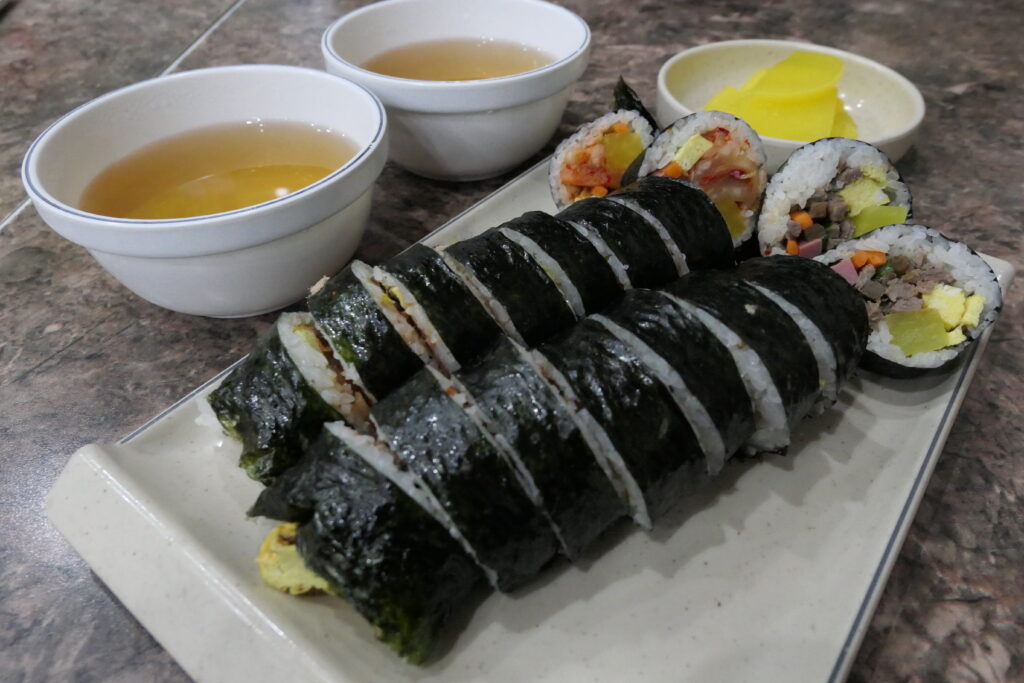
A Few Favorite Variations
Gimbap is a canvas. 참치김밥 (chamchi/tuna gimbap) folds mayo-dressed canned tuna into the roll and is one of the most popular modern versions; 치즈김밥 tucks in a strip of cheese; 김치김밥 adds chopped, squeezed-dry (often stir-fried) kimchi for a tangy kick. 누드김밥 (nude/inside-out gimbap) flips the structure with rice on the outside, often rolled in sesame seeds. Shops also turn out sausage/ham, chicken (닭고기김밥), anchovy (멸치김밥), and all-vegetable vegan rolls (야채김밥).
Two regional and street stars deserve special mention. 충무김밥 (Chungmu gimbap) hails from Tongyeong (the old Chungmu City) on the South Gyeongsang coast: plain rice rolled thin in gim with no fillings and no sesame-oil brushing, served alongside spicy seasoned squid (오징어무침) and tangy radish kimchi. Legend says a fisherman’s wife kept the rice and spicy sides separate so the food wouldn’t spoil at sea. Meanwhile, 마약김밥 (“narcotic gimbap”) — thumb-sized mini rolls of carrot, spinach, and danmuji, famous at Seoul’s Gwangjang Market — earns its nickname for being addictively good, served with a sweet-tangy mustard-soy dipping sauce.
How to Eat Gimbap
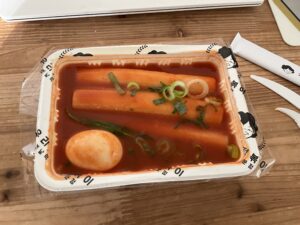
Gimbap is finger food: pick up the rounds one at a time, ideally fresh and at room temperature the same day they’re made (it doesn’t refrigerate well — the rice hardens). It’s the default 소풍, hike, road-trip, and lunchbox meal, sold everywhere from 분식 (bunsik) snack shops and convenience stores to dedicated chains. Eat a roll on its own, or pair it with 라면 (ramyeon) — and don’t miss the classic combo of dipping gimbap into 떡볶이 (tteokbokki) sauce. For the regional styles, alternate bites of 충무김밥 with the spicy squid and radish kimchi, and dunk your 마약김밥 in that mustard-soy sauce. And remember: leftover slices get a second life pan-fried in beaten egg.
Where to eat 김밥 (gimbap) in Seoul
Gimbap ranges from cheap, addictive market bites to refined “premium” rolls with carefully sourced fillings. These two ends of the spectrum are the most rewarding way to taste it in Seoul, so here are a few reliable spots to try the real thing.
- 모녀김밥 / 모녀마약김밥 (Monyeo Gimbap / Monyeo Mayak Gimbap) — Gwangjang Market, Jongno-gu; nearest station Jongno 3(sam)-ga area, Jongno 5(o)-ga (Line 1, Exit 8) or Euljiro 4(sa)-ga (Lines 2/5, Exit 4). The dish: bite-size 마약김밥 (mayak gimbap), rolled thin with carrot and pickled radish and dipped in a mustard-soy sauce. This roughly 40-year-old stall is widely credited with starting the whole “mayak (addictive) gimbap” craze, and it’s still the go-to for the original at the market.
- 삼모녀마약김밥 (Sammonyeo Mayak Gimbap) — Gwangjang Market, Jongno-gu; nearest station Jongno 5(o)-ga (Line 1) or Euljiro 4(sa)-ga (Lines 2/5). The dish: the same little mayak gimbap, often served with a side of 떡볶이 (tteokbokki). A long-running, heavily-recommended stall in the same market and a handy backup when the original has a long line, so you can get your fix of the same dish without leaving Gwangjang.
- 리김밥 압구정본점 (Lee Gimbap, Apgujeong main branch) — Sinsa-dong / Apgujeong, Gangnam-gu; nearest station Apgujeong (Line 3, Exit 2) or Apgujeong Rodeo (Bundang Line). The dish: “premium” gimbap with fuller, fresher fillings and creative variations. This Apgujeong flagship is considered a pioneer of Korea’s upscale gimbap category and has been featured on Korean food TV, making it a good contrast to the market style.
Find them on the map: 모녀김밥 / 모녀마약김밥 · 삼모녀마약김밥 · 리김밥 압구정본점
Hours and weekly closing days change often, and these market stalls and franchise branches are no exception, so check current hours (and the rest day) before you go. The Gwangjang Market mayak gimbap stalls in particular get very busy at peak times, so be ready to queue.



Leave a Reply