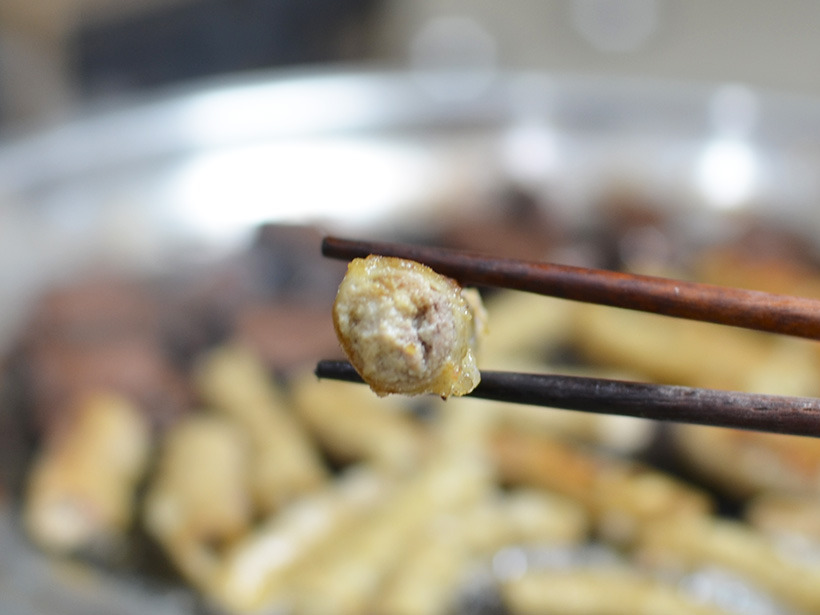
Walk past a busy gopchang-jib (곱창집) on a Korean side street at night and you will smell it before you see it: beef intestine searing on a hot iron plate, fat hissing into the grooves, a haze of smoke over tables crowded with green soju bottles. Gopchang-gui (곱창구이) is grilled beef offal, and it is one of the great Korean drinking foods — the quintessential partner to soju. The intestine is grilled until the outside turns crisp and golden while the inside stays chewy and springy, then dipped in gireumjang (기름장), a simple sauce of salt and sesame oil.
The word 곱창 refers to the beef small intestine, and the “곱” is the rich, savory fatty matter inside the tube — that is what makes good gopchang prized (it is not the same as plain fat). At a proper gopchang house three cuts usually arrive together: 곱창 (small intestine, chewy with the savory 곱 inside), 대창 (daechang, the fat-rich large intestine, intensely gosohan/nutty-rich, essentially a tube of pure fat), and 막창 (makchang, in Korean usage usually the cow’s fourth stomach a.k.a. reed tripe in Daegu style; for pig it is the end of the large intestine). One honest warning before you start: the make-or-break of this whole dish is the cleaning. Done carelessly, intestine reeks; done right, it is clean and nutty.
Ingredients (serves 3–4)
- Beef small intestine (소곱창) — 1 kg
- For cleaning: several Tbsp flour (밀가루), coarse salt (굵은소금), milk (우유) ~2–3 cups (enough to submerge)
- Cooking string (실), optional — to tie the ends so the 곱 doesn’t escape
- For parboiling: 1 scallion (대파), 5–6 garlic cloves (마늘), a few slices ginger (생강), peppercorns (통후추), a splash of soju (소주), 1 bay leaf (월계수잎, optional)
- Grill add-ins: 1 onion (양파), 2 handfuls garlic chives (부추), 10 garlic cloves (마늘), 1 potato (감자, 야채곱창-style), optional perilla leaves (깻잎) or scallion
- Gireumjang dip (기름장): sesame oil and salt in a 3:1 ratio, plus pepper; optional ½ tsp minced garlic and 1 tsp minced scallion
How to make gopchang-gui
- Clean it (the make-or-break). Rinse the inside under running water. Coat the outside with flour and coarse salt and scrub hard (박박) to strip the slippery membrane and odor, then tear off the heavy outer fat membrane (기름막). Rinse well and repeat the flour-and-salt scrub 2–3 times until there is no slime and no smell.
- Soak in milk. Soak the cleaned gopchang in milk for about 30 minutes to pull out any remaining odor, then rinse.
- Parboil. Bring water to a boil with the scallion, garlic, ginger, peppercorns, bay leaf and a splash of soju. Blanch the gopchang about 3 minutes — a short parboil de-smells and pre-cooks, while a longer simmer also tenderizes. Drain and cut into bite-sized, roughly 3-inch pieces.
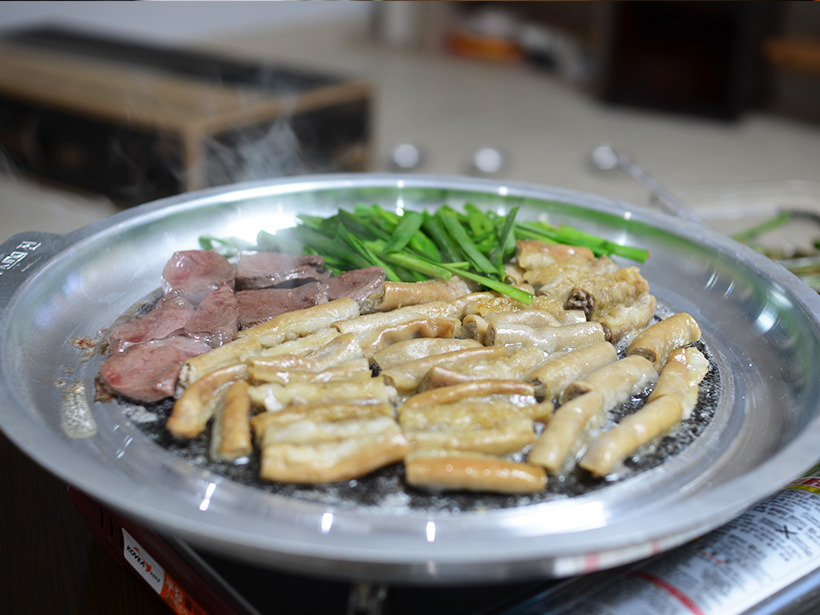
- Grill. Heat a lightly greased iron plate (불판/철판) or charcoal grill and lay the gopchang out over medium-high heat. Do not under-cook it — poke a piece with a toothpick and keep going until no liquid runs out. Under-cooked gopchang is rubbery (질김), so render it until crisp and golden. Add the garlic, onion and potato as it cooks, and toss in the garlic chives near the very end.
- Serve. Eat it hot, dipped in gireumjang — stir a little salt into the sesame oil until it softens, then finish with pepper.
How to eat it
Eat gopchang straight off the grill while it is crisp — let it go cold and the fat congeals. Dip each piece in gireumjang, or build a wrap (쌈) with lettuce or perilla leaf, a piece of gopchang, a little chive salad (부추무침, dressed with chili flakes, sesame oil and vinegar) and a clove of raw or grilled garlic. The daechang’s molten fat is best taken in a single bite. For drinks, soju is the canonical match — its clean, slightly sweet edge cuts the richness — though beer or somaek (soju-beer) work too. Like grilled offal, jeon (Korean savory pancakes) is another classic soju snack you’ll meet at traditional markets, and if you want to try the real thing in Seoul, Gwangjang Market is the place to go for cheap grilled and braised offal.
The finish you must not skip: when the meat is gone, do not wipe the plate. Drop steamed rice into the leftover rendered fat with some kimchi and make fried rice (볶음밥) right there on the hot plate, finishing with toasted seaweed flakes (김가루), sesame oil and toasted sesame seeds. For many Koreans this mamuri (마무리) fried rice is the best part of the whole meal.
Variants
The same family of dishes shows up in a few forms. 야채곱창 uses pork small intestine stir-fried on a hot plate with cabbage, onion, carrot, chives, rice cake and potato in a spicy gochujang/chili sauce — cheaper, spicier and more casual. 곱창전골 is a gopchang hot-pot simmered tableside with vegetables, glass noodles (당면), rice cake and a spicy gochujang broth, good for groups and cold weather, while 곱창볶음 is a drier spicy stir-fry. And you can cook the other cuts solo: 대창구이 for lovers of pure rendered-fat richness, and 막창구이, a Daegu specialty eaten with a doenjang-based sauce or plain gireumjang.
Where to eat 곱창구이 (gopchang-gui, grilled beef intestine) in Seoul
Gopchang-gui — beef intestine grilled at the table until the fat renders and the casing turns crisp-chewy — is a Seoul late-night institution, and the city has a few neighborhoods that locals treat as its true home. Wangsimni even has a dedicated “gopchang street.” Here are a handful of long-running spots worth seeking out.
- 제일곱창 (Jeil Gopchang) — Wangsimni, Seongdong-gu (near the Wangsimni gopchang street), close to Wangsimni Station (Lines 2/5, Gyeongui-Jungang, Bundang). Widely called the most famous shop on Seoul’s signature gopchang street; staff grill at your table using same-day Majang-dong intestine, which is also why it closes on Sundays. Be warned: walk-in waits can stretch to two or three hours, and it sells out.
- 황소곱창 (Hwangso Gopchang) — Wangsimni / Hanyang University area, Seongdong-gu, about a 3-minute walk from Wangsimni Station Exit 6 into the Hanyang Univ. food alley. A roughly 28-year veteran offering a range of cuts (gopchang, daechang, makchang, vary by the day), with an outdoor terrace running in warm weather. Expect a full house on weekends.
- 평양집 (Pyeongyangjip) — Samgakji, Yongsan-gu, right in front of Samgakji Station (Lines 4/6), Exit 14. A genuine old-establishment running at the same address since 1973, grilling same-day-sourced offal on a custom steel rack; it also serves an offal gomtang if you want something brothy. Closed Mondays.
One note on a famous name: 양미옥 (Yangmiok), long associated with Euljiro 3-ga, no longer operates that original branch (the building was hit by a 2021 fire and the area’s redevelopment). The brand’s currently active venue is its Namdaemun branch in Jung-gu, near Namdaemun Market, if you’re set on trying it.
Hours, closing days, and prices change often, so verify before you go — and remember the most popular gopchang spots, especially around Wangsimni, regularly run long queues and can sell out, so arrive early or off-peak.


Leave a Reply