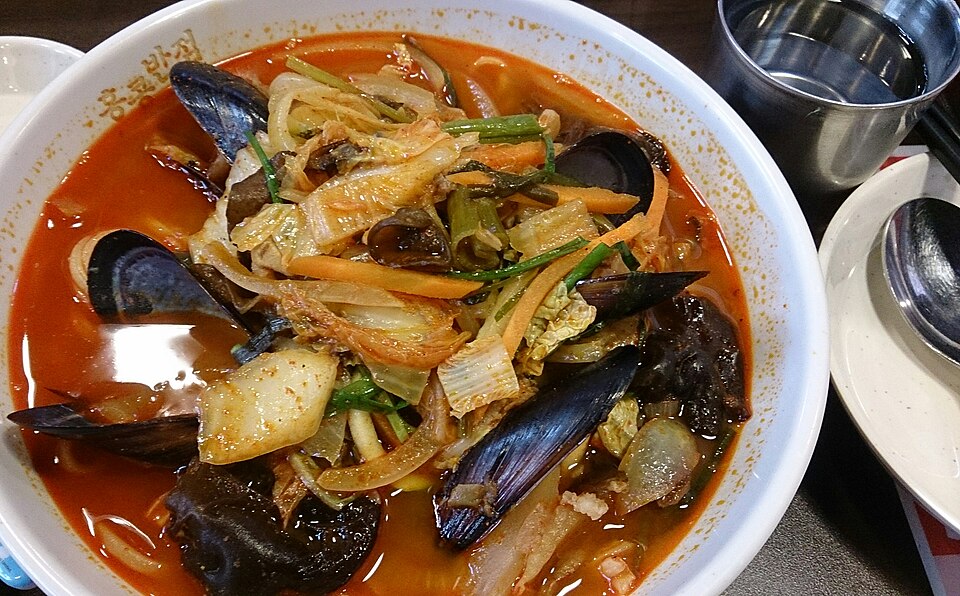
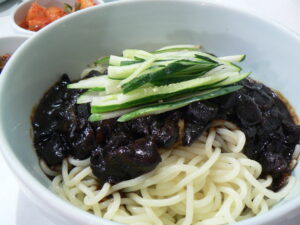
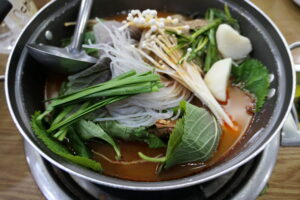
Order at any junghwa-jip — a Korean-Chinese restaurant — and you face the one decision that has split tables for decades: black-bean jjajangmyeon, or red-hot jjamppong (짬뽕)? If jjajangmyeon is the sweet, mellow one, jjamppong is the bowl that walks in breathing fire. Deep crimson, slick with chili oil, crammed with squid, mussels, shrimp, a little pork, and a tangle of stir-fried vegetables over springy wheat noodles.
What Is Jjamppong?
Jjamppong is Korean-Chinese cooking, born from Chinese immigrants — largely from Shandong province — who settled in the port of Incheon in the late 19th and early 20th centuries. It started as a Shandong-style stir-fried noodle soup, but Korean cooks rebuilt it from the 1960s on, leaning hard into gochugaru (Korean red chili flakes) and chili oil. Even the name took a detour: Japanese speakers tied the dish to their own champon, and the word landed in Korean, phonetically, as “jjamppong.”
What sets it apart is the method. There’s no long-simmered bone broth here. Classic jjamppong starts by stir-frying aromatics and chili flakes in hot oil to bloom the color and smokiness, then searing the seafood and vegetables before any stock hits the pot. That fast, high-heat bokkeum step is what gives the broth its glossy red surface and that faintly charred “wok hei” depth.
How It Tastes and How It’s Eaten
The broth comes at you spicy, briny, and savory at the same time — chili heat first, oceanic sweetness from the shellfish underneath, a smoky edge from the bloomed gochugaru. Thick, chewy noodles; seafood that stays tender as long as nobody overcooks it. A loud, slurpable, sweat-inducing bowl.
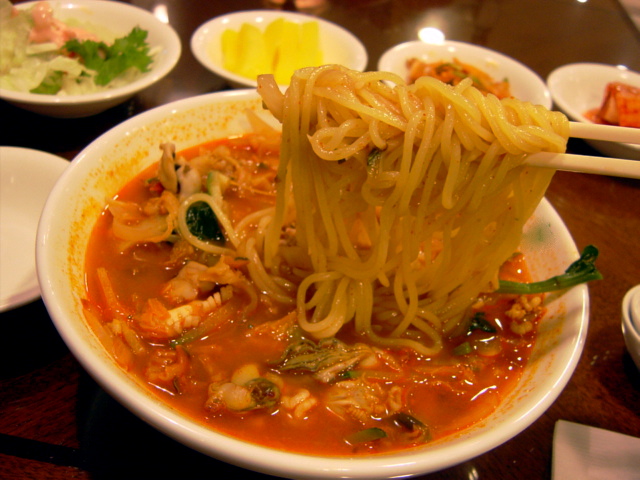
Eat it hot — chopsticks for the noodles and seafood, spoon for the broth. The standard table companions are a small dish of danmuji (yellow pickled radish) and raw onion with black-bean sauce, both there to cut the richness. The smart move, and a common one: order one jjajangmyeon and one jjamppong for the table and split them.
Regional and Menu Variations
- Samseon jjamppong (삼선짬뽕): a premium “three-fresh” version loaded with extra seafood.
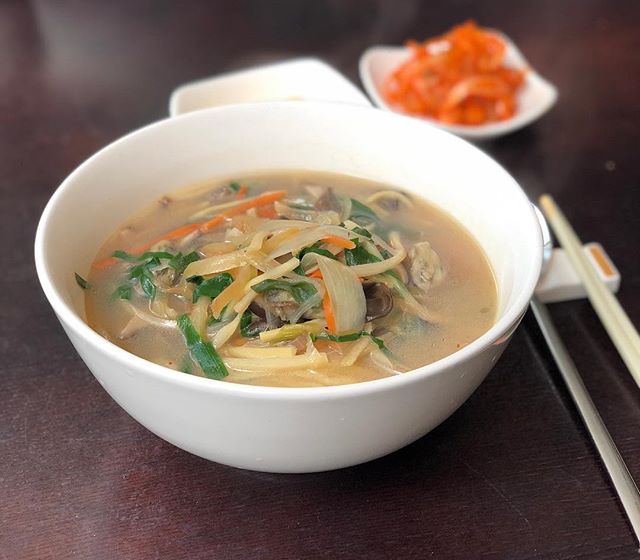
- Gul jjamppong (굴짬뽕): made with oysters, often in a milder, less-red or even white broth.
- Gochu jjamppong (고추짬뽕): turbo-charged with fresh and dried chilies for the heat-seekers.
- Jjamppong-bap (짬뽕밥): the same spicy seafood broth served with rice instead of noodles.
How to Make Jjamppong at Home
Two things decide whether your bowl works. Bloom the gochugaru in oil so it doesn’t taste raw or dusty, and cook the noodles in their own pot so they stay chewy. Skip either and you’ll know.
Ingredients (serves 2)
- 2 portions fresh or dried wheat noodles (jjamppong or udon-style)
- 100 g pork belly or shoulder, thinly sliced
- 1 small squid, cleaned and cut into rings
- 8–10 mussels and/or clams, scrubbed
- 6–8 shrimp, peeled
- 1/2 onion, sliced; 2 cabbage leaves, chopped; 1/2 carrot, julienned; 1 handful sliced zucchini; 2 green onions
- 3 Tbsp gochugaru (Korean chili flakes)
- 4 cloves garlic and 1 tsp grated ginger, minced
- 1 Tbsp soy sauce, 1 Tbsp rice wine, 1 tsp sugar, salt to taste
- 2 Tbsp neutral oil + 1 tsp toasted sesame oil
- 4 cups anchovy-kelp stock or water
Steps
- Bring a separate pot of water to a boil for the noodles; cook them at the very end so they don’t go soggy.
- Heat the neutral oil in a wide pot over medium. Add gochugaru, garlic, ginger, and the white parts of the green onion. Stir 30–60 seconds until the oil turns red and fragrant — do not let it burn.
- Add the pork and stir-fry until it loses its pink color.
- Add onion, carrot, cabbage, and zucchini. Stir-fry over high heat 2–3 minutes until just softened and lightly charred at the edges.
- Pour in the rice wine and soy sauce, then add the stock. Bring to a boil and simmer 5 minutes.
- Add the seafood (mussels, clams, shrimp, squid). Cook 3–4 minutes until shells open and squid turns opaque. Season with sugar and salt.
- Divide the freshly drained noodles into bowls and ladle the broth and toppings over them. Finish with green onion and a drop of sesame oil. Serve immediately.
Honest Cautions
This is genuinely spicy. Start with less gochugaru if you’re heat-sensitive, and keep in mind the flakes only get more assertive as the broth reduces. Mind the shellfish allergens, and throw out any mussels or clams that stay shut after cooking. And move fast — squid and shrimp go rubbery within minutes, so they go in last and the bowl goes to the table right away.
Where to eat 짬뽕 (jjamppong, spicy seafood noodle soup) in Seoul
Seoul’s best jjamppong tends to come from old Hwagyo (ethnic-Chinese) family restaurants, where the recipes have passed down through generations — springy noodles in a fiery red broth loaded with seafood and vegetables, carrying the smoky aroma of a screaming-hot wok. Three spots worth the trip:
- 안동장 (Andongjang) — Euljiro 3-ga, Jung-gu (을지로3가); Euljiro 3-ga Station (Lines 2/3), Exit 10, about a 1-minute walk. Seoul’s oldest continuously operating Korean-Chinese restaurant, founded in 1948 and now run by the third generation, it is credited with inventing 굴짬뽕 (oyster jjamppong) in Korea and is a designated Seoul Future Heritage site. The history is as good as the bowl.
- 영화루 (Yeonghwaru) — Seochon / Tongin-dong, Jongno-gu (서촌 통인동); Gyeongbokgung Station (Line 3), Exit 1, about a 10-minute walk. A third-generation Seochon institution since 1966, once the only Chinese restaurant permitted to deliver to the Blue House. Its cheongyang-chili 고추짬뽕 is a fiercely spicy local classic. Closed Tuesdays.
- 초마 홍대본점 (Choma, Hongdae main branch) — Seogyo-dong, Hongdae, Mapo-gu (홍대 서교동); Hongik University Station (Line 2 / AREX / Gyeongui-Jungang), a short walk. Run by a third-generation Chinese restaurateur and repeatedly ranked among Korea’s top jjamppong spots, prized for strong wok-fire aroma (불향) and a deep, clean broth rather than a heavy or greasy one. They also offer a white (백짬뽕) version. Closed Mondays.
Hours and closing days can change, and these neighborhood favorites sometimes shorten service or sell out — please double-check the latest opening hours before you go.




Leave a Reply