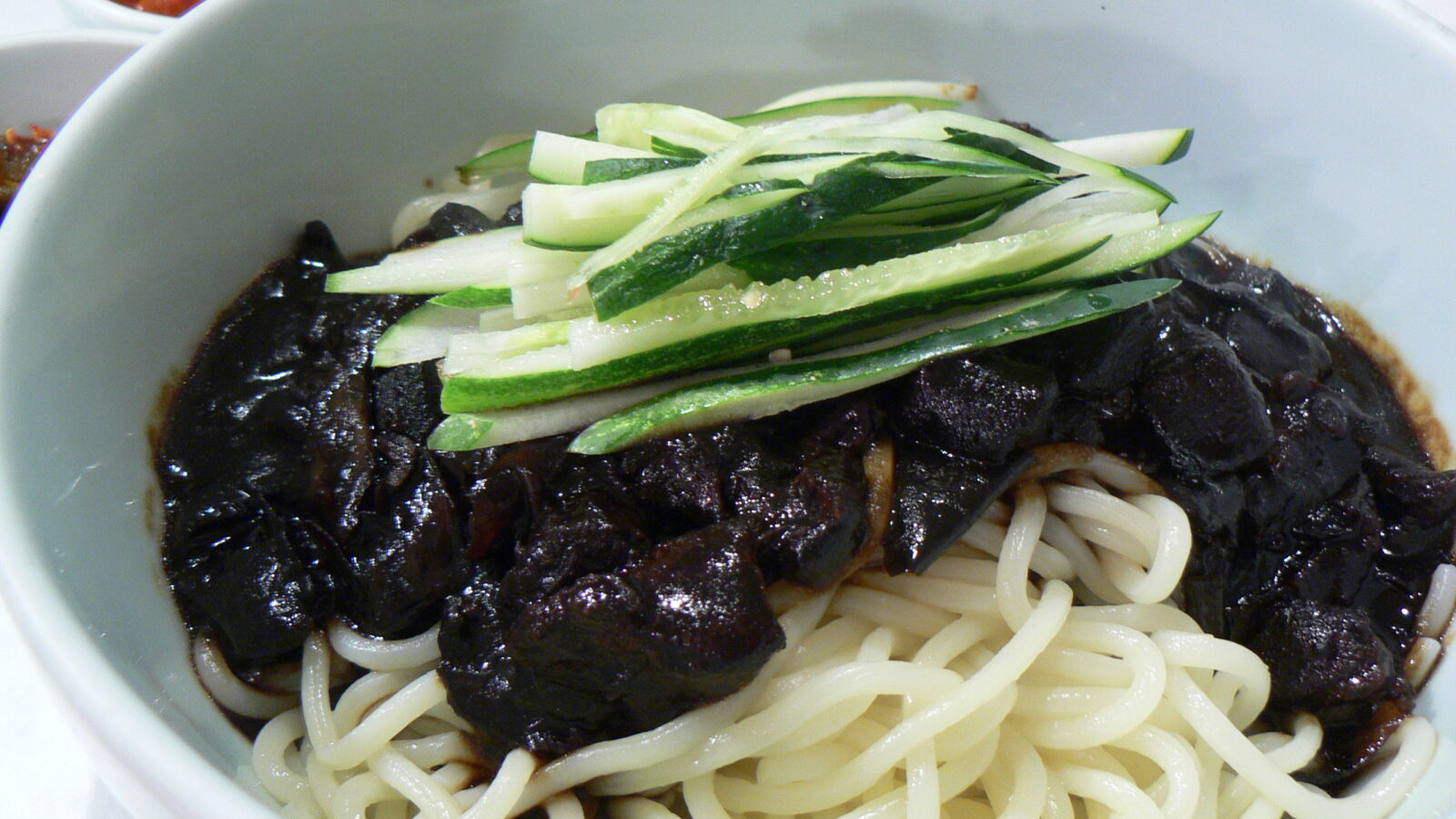
Jjajangmyeon (짜장면) is the dish a Korean family orders on moving day, the meal that follows a graduation, and the one singles share on Black Day. It’s a bowl of thick, chewy wheat noodles buried under a glossy black sauce — savory, faintly sweet, studded with pork and vegetables. It’s not really Chinese and not exactly Korean either: it’s Korean-Chinese (한국식 중화요리), born in Incheon’s Chinatown after the port opened in 1883, when ethnic-Chinese (화교) immigrants from Shandong started cooking for Korean tastes. The Incheon restaurant Gonghwachun (공화춘), open since 1905, is credited as the birthplace and even houses a Jjajangmyeon Museum today. Here’s how to make a proper bowl at home for two to three people.
One spelling note before we cook: 짜장면 was only officially accepted as a standard spelling alongside 자장면 by the National Institute of Korean Language on 31 August 2011. Both are correct now, but 짜장면 is the everyday form you’ll see and hear.
The secret is frying the chunjang first
If you take one thing from this recipe, make it this: fry the 춘장 (chunjang, fermented black-bean paste) on its own before anything else touches it. Straight from the tub, chunjang is bitter and sour — frying it in hot oil for a couple of minutes turns it mellow, glossy, and almost caramel-like. Skip this step and the whole sauce tastes harsh. It’s the difference between a takeout-quality bowl and a sad one.
What you’ll need (serves 2–3)
- 4–5 tbsp chunjang (춘장, Korean fermented black-bean paste)
- 2–3 tbsp neutral oil, plus 1 tbsp more for the meat
- 1 tbsp sugar (and 1 tbsp oyster sauce, optional, for depth)
- About 1 cup water or chicken stock
- Starch slurry: 2 tbsp potato or corn starch dissolved in 1/4 cup cold water
- 8–10 oz (about 250g) pork belly or shoulder, cut into 1/2-inch cubes
- 1 tbsp soy sauce (plus, optional, 1 tsp grated ginger + 1 tbsp rice wine to marinate the pork)
- 1 large onion, diced
- 1 medium potato, diced
- 1 small zucchini, diced
- A wedge of green cabbage and/or a chunk of Korean radish (무), diced
- Fresh wheat jjajangmyeon or udon-style noodles, about 6 oz per person
- To serve: shredded cucumber, and danmuji (단무지, pickled yellow radish)
How to make it
- Prep first: dissolve the starch in cold water and set it aside, dice all the vegetables and the pork into roughly 1/2-inch pieces, and marinate the pork briefly if you’re using ginger and rice wine.
- Fry the chunjang separately. Heat 2–3 tbsp oil in a small pan over medium heat, stir in the 4–5 tbsp paste, and cook for 2–3 minutes (up to 5 is fine), stirring constantly so it never scorches. It should turn glossy and smell mellow. Set it aside.
- In a wok over medium-high heat, stir-fry the pork in 1 tbsp oil for 4–5 minutes until browned and slightly crisp. Pour off excess fat, then add 1 tbsp soy sauce.
- Add the firmest vegetables first — radish and potato — for 1–2 minutes, then the onion, then the zucchini and cabbage. Stir-fry about 3 minutes, until the potato looks slightly translucent.
- Scrape in the fried chunjang and toss to coat everything, then stir in the sugar (and oyster sauce, if using).
- Pour in the water or stock, bring to a boil, and simmer for 3–4 minutes.
- Re-stir the starch slurry and drizzle it in while stirring. Cook for 1 minute, until the sauce turns thick, sticky, and shiny. Taste and adjust sugar or salt.
- Boil the noodles per the package, then drain them without rinsing — rinsing washes off the surface starch that helps the sauce cling.
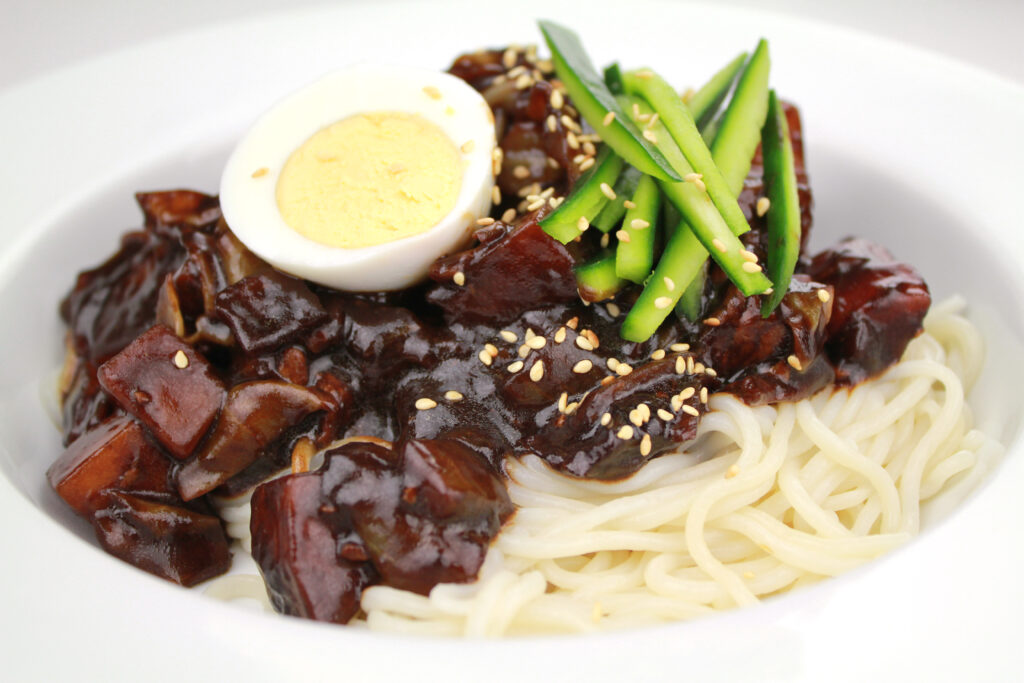
- Divide the noodles into bowls, ladle the sauce generously over the top, and finish with shredded cucumber. Serve at once with danmuji and raw onion on the side.
The variants worth knowing
Once you’ve got the base sauce, the family tree opens up. Ganjjajang (간짜장) is stir-fried fresh to order with no water or starch slurry and served in a separate dish, prized for its smoky wok-fire flavor and crunchier vegetables. Jaengban-jjajang (쟁반짜장) tosses noodles and a looser sauce together on a wide sharing platter, often with seafood. Yuni-jjajang (유니짜장) uses finely minced meat and vegetables for a smooth, mild sauce that kids and older diners love. Samseon-jjajang (삼선짜장) adds “three delicacies” — shrimp, squid, scallops, or sea cucumber. And jjajangbap (짜장밥) simply spoons the same sauce over rice. Common add-ons across all of them: a fried egg on top, or extra noodles (면사리).
How to eat it (and the eternal dilemma)
Jjajangmyeon arrives unmixed. The ritual is to dump the black sauce over the noodles and toss thoroughly so every strand is coated before you take a bite, then eat fast and slurpy while it’s hot — the starch-thickened sauce keeps clinging if you don’t let it sit. The free banchan are part of the deal: danmuji to crunch as a palate cleanser, raw onion wedges to dip into leftover chunjang, and often jjasai (pickled mustard tuber). The sauce stains, so expect a drop or two on your shirt; locals joke it’s just part of the experience.
Its inseparable rival is jjamppong (짬뽕), a fiery red seafood noodle soup, and choosing between them — “짜장이냐 짬뽕이냐” — is Korea’s classic mealtime dilemma. If you can’t decide, do what Koreans do: order jjamjjamyeon (짬짜면), half of each in one bowl, or get one of each and share. It’s overwhelmingly a delivery dish, so make a big batch, mix fast, and eat with someone.
Where to eat 짜장면 (jjajangmyeon, black-bean noodles) in Seoul
Seoul’s best jjajangmyeon lives in old Chinese-Korean (화교) kitchens that have been pulling noodles for decades. These three are the classics — two of them turn up again and again on lists of “Seoul’s three great jjajangmyeon” — so expect deep, savory black-bean sauce done the traditional way.
- 영화장 (Yeonghwajang) — Imun-dong, the Hankuk University of Foreign Studies (외대앞) area, Dongdaemun-gu; Line 1 Hankuk Univ. of Foreign Studies Stn (외대앞역) Exit 1, about a 4-minute walk. A 화교 restaurant running since 1970 and certified as a “백년가게” (Hundred-Year Store), often named one of Seoul’s three great jjajangmyeon. Come for the jjajangmyeon and 간짜장, and you’ll see locals ordering the signature 굴짬뽕 (oyster jjamppong) too. (Note: some listings say “Ihyeon-dong,” but every source places it in Imun-dong — same HUFS neighborhood.)
- 신성각 (Sinseonggak) — Singongdeok-dong, near Hyochang Park / Gongdeok, Mapo-gu; Line 5/6 Gongdeok Stn (공덕역) area. A tiny one-master kitchen open since 1981, beloved for hand-pulled (수타) noodles and a clean gan-jjajang that fans regularly rank #1 in the city. It’s lunch-only, cash or bank-transfer, with just a handful of tables — and it closes when the day’s ingredients run out, so go early.
- 진아춘 (Jinachun) — Hyehwa-dong / Daehak-ro, Jongno-gu; Line 4 Hyehwa Stn (혜화역) Exit 4, about a 2-minute walk. Founded in 1925 by a Shandong 화교 immigrant and registered as a Seoul Future Heritage (서울미래유산), this third-generation institution serves classic jjajangmyeon with thin, soft noodles and a balanced, savory sauce. Handmade 군만두 and 굴짬뽕 round out the order.
One honest heads-up: hours, break times, and closing days change, and several of these are small, cash-leaning shops that sell out — verify hours and closing before visiting, and be ready to queue, since these popular spots often have a wait.

Leave a Reply