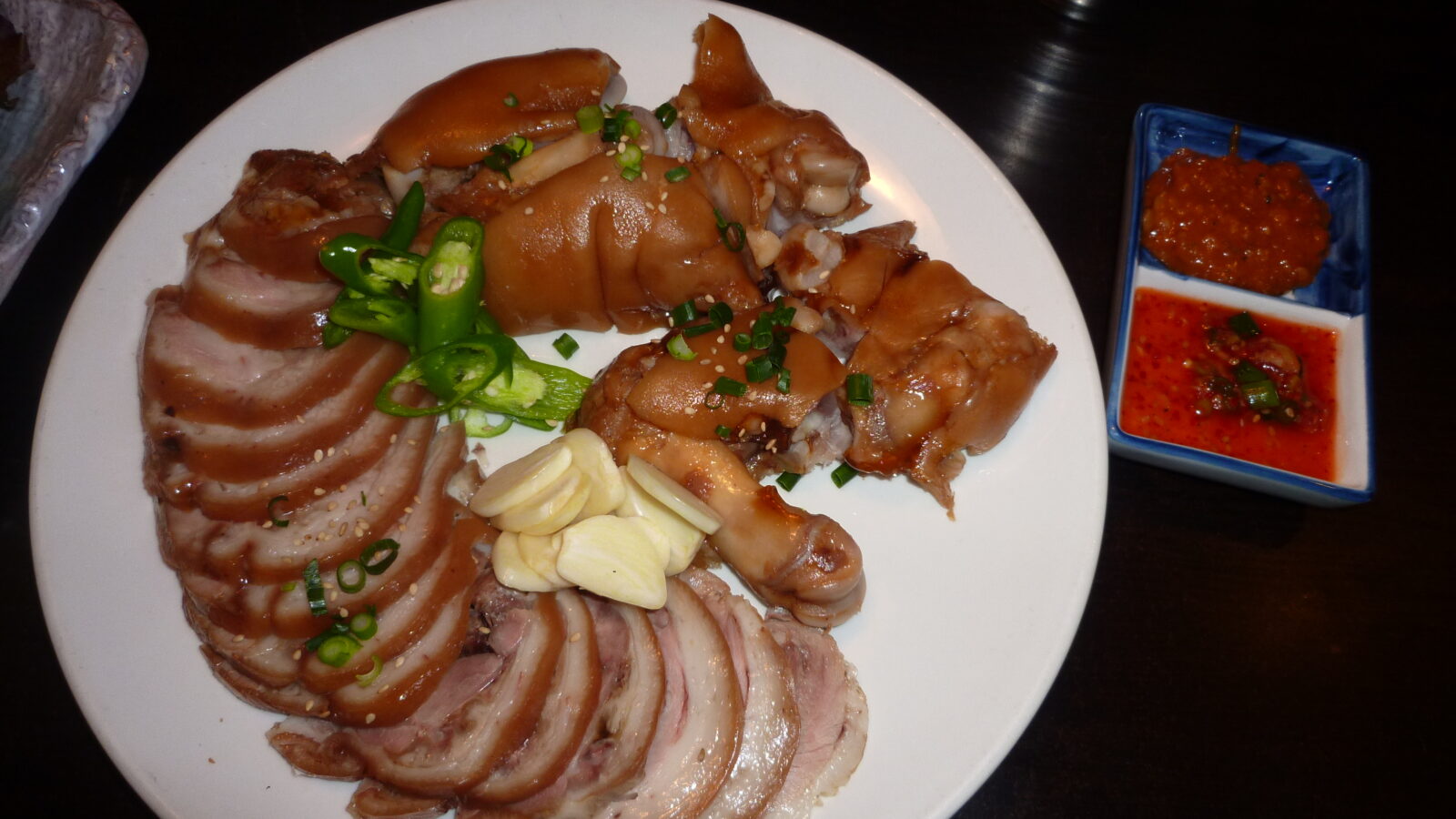
Jokbal (족발, jok-bal, literally “foot-foot”) is one of Seoul’s most beloved comfort foods: pig’s trotters slowly braised in a dark, aromatic broth of soy sauce, ginger, garlic and rice wine until the skin turns glossy and the meat falls from the bone. It is cooled, sliced into thin rounds, and piled onto a platter to be shared — equal parts dinner, party food, and late-night drinking snack.
What Jokbal Actually Is
The dish uses the lower leg and foot of the pig — a cut that is roughly half collagen-rich skin and connective tissue, half lean meat. Long, gentle braising transforms that collagen into silky gelatin, which is why properly made jokbal has its signature texture: a luscious, slightly sticky layer of skin and fat over tender, savory meat. The braising liquid typically combines soy sauce, ginger, whole garlic, onion, leek, rice wine (or soju), and warm spices such as cinnamon, star anise, bay leaf and black pepper. Some shops add coffee, doenjang (soybean paste), or a few dried herbs to round out the flavor and tame any porkiness.
Taste and Texture
Good jokbal is deeply savory and faintly sweet, with a clean soy backbone rather than a heavy gamey edge. The skin is gelatinous and yielding, the meat moist and well-seasoned through to the bone. It is served warm or at room temperature, never piping hot, so the gelatin sets just enough to hold each slice together.
How Koreans Eat It
Jokbal is a quintessential ssam (wrap) food. You take a slice, lay it on a leaf of lettuce or perilla (kkaennip), add a sliver of raw garlic, a smear of ssamjang (seasoned soybean paste) or a pinch of saeujeot (salted fermented shrimp), maybe a strip of green chili, then fold and eat in one bite. It almost always arrives with sides: pickled radish, kimchi, raw onion in vinegar, and a light broth or noodles. It is also a classic anju — food eaten with alcohol — pairing famously with soju and beer, which is why it dominates Korea’s late-night delivery scene.
Jangchung-dong and the Bossam Cousin
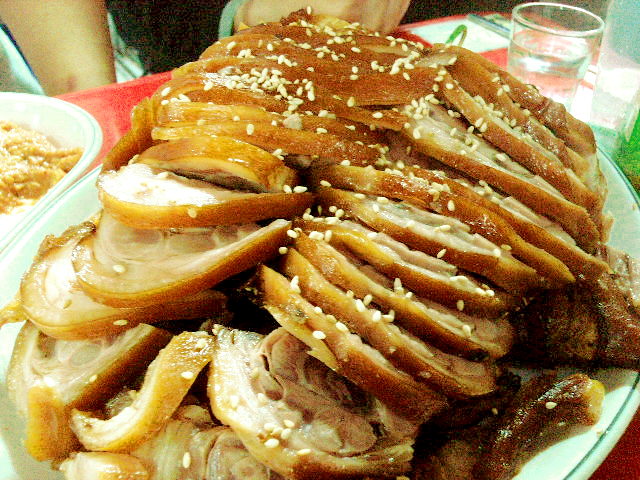
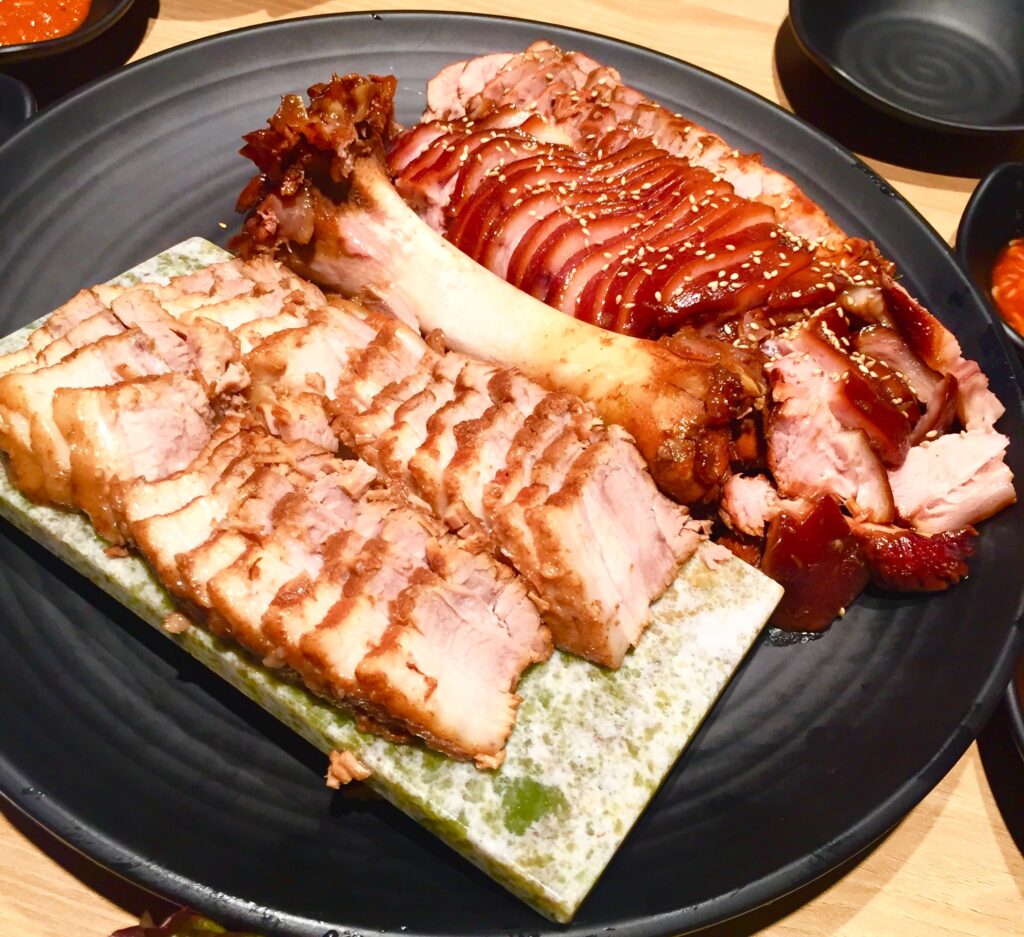
Modern jokbal traces to Jangchung-dong in central Seoul, where in the 1960s cooks who had fled south from Pyongan and Hwanghae provinces during the Korean War began braising trotters to make a living. The neighborhood near Dongguk University Station became “Jokbal Alley” (족발골목), lined with shops that each claim to be the original, some now with 50-year histories. Jokbal is frequently mentioned in the same breath as bossam, its close cousin — bossam is boiled pork belly or shoulder, served sliced and wrapped the same ssam way. Where bossam is plainer boiled pork, jokbal is the richer, soy-glazed sibling.
How to Make Jokbal at Home
It takes time but very little skill — the braise does the work. Ask your butcher for whole trotters cut crosswise into rounds, which cook faster and are easier to serve.
- 2 kg pig’s trotters (front trotters preferred — meatier), cut into rounds
- 1 cup soy sauce
- 1/2 cup rice wine or soju
- 1/3 cup sugar (or a mix of sugar and a splash of plum syrup)
- 1 whole head garlic + 1 thumb ginger, smashed
- 1 onion, 1 leek (white part), both halved
- 2 dried red chilies, 4 black peppercorns, 2 bay leaves, 1 cinnamon stick, 2 star anise
- 1 Tbsp instant coffee or a small piece of doenjang (optional, for depth)
- Water to cover (about 8 cups)
- Soak and blanch. Soak trotters in cold water 1–2 hours to draw out blood, changing the water once.
- Bring a large pot of water to a boil, add the trotters, boil 8–10 minutes, then drain and rinse off the scum. This is the key step for removing any off smell.
- Build the braise. Return trotters to a clean pot with all remaining ingredients and enough water to nearly cover.
- Bring to a boil, then simmer covered on low for about 1.5–2 hours, turning the trotters occasionally, until a chopstick slides easily into the meat.
- Glaze. Uncover, raise the heat, and reduce the liquid 15–20 minutes, basting the trotters until glossy and lacquered.
- Rest and slice. Let cool slightly so the gelatin sets, debone, and slice into bite-size pieces. Serve with lettuce, perilla, raw garlic, ssamjang and saeujeot.
Honest Cautions
Jokbal is rich — it is mostly skin, fat and collagen, so it sits heavy and is high in sodium from the soy braise; treat it as a shared dish. The single most important step is the blanch-and-rinse: skipping it leaves a noticeable porky odor, and trotters that smell strongly of ammonia before cooking are not fresh — buy from a trusted butcher and cook the same day or freeze. Thorough cooking is essential, but that is automatic with a two-hour braise. There is no raw component here, so jokbal carries none of the parasite or freshness risk of raw-seafood dishes.
Where to eat 족발 (jokbal, braised pig trotters) in Seoul
Jokbal is soy-braised pig trotter, sliced thin and eaten with salted shrimp sauce, garlic, and ssam wraps. Seoul has two legendary jokbal clusters: the storied Jangchung-dong alley near Dongguk University, and the gritty Gongdeok Market lane in Mapo. Here are three long-running shops worth seeking out.
- 평안도족발집 (Pyeongando Jokbaljip) — Jangchung-dong jokbal alley, Jung-gu, 1-2 min from Dongguk Univ. Station (Line 3, Exit 3). The recognized 원조 (pioneer) of the alley, in business at the same spot for some 60 years. Its clean, lean North Korean-style braise earned a place in the comic 식객 and TV features on 수요미식회 and 백종원의 3대천왕 — go for the jokbal with a side of 막국수. Closed Mondays.
- 뚱뚱이할머니집 (Ttungttungi Halmeonijip) — Jangchung-dong jokbal alley, Jung-gu, ~2 min from Dongguk Univ. Station (Line 3, Exit 3). One of the oldest founding shops on the same alley (50+ years), affectionately called the elder of the originals and counted among Seoul’s “3대 족발.” The homemade doenjang-and-anchovy braise gives it a deeper, savorier flavor than its neighbors. Closed Tuesdays.
- 마포소문난원조족발 (Mapo Somunnan Wonjo Jokbal) — Gongdeok jokbal alley (Gongdeok Market), Mapo-gu, near Gongdeok Station (Lines 5/6, AREX, Gyeongui-Jungang). A ~45-year nopo anchoring Seoul’s other famous jokbal cluster, known for a chilled-then-served chewy texture plus market-style free sundae and soup. A great pick if you want the rougher, livelier market atmosphere.
Hours and closing days shift, especially at family-run nopo — please double-check the day’s hours before you go.


Leave a Reply