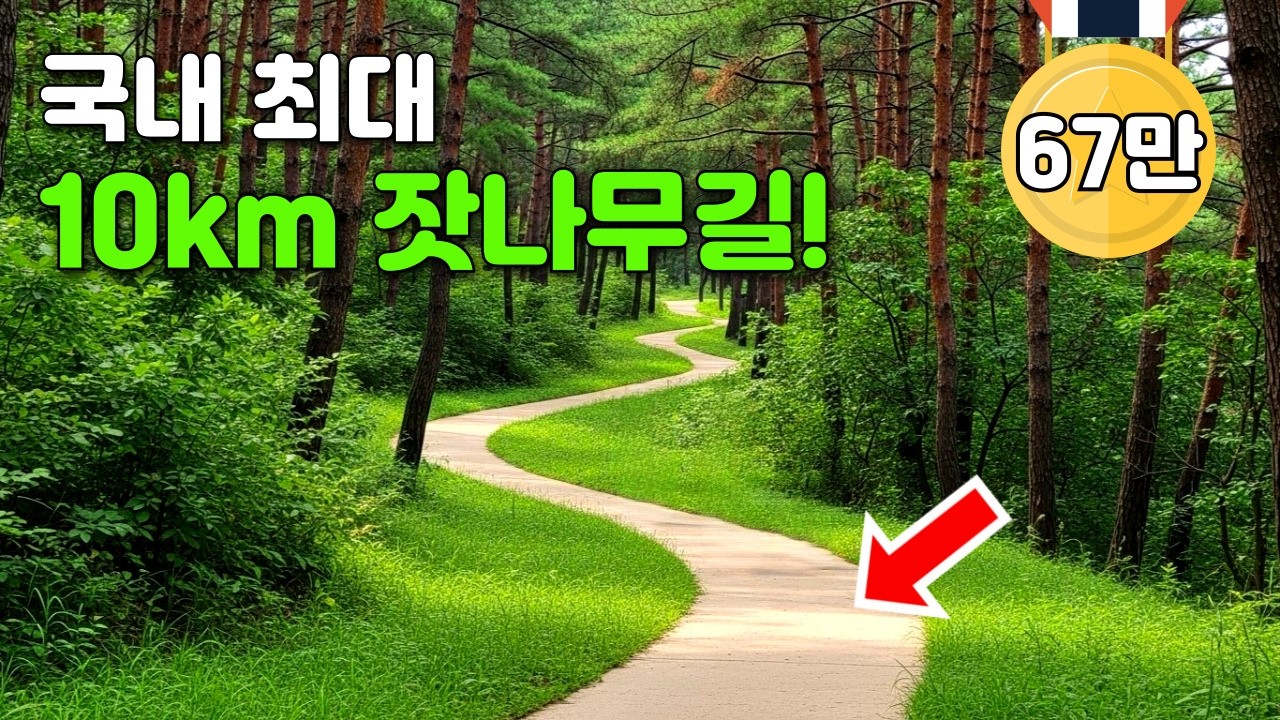

A forest you enter, not a view you look at
About 50 minutes east of Seoul, on the ridge between Chungnyeongsan (축령산, ~879 m) and Seorisan (서리산, ~825 m), sits one of the Seoul area’s best car-free day trips for people who want trees over traffic. The Korean name is 경기도 잣향기푸른숲 — roughly “Gyeonggi Pine-Fragrance Green Forest” — a Gyeonggi provincial forest-healing area in Sangmyeon, Gapyeong-gun, run by the Gyeonggi-do Forest Environment Research Institute (산림환경연구소).
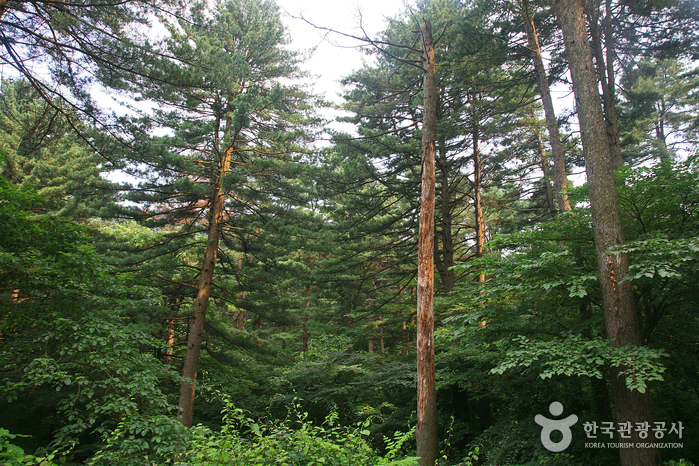
What makes it special is the trees. The forest centers on roughly 150-plus hectares (often cited as ~153 ha) of Korean pine — 잣나무, the Korean nut-pine — about 50,000 trees aged 80 to 90 years, described as Korea’s largest concentration of mature Korean pine. The trunks are reportedly thick enough that two adults have to link arms to encircle one. Because Korean pine emits abundant phytoncide and the trees stand densely, sources report this forest has the highest annual-average phytoncide concentration among the Gyeonggi-do forest recreation sites that have been analyzed. Visitors tend to describe it as a space you step into rather than scenery you photograph: at 450–600 m elevation, the air, the sound, and the pine scent change the moment you arrive.
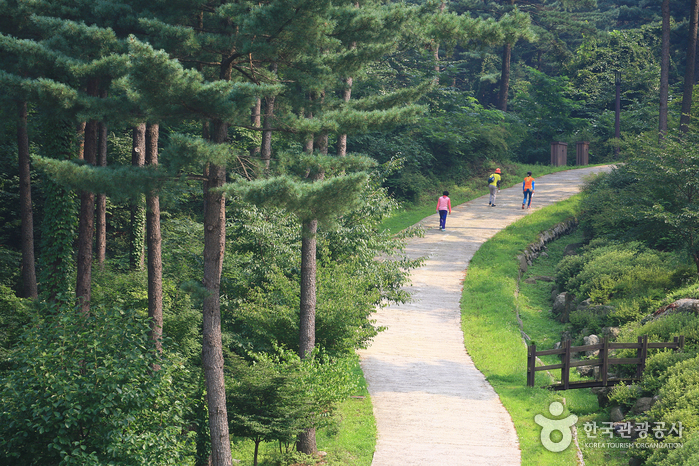
What you actually walk
An honest note up front: the source video that inspired this trek deliberately hides the forest’s name and its full route couldn’t be retrieved, so the exact 10 km waypoint sequence can’t be verified turn-by-turn. What can be confirmed is the forest’s published trail network and the named courses within it — so think of the route below as representative, not a verbatim transcription.
The trail network totals roughly 13 km (about 4 hours if you walk most of it), and the beauty of the place is that you can scale it to your fitness — from a short stroll to a ~10 km trek. The named, signposted courses are:
- 무장애 나눔길 (barrier-free “Nanum-gil”), ~1 km — the accessibility highlight (more below).
- 피톤치드길 (Phytoncide Trail), ~860 m, ~30 min — the dedicated forest-bathing stretch.
- 하늘호수길 (Sky-Lake Trail), ~1 km, ~40 min one-way — out to a check-dam / small-lake viewpoint.
- 산책길 (Walking course), ~1.6 km, ~40 min — passing a suspension bridge and the village site.
- 둘레길 (loop trail), ~5.8 km, ~2 hr — the circumference walk.
A typical longer healing trek chains these from the visitor center — 축령백림관 (the Chukryeong Baekrim exhibition hall) → the 잣향기 woodworking studio → the 출렁다리 suspension bridge → the 화전민 village → the Healing Center → 피톤치드길 and forest road (임도) → 사방댐 (check dam) → 전망대 (observation deck) → and back along the 무장애 나눔길. The ~10 km figure realistically folds in the forest-road approach walk plus the looped courses combined. Dedicated forest-bathing features along the way include a 바람숲 (wind-bath) rest area, barefoot-walking sections, and tree-hugging and meditation spots — a textbook 삼림욕 (forest-bathing) course.
The barrier-free Nanum-gil
The standout feature, and an unusual one for a mountain forest, is the 무장애 나눔길 — a roughly 1 km accessible trail built so wheelchairs, strollers, older visitors, and people with disabilities can reach the forest’s most scenic interior. It’s described as about 600 m of wooden deck plus ~400 m of compacted, firm gravel (some sources cite a longer flat “평지길” of ~1.4 km), graded with minimal slope and routed past rest areas and small streams. It’s generally usable year-round, but can be restricted in winter when ice or snow makes the deck unsafe.
An old slash-and-burn village in the trees
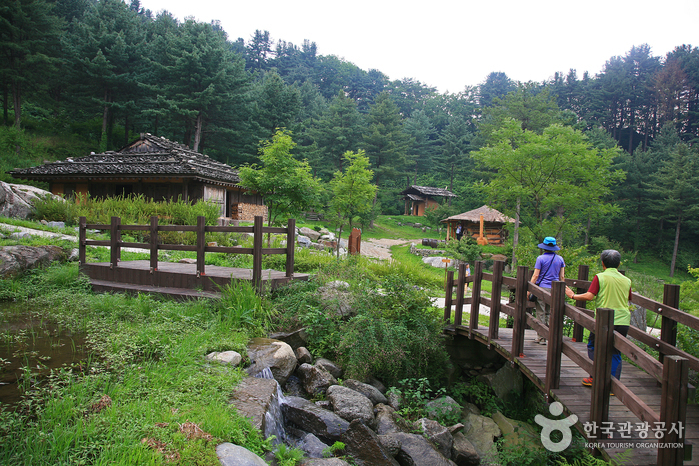
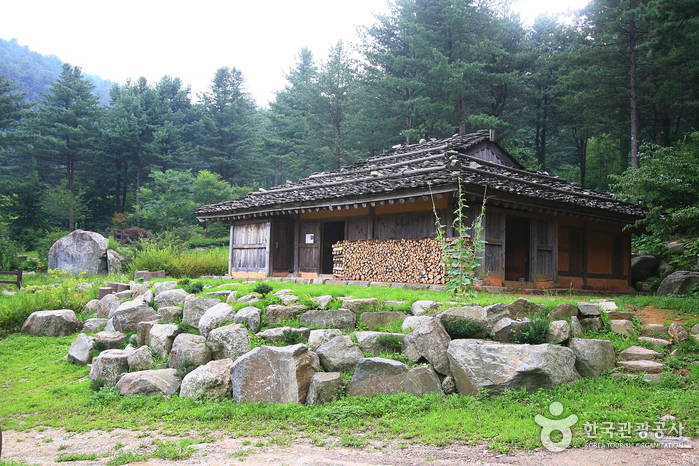
Partway up the mountain is a reconstructed 화전민 마을 — a slash-and-burn farmers’ village recreating mountain life of the 1960s–70s. It depicts about six households and traditional mountain structures: a 너와집 (shingle-roof house), a 귀틀집 (dovetail log house), a 숯가마 (charcoal kiln), thatched roofs, and a 초정 (spring house), along with the farming and household tools the settlers used 40–50 years ago. It works as an open-air heritage stop on the trek — a reminder that these slopes were once farmed by 화전민 before reforestation grew today’s pine stands.
Getting there from Seoul, car-free
This is the easy part. Take the Gyeongchun Line (경춘선) — the limited-stop ITX-Cheongchun is fastest — to Cheongpyeong Station (청평역) in Gapyeong-gun. It’s roughly 50 minutes from Seoul (about 50–60 min depending on your boarding station and train).
From Cheongpyeong Station, the realistic option is a taxi to the forest entrance: about 15 minutes, roughly ₩18,000–20,000. Public bus is possible but sparse and not for the schedule-averse: Gapyeong local bus 30-8 (Cheongpyeong terminal ↔ Haenghyeon-ri; alight at 독박골/Dokbakgol) runs only about twice a day, while the more frequent 30-6 / 30-7 (Cheongpyeong terminal ↔ Achim Goyo Arboretum via Haenghyeon-ri) get you closer. Even then, from the nearest stop the forest entrance is still about 3.5 km uphill on foot — which is exactly the kind of forest-road (임도) approach walk that fills out a longer trek. Bus headways are long and schedules irregular, so confirm times with Gapyeong Transport (가평교통, 031-582-6866) or Cheongpyeong terminal (031-585-7242) and check a transit app the day you travel.
Practical bits
- Admission (a genuine selling point): adults ₩1,000; youth/military ₩600; children ₩300; groups of 20+ around ₩800. Parking is free (~68 spaces) if you do end up driving.
- Hours: summer (roughly Apr–Oct) 09:00–18:00; winter (roughly Nov–Mar) 09:00–17:00. Last entry is earlier than closing.
- Closed every Monday (정기휴무) — plan your day trip around it.
- Reservations: general trail walking just needs admission, but forest-therapy and certain programs require advance booking via the Gyeonggi reservation portal (경기농정). Woodworking and some programs carry a small materials fee; most others are free. Booking ahead is wise on busy weekends.
- Contact: 031-8008-6769. Address: 경기 가평군 상면 축령로 289-146.
When to go
Best overall is late spring and summer. Summer is when the pine canopy is fullest and phytoncide concentration peaks, and the 450–600 m elevation plus pine shade keep it noticeably cooler than the city — ideal for a healing walk. Late spring (late April–May) adds royal azalea (철쭉) bloom on neighboring Seorisan. Autumn is crisp and pleasant, with shaded sections staying cool. Winter is quietest, but the barrier-free deck may be closed by ice or snow. Whatever the season, remember the Monday closure — and that the real draw here isn’t a single photo-stop but the simple, cheap luxury of a few hours breathing pine.
Hungry after the pines? The same Korean pine that names this forest gives Gapyeong its signature dish — a warm bowl of jatjuk, pine-nut porridge.




Leave a Reply