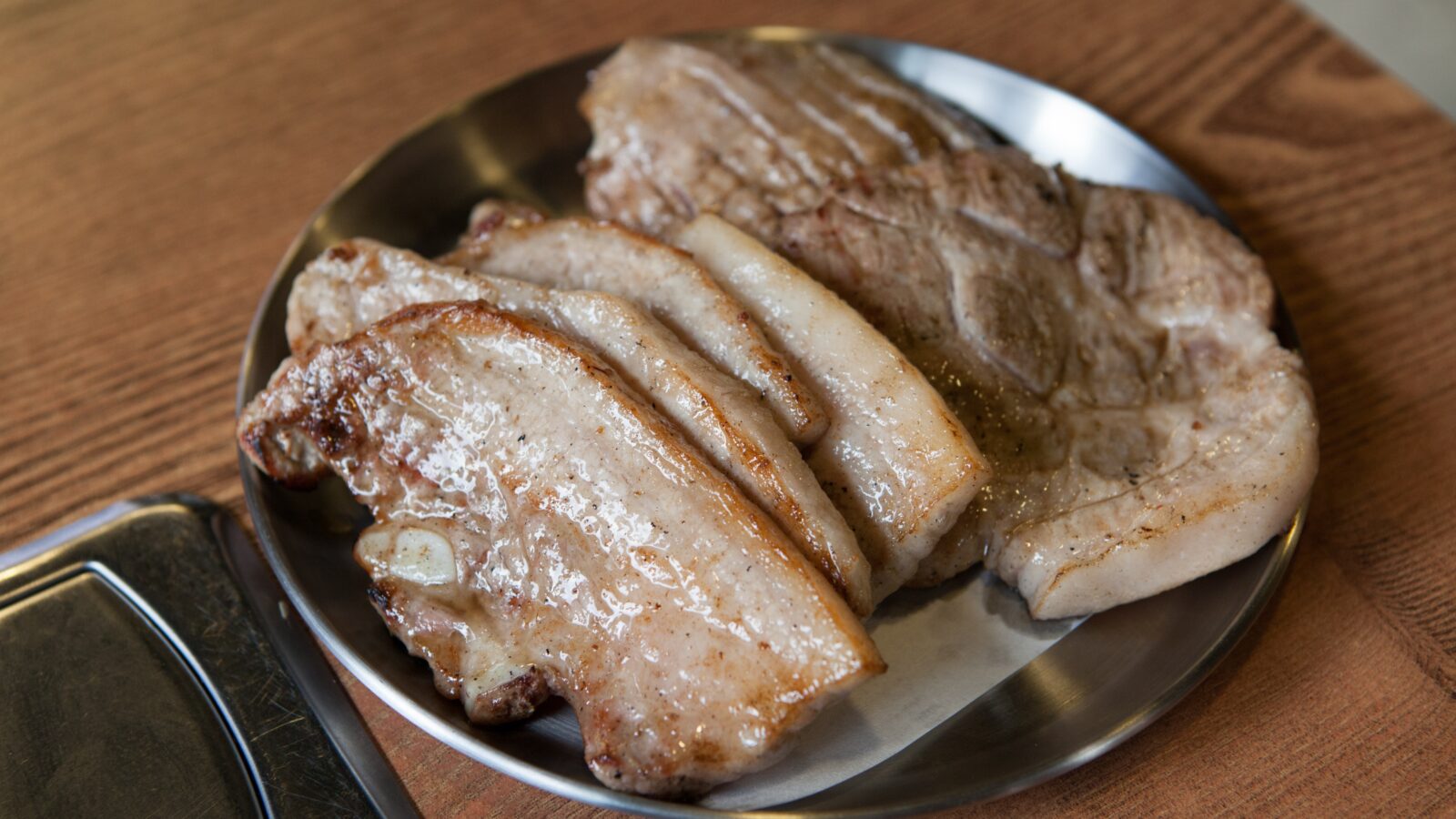
Samgyeopsal is the dish at the center of Korean BBQ: thick slices of pork belly sizzling on a grill set into the middle of the table, cooked by the diners themselves and eaten straight off the heat. It’s affordable, sociable, and as close to a national comfort food as Korea has. Here’s what the cut is, how it’s grilled and eaten, the spread of sides and drinks that come with it, and how to do a version at home.
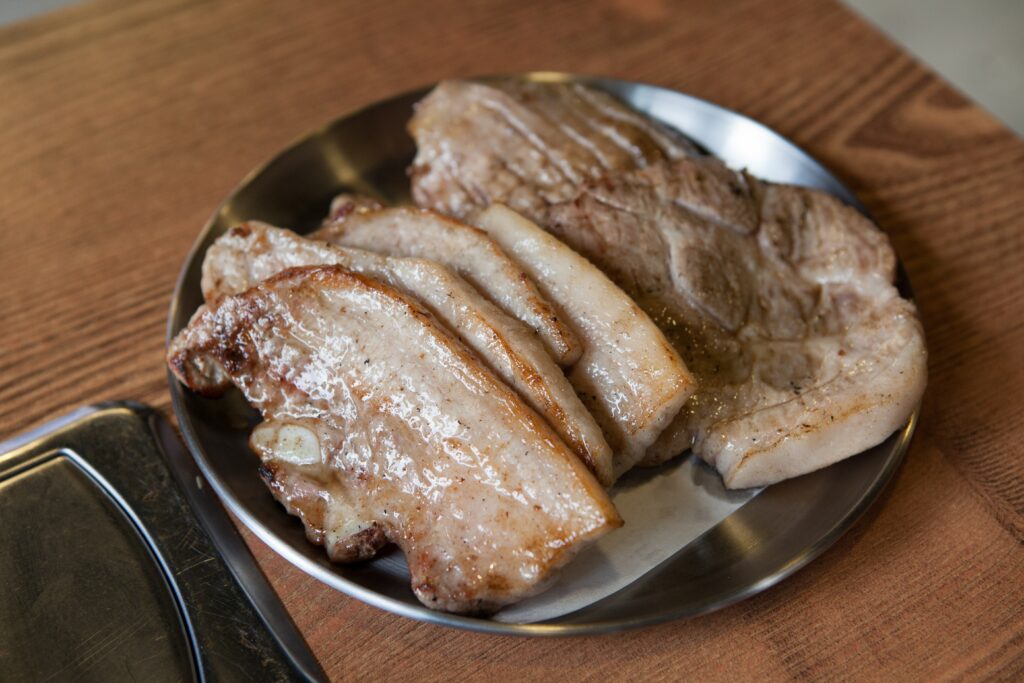
What samgyeopsal actually is
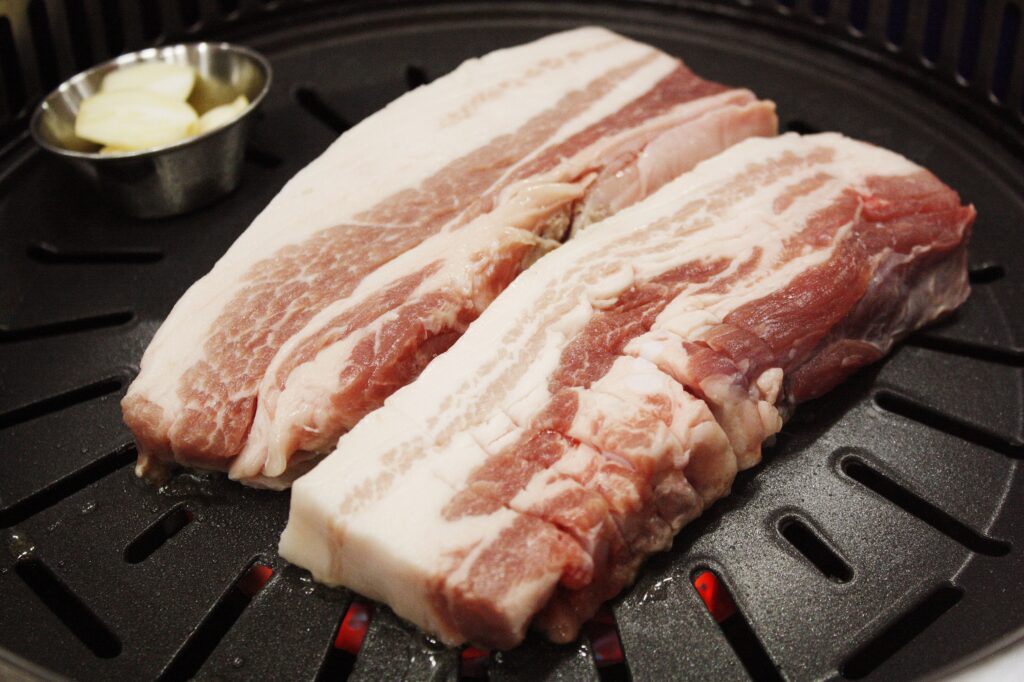
Samgyeopsal (삼겹살) literally means “three-layer meat” — sam (three), gyeop (layer), sal (flesh) — a description of the bands of lean meat and fat that show up as three stripes when pork belly is cut crosswise. It’s grilled unseasoned and shared off the grill, and surveys consistently rank pork belly as Koreans’ favorite cut by a wide margin (a 2006 survey put it around 85%). The dish in its modern form is surprisingly recent: the word “samgyeopsal” only entered the Standard Korean Language Dictionary in the 1990s, and its popularity surged in the late 1980s and ’90s as big companies like Samsung and Lotte moved into pork farming and better breeding cut the gamey odor that older recipes had once masked with strong spices.
The cut, and its variations
The meat is fresh, skin-off pork belly — the same primal as bacon — prized for its alternating layers of lean and fat. Thickness varies a lot: classic thick-cut fresh slices run roughly 1/4 to 1/2 inch (about 6–12mm), while a common “sweet spot” for sliced belly is around 3.0–3.5mm. A few variants are worth knowing:
- Fresh/chilled samgyeopsal — thick, fatty slices grilled to a crisp outside and juicy inside. Many enthusiasts prefer chilled over frozen for sweeter fat and a softer bite.
- Daepae-samgyeopsal — paper-thin shaved slices, named after the daepae, a carpenter’s plane used to shave wood. It’s partially frozen so it can be shaved very thin, cooks fast with crispy edges, renders less grease, and has a chewy, concentrated bite (a style popularized from the mid-1990s).
- Ogyeopsal (오겹살, “five-layer meat”) — the same belly with the skin left on, adding two extra textural layers for a chewier, more gelatinous result.
A later novelty, beoljip (“beehive”) samgyeopsal, is scored in a honeycomb pattern before grilling.
How it’s grilled at the table
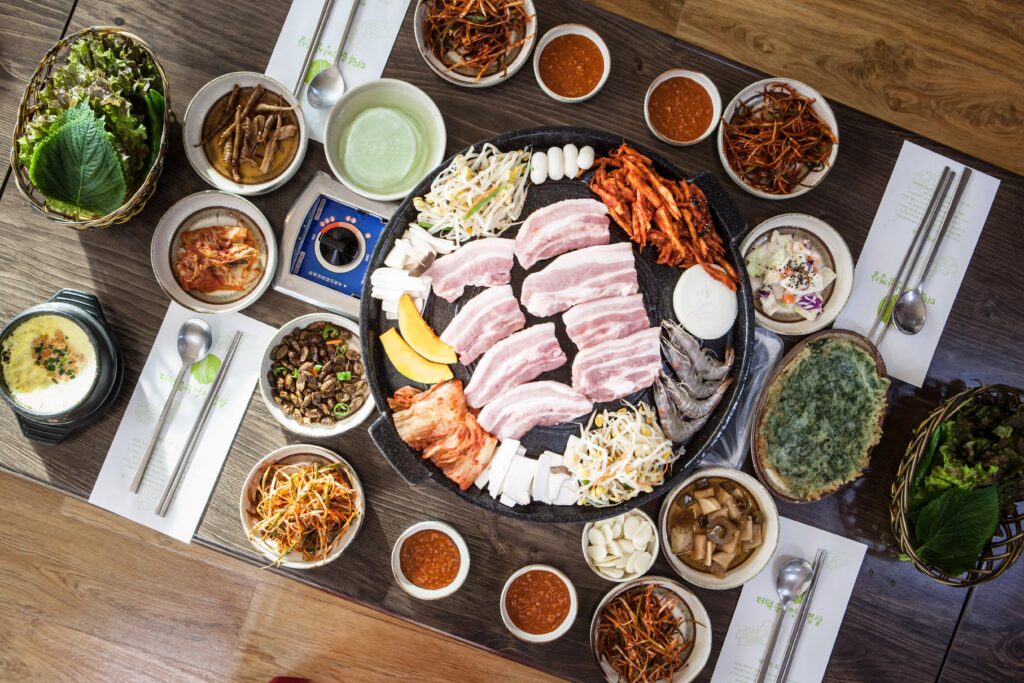
Grilling happens right in front of you on a slanted or domed metal griddle over inset charcoal or a convex gas burner, and you cook it yourself. Lay the slices on the preheated grill and let the fat render fully — about 3–4 minutes per side, flipping with tongs, until golden brown with slightly charred, crispy edges. Don’t rush it: the rendered fat is what makes the meat both juicy and crisp. Because pork belly throws off so much grease, the slanted grill or a drip channel drains the fat away, and cooks blot the surface with paper towels or scoop off pooled fat to cut down smoke and splatter. Whole unpeeled garlic cloves, sliced onion, green chili, mushrooms, and kimchi go on alongside the meat to cook in the rendered fat — roasted garlic turns sweet and creamy, grilled kimchi goes smoky and tangy. Pork is always cooked fully through, never rare. Once a slice is browned, you snip it into bite-size pieces with kitchen scissors, cutting against the grain at a slight diagonal, and finish it on the grill until crisp.
How to eat it: the ssam wrap
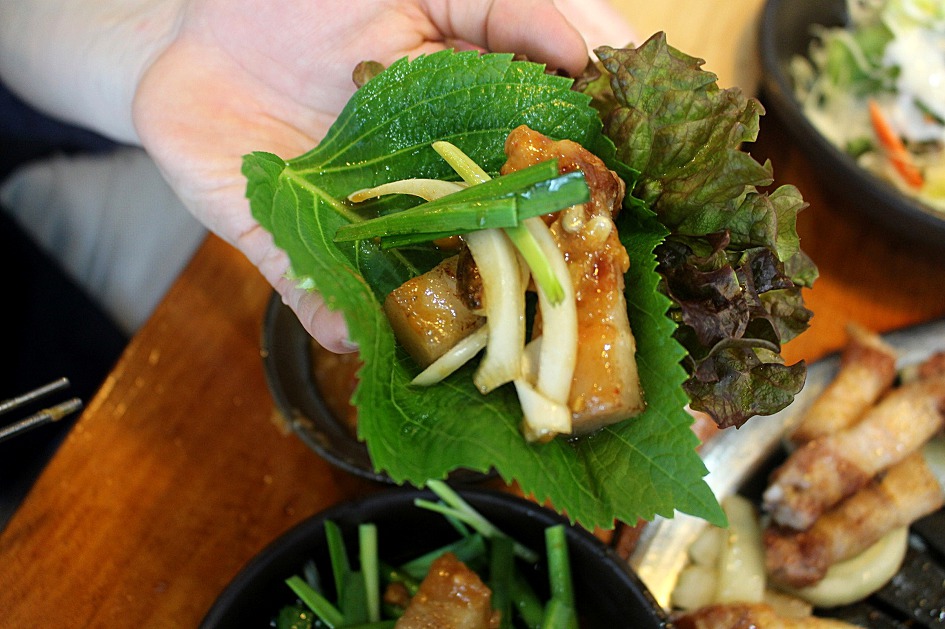
Samgyeopsal is eaten as ssam (쌈), a wrap built and eaten in a single bite. Take a leaf of lettuce, optionally lay a perilla leaf (kkaennip — slightly minty and anise-like) inside it, add a hot piece of grilled belly, then a small dab of ssamjang. From there it’s your call: a slice of raw or grilled garlic, a piece of grilled kimchi, a strip of green chili, or a pinch of pa-muchim scallion salad. Fold it into a little parcel and put the whole thing in your mouth at once. Wrapping the perilla inside the lettuce is considered the authentic touch. Diners who want to taste the meat on its own skip the wrap entirely and dip the pork in gireumjang — a sesame-oil-and-salt dip — instead of ssamjang.
The banchan and the soju culture
A spread of sides comes with the meat. The two key dips are ssamjang (a thick blend of doenjang soybean paste and gochujang, often with sesame oil, garlic and scallion) for the wraps, and gireumjang (sesame oil, salt, black pepper) for plain meat. Cutting the richness is pa-muchim, a tangy-spicy shredded scallion salad of green onions soaked in cold water and dressed with gochugaru, sesame oil, soy or vinegar and a little sugar. Around those you’ll get kimchi (raw and grilled), ssammu pickled radish sheets, assorted soy-pickled vegetables, raw garlic and chili, onion in a tangy soy dressing, and the leaf basket of lettuce and perilla.
Soju is the classic pairing — samgyeopsal is a quintessential anju (food eaten with alcohol), and shots are poured for one another as a gesture of respect. Somaek, a shot of soju dropped into beer, is hugely popular too. This is the default centerpiece of hoesik (회식), the Korean after-work team dinner, where colleagues head out for grilled meat and drinks (often with a noraebang round after) to build camaraderie. Hoesik has long been an almost-expected part of work life, though the culture is shifting as younger workers increasingly favor shorter, optional, less drink-heavy, or lunchtime versions.
Eating out vs. a home version
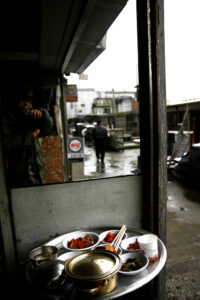
The iconic experience is eating out at a gogi-jip (“meat house”), with its built-in tabletop grill, staff who may help cut and tend the meat, unlimited banchan refills, and the communal buzz. At home, people without a Korean tabletop grill use a stovetop version — a cast-iron griddle or a dedicated samgyeopsal pan (often sloped, with a perimeter groove that channels rendered fat away and prevents flare-ups), or simply a heavy cast-iron skillet. Preheat the pan well, lightly oil it, and pan-grill the belly in batches over medium-high to high heat about 3–4 minutes per side until crisp, blotting or draining the fat as it renders. Because it cooks fast and is best eaten sizzling, arrange all the wraps, sauces and banchan on the table before you start.
One more thing: Samgyeopsal Day
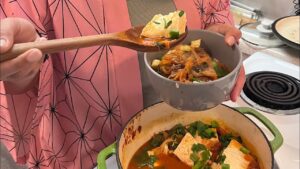
March 3 (3/3) is Samgyeopsal Day — a pun on sam (three) and the three layers, with a date that packs two 3s. It was created in 2003 by the Paju-Yeoncheon Livestock Cooperative as a marketing campaign to boost domestic pork-belly sales and help farmers facing oversupply, and it grew into a widely observed tradition with supermarket discounts and restaurant promotions. To finish a samgyeopsal meal, Koreans typically order a bubbling pot of kimchi-jjigae or doenjang-jjigae with rice, or have the leftover meat and rice fried right on the grill into bokkeum-bap. If grilled pork is your thing, the marinated, sweet-savory world of bulgogi and Busan’s pork-and-rice soup, dwaeji-gukbap, are the natural next stops.



Leave a Reply