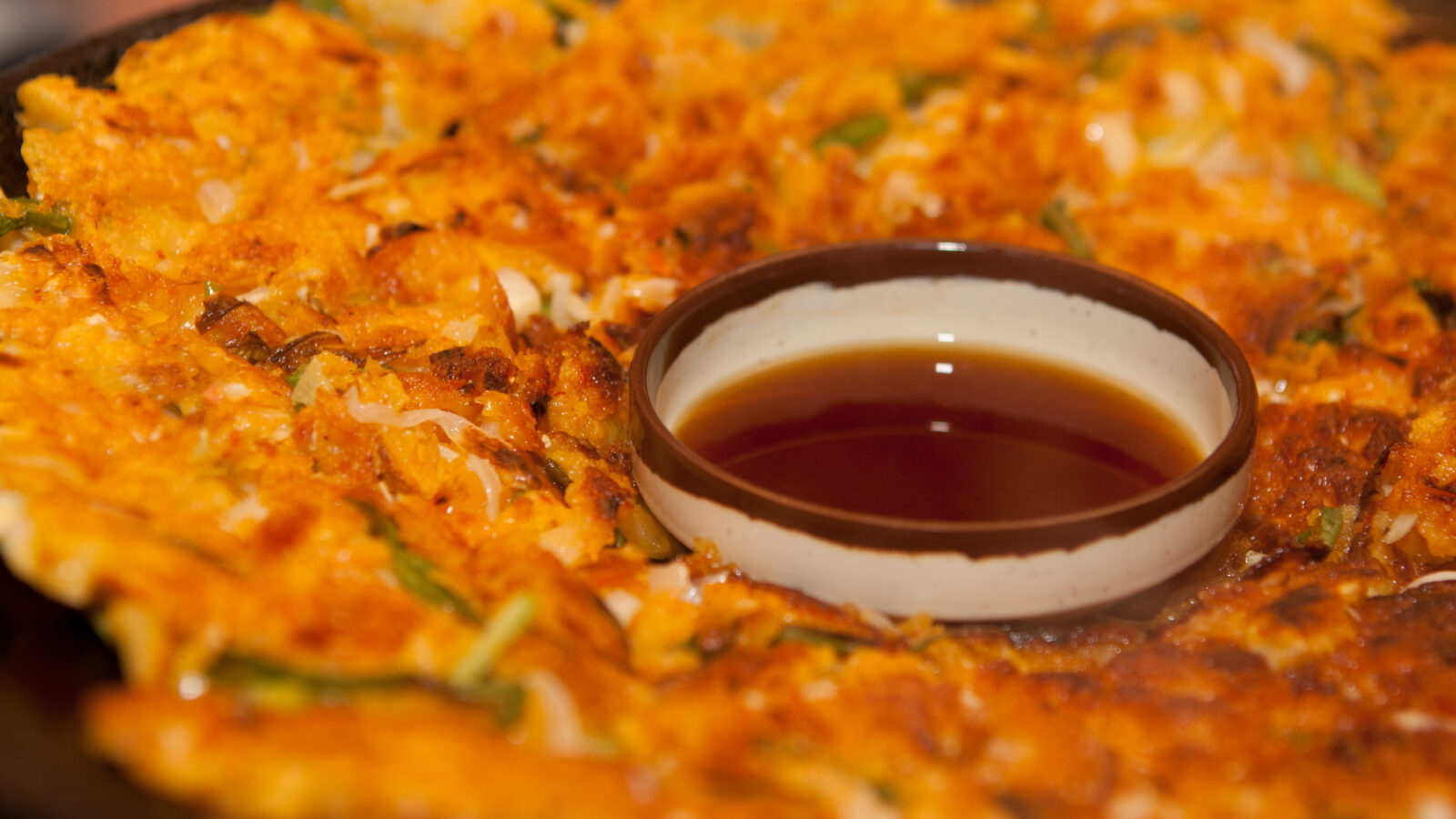
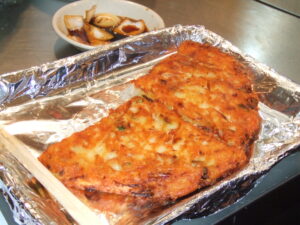
If jeon is Korea’s answer to “I have a frying pan and some odds and ends,” then haemul-pajeon (해물파전) is its show-off cousin. It is a thin savory pancake whose whole body is built from scallions laid side by side, studded with seafood, bound in a light batter, and shallow-fried until the edges crisp and the scallions go soft and sweet. The name is literal: pa (파) means scallion and haemul (해물) means seafood, so this is a scallion pancake upgraded with squid (오징어), shrimp (새우), clam meat (조갯살), and in the best versions oysters (굴).
It belongs to the broad jeon (전) family of pan-fried batter pancakes, and more specifically to pajeon (파전), the scallion-pancake branch. In everyday speech all of these get lumped under buchimgae (부침개), the casual word for any pan-fried pancake. Culturally, this is rainy-day food and drinking food. The saying 비 오는 날엔 파전에 막걸리 (“on rainy days, pajeon with makgeolli”) is a near-universal Korean reflex; one folk theory holds that batter sizzling in oil sounds like rain on the eaves.
Ingredients (makes 2 large pancakes)
- 1 cup Korean pancake mix (부침가루, buchim-garu) or all-purpose flour; for extra crisp, use flour plus a few tablespoons of potato or corn starch
- 1/2 tsp salt (only if using plain flour)
- 3/4 cup ice-cold water, added 1 tablespoon at a time
- 1 egg, lightly beaten (optional, drizzled on top)
- 1–2 bunches scallions (쪽파 thin spring onions, or 대파 large scallions with thick whites split lengthwise), trimmed to fit the pan
- 1.5–2 cups mixed seafood (squid, shrimp, clam meat, oysters, or mussels), cut bite-size and patted very dry
- 1 tbsp sesame oil, to toss the seafood
- 1 red chili, thinly sliced (optional, for color)
- 3–4 tbsp neutral oil for frying, plus more for the flip
For the dipping sauce (초간장, cho-ganjang): stir together 1 tablespoon soy sauce, 2–3 teaspoons vinegar, 1 tablespoon water, and a pinch each of gochugaru and black pepper. Add 1/2 teaspoon sugar, a little chopped scallion, and sesame seeds if you like.
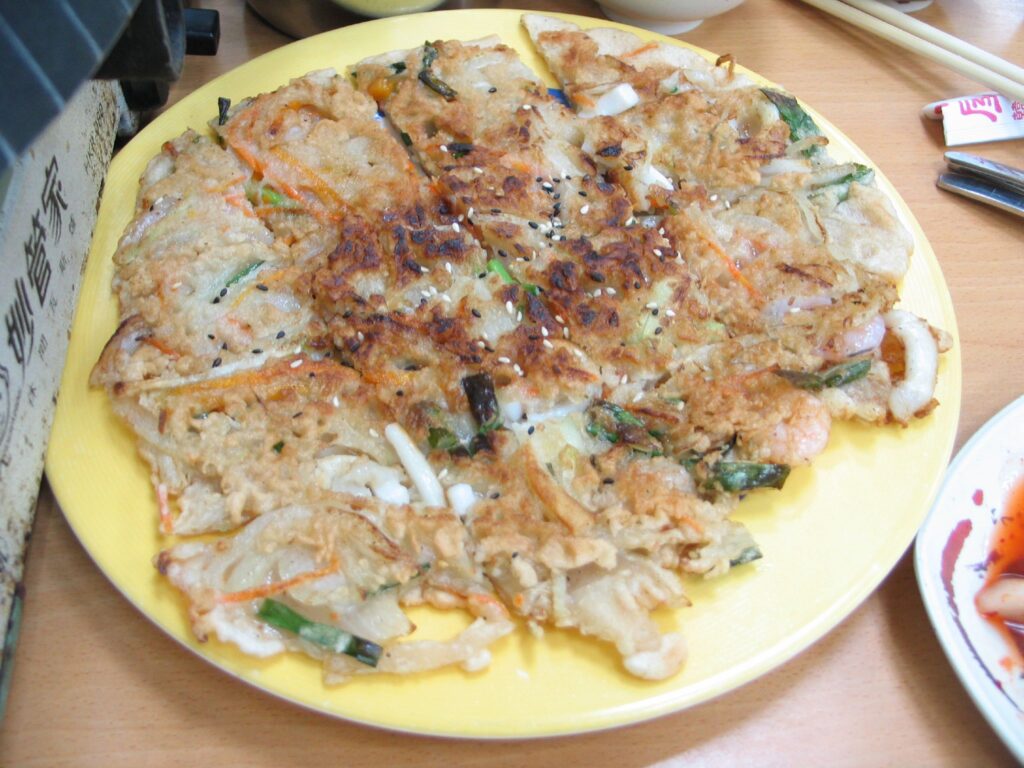
How to make it
- Drain and pat the seafood and scallions thoroughly dry — excess water is the enemy of crisp. Toss the seafood with the sesame oil and a pinch of salt and pepper.
- Whisk the pancake mix (or flour, starch, and salt) with the ice-cold water into a pourable batter, thinner than Western pancake batter but thicker than crepe batter. Keep it cold and do not over-mix.
- Heat 2–3 tablespoons of oil in a large non-stick or cast-iron skillet over medium-high until it shimmers. The pan must be genuinely hot before the batter goes in.
- Pour a thin layer of batter, then lay the scallions across in one direction, alternating white ends and green ends for even cooking, and press gently. Scatter the seafood and chili on top, then drizzle a little more batter (and the beaten egg, if using) over the lot to lock it together.
- Cook undisturbed for 3–4 minutes, until the underside is golden and the edges crisp. Add 2–3 tablespoons of oil around the rim just before flipping.
- Flip once — it is too heavy to toss, so use a big spatula or slide it onto a plate and invert it back into the pan. Press it flat and cook 3–4 minutes more.
- Cut into squares or wedges and serve hot off the pan with the dipping sauce.
The crispiness rules are the same as for all jeon: keep the batter thin and cold, get the pan genuinely hot, be generous with the oil, drain everything dry, add a little starch to the flour, and flip only once. Poking and re-flipping breaks the crust you are trying to build.
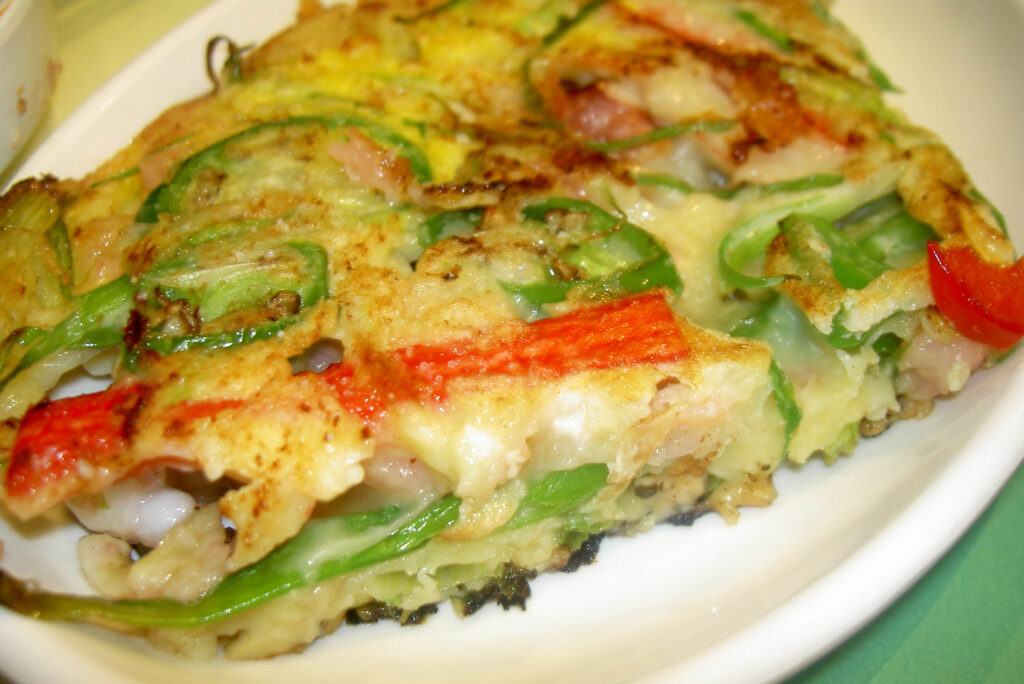
Variations
The plainer foundation is just pajeon (파전) — scallions only, no seafood. Swap the seafood for kimchi and you get kimchijeon (김치전), the most forgiving beginner version; swap the scallions for Asian chives and you get buchujeon (부추전), common in the southern provinces. The famous regional version is Dongnae-pajeon (동래파전) from Busan: whole uncut scallions and a heavy load of seafood (and traditionally some beef) over only a thin batter of mixed glutinous and non-glutinous rice flour, deliberately soft and almost porridge-like rather than crispy. It is a heritage dish — the landmark 동래할매파전 traces its lineage to a Dongnae Market stall from the 1920s–30s, now four generations deep. Home cooks often add a beaten egg on top for richness; restaurant and modern styles lean on starch and lots of oil for a lacy crunch.
How to eat it
Eat it hot, straight from the pan, while the edges are still crisp — that is the whole point, and reheated pajeon goes limp. It is shared, not plated individually: cut it into squares or wedges, put it in the middle of the table, and let everyone pick from it with chopsticks. Dip each piece in the soy-vinegar sauce as a quick salty-tangy accent; never drown it. The classic pairing is makgeolli (막걸리), cloudy unfiltered rice wine, especially on a rainy day, though soju or beer work too. If you make it the way most home cooks do, this is also covered in our wider guide to the jeon family, where the same batter and technique apply to every filling. And if you ever find yourself in Busan, order Dongnae-pajeon at a heritage house and expect a softer, seafood-heavy, knife-and-spoon kind of pancake meant to be lingered over with makgeolli rather than snacked on.
Where to eat 해물파전 (haemul-pajeon) in Seoul
Haemul-pajeon is best enjoyed the traditional way: hot off the griddle, with a bowl of makgeolli, in one of Insadong’s old-school folk taverns. Both spots below are jeon-and-makgeolli houses where the seafood-scallion pancake sits comfortably alongside their signature jeon variants. They cluster within easy walking distance in Jongno-gu, so you can pair a visit with a stroll through Insadong’s galleries and tea houses.
- 누룩나무 (Nurukamu) — Insadong, Jongno-gu; nearest station Anguk (안국) Line 3, Exit 6 (Jonggak Line 1 is also walkable). A consistently top-ranked Insadong jeon-and-makgeolli bar with crispy pancakes and a deep makgeolli list. Note its most precise signature is 해물부추전 (seafood-chive pancake, around ₩20,000), a close cousin of haemul-pajeon, so it is unmistakably a haemul-jeon house even if the exact name differs.
- 꽃피는산골 (Kkotpineun Sangol) — Insadong near Jonggak, Jongno-gu; nearest station Jonggak (종각) Line 1, Exit 3, about a 3-minute walk. A long-established two-floor 민속주점 (traditional folk tavern) in the old Pimatgol style, built on pan-fried jeon and a wide makgeolli selection. Haemul-pajeon (해물파전) is listed on the menu, though its true signature is the shrimp-and-water-dropwort jeon (새우미나리전, around ₩19,000).
Hours and closing days shift, and both close on Sundays, so verify the latest hours before visiting; these popular Insadong taverns fill up fast in the evenings and on weekends, so expect a queue at peak times.


Leave a Reply