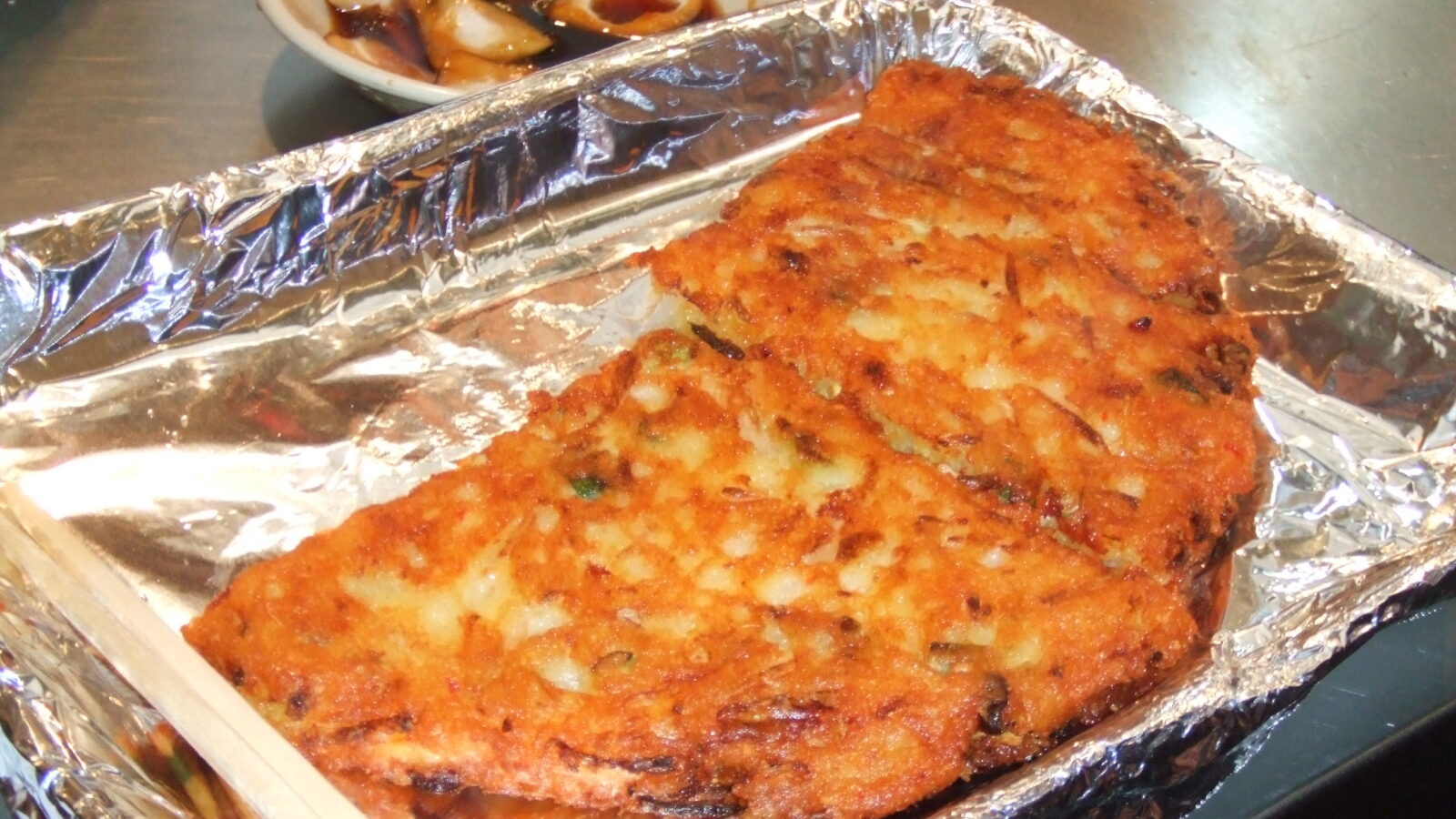
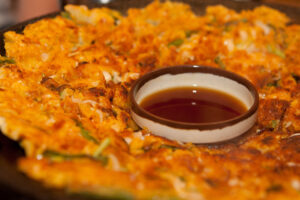
Most Korean pancakes bind their fillings in a wheat-flour batter. Bindaetteok (빈대떡) does something different: here the batter is the bean. Skinned split mung beans are soaked and coarsely ground, loaded with kimchi, sprouts, and pork, then shallow-fried thick in plenty of oil until the outside turns deep golden and shatteringly crisp while the inside stays soft. It belongs to the jeon family, but it’s the bean-batter cousin — heartier, nuttier, and built for a rainy day.
The dish goes by several names — 녹두전, 녹두빈대떡, and 녹두지짐 (the Pyeongan-province and northwestern term). It started as frugal food in 평안도 (Pyeongan Province): by one common account, poor families fried leftover pork fat and scraps into mung-bean batter to approximate the taste of meat, which is why one etymology reads it as 빈자(貧者)떡, “the poor person’s tteok.” Today it’s pure Seoul comfort food — the rhythmic sizzle and the smell of frying beans at 광장시장 (Gwangjang Market), paired with a tin kettle of 막걸리, are inseparable from a grey afternoon.
Ingredients (makes 4–6 pancakes)
- 2 cups dried skinned & split mung beans (거피 녹두; soaks to about 4 cups)
- About 3/4 cup cold water, for grinding
- 1/2 tsp salt
- Optional: 2–3 tbsp soaked glutinous (sweet) rice, ground in with the beans for extra chew
- 8 oz (about 1.5–2 cups) mung-bean sprouts (숙주)
- 8 oz well-fermented kimchi, thinly sliced
- 4 oz ground or finely chopped pork
- 6–8 scallions, sliced
- A handful of soaked-and-cooked 고사리 (fernbrake), chopped
- 1 tsp minced garlic
- 2 tsp soy sauce
- 1 tbsp sesame oil
- Salt and pepper, to taste
- Plenty of neutral oil, for frying
For the dipping sauce, stir together 2 tbsp soy sauce, 1 tbsp vinegar, 2 tbsp water, and a pinch of gochugaru and black pepper (sesame seeds optional).
How to make it
- Rinse the mung beans and soak them 3–4 hours (or up to 6–24 hours), then drain. The skins are already removed, so there’s no peeling to do.
- Blend the beans with the 3/4 cup cold water and 1/2 tsp salt to a coarse, sand-like batter. Stop while it’s still slightly grainy and thick — do not puree it smooth. Those tiny gritty bits are what give bindaetteok its signature texture. (Add the soaked sweet rice here if using.)
- Blanch the 숙주 for 10 seconds to 2 minutes, rinse under cold water, squeeze them dry, and chop, so they don’t water down the batter.
- Combine the sliced kimchi, scallions, and 고사리 with the pork, garlic, soy sauce, and sesame oil, then fold this and the sprouts into the bean batter. It should be thick and spoonable, not pourable. Season with salt and pepper.
- Heat 1–2 tbsp oil (be generous) in a non-stick or cast-iron pan over medium-high until it shimmers. Ladle in about 1 cup of batter and spread it with the back of the spoon into a 6-inch round, roughly 1 cm thick.
- Fry 2–3 minutes until the underside is golden and crunchy, then flip once, add a little oil around the edge, press flat, and cook another 2–3 minutes. Bindaetteok is shallow-fried, not dry-cooked — keeping the oil ample and the pan genuinely hot is what builds the crust. Serve immediately with the soy-vinegar dip.
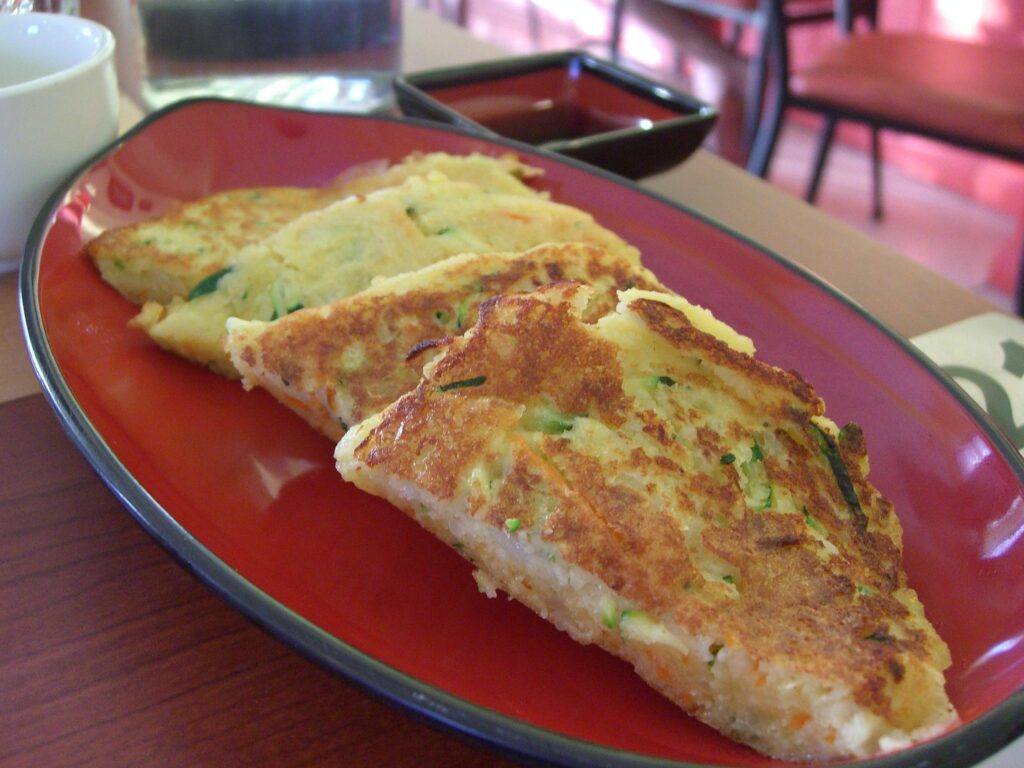
The thing that makes the crust
Two habits make or break bindaetteok, and they’re the same ones that make any good jeon: grind the beans coarse, not smooth, and don’t be shy with the oil. A smooth puree fries up dense and gummy; the grainy batter is what shatters. And because this pancake is thick, a stingy, cool pan steams the inside before the outside crisps. Keep the oil ample, the pan genuinely hot, and flip only once — poking and re-flipping breaks the crust you’re trying to build.
Variants worth knowing
Same dish, many names: 녹두전, 녹두빈대떡, and 녹두지짐 (with 막부치 in 황해도/Hwanghae). For a meatier, market-style version, fold in extra pork or beef (고기빈대떡). A Gwangjang Market classic is 육회 빈대떡 — a fresh pancake served alongside 육회 (Korean beef tartare). Prefer the bean flavor to lead? Make a plain nokdujeon with just sprouts, scallion, and a little pork. It’s easily vegetarian, too: skip the pork and use vegan kimchi, and the bean batter holds together fine on its own. For texture, a spoon of ground sweet rice adds chew, while a touch more water gives you lacier edges.
How to eat it
Eat bindaetteok hot off the pan, while the edges are still crackling — it loses its crunch as it cools and turns dense. Cut it into wedges or squares and dip each piece in the soy-vinegar-gochugaru sauce; the acidity cuts the richness of the oil. The classic pairing is 막걸리: a thick, crispy pancake and a bowl of cloudy rice wine is the quintessential Korean rainy-day combo. It’s shared food, so set a stack in the middle of the table. At 광장시장, the move is to grab a stool at a stall like 순희네빈대떡 — open since around 1994 from an eight-pyeong space, famous for grinding the mung beans in front of customers — watch the beans go through the mill, and order a freshly-fried 녹두빈대떡 (around 5,000 won) with makgeolli, maybe adding 고기완자 (meat patties) or 육회. Reheating leftovers? Use a dry pan or the oven, never a microwave, to bring the crisp back.
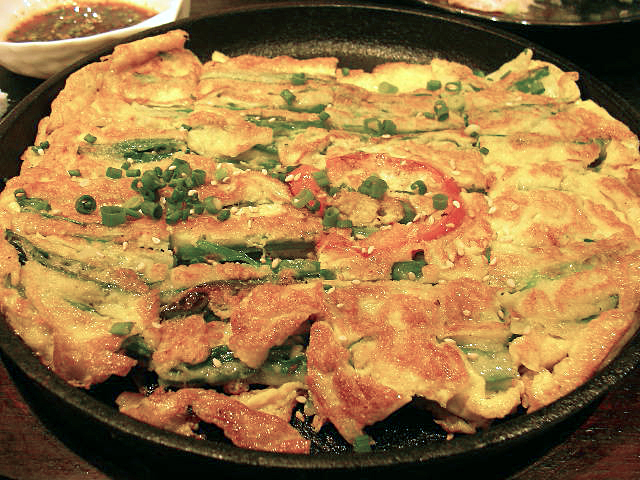
If this is your first bean-batter pancake, it’s worth meeting the wider family: bindaetteok is the heartier cousin of the wheat-flour jeon — kimchijeon, pajeon, and the rest — that share its hot-pan, generous-oil, flip-once, soy-vinegar-dip method. And if you want to taste the real thing rather than make it, 광장시장 in Seoul is where the smell of frying mung beans and a kettle of makgeolli come together exactly as they’re meant to.
Where to eat 빈대떡 (bindae-tteok, mung-bean pancake) in Seoul
Few dishes say “Seoul market food” like bindae-tteok: a thick batter of stone-ground mung beans, fried crisp on a sizzling griddle and best chased with a bowl of makgeolli. The historic stalls of Gwangjang Market and the old Pimatgol lanes of Jongno are the classic places to try it. Here are three reliable spots to start.
- 순희네빈대떡 (Sunhuine Bindaetteok) — Gwangjang Market, Jongno-gu; nearest subway Jongno 5(o)-ga Station (Line 1), Exit 8. The most photographed bindae-tteok stall in the market, frying nokdu (mung-bean) pancakes right at the counter. It is the name most tourists and locals cite first, so expect a crowd and a wait at peak hours.
- 박가네 빈대떡 (Bakgane Bindaetteok) — Gwangjang Market, Jongno-gu; nearest subway Jongno 5(o)-ga Station (Line 1), Exit 8, about a 3-minute walk. A three-generation, roughly 60-year stall (since 1966) known for batter ground from 100% mung beans, often called one of the market’s original makers. A good choice if you want the heritage version alongside the market’s yukhoe and other snacks.
- 열차집 (Yeolchajip) — Gongpyeong-dong / Jongno area, Jongno-gu; nearest subway Jonggak Station (Line 1), Exit 2, about 100 m. A historic nopo (old-timer) dating to the 1950s in the former Pimatgol lanes and now a designated Seoul Future Heritage site. Its freshly ground green-bean batter fried in pork fat gives an unusually nutty, crisp-edged pancake, traditionally served with oyster jeotgal. A sit-down alternative to the standing market stalls.
Hours and closing days change often, and these are popular spots that frequently queue, so check current hours before you go and arrive off-peak if you can. At Gwangjang Market in particular, watch for similar or copycat names and confirm the exact stall.


Leave a Reply