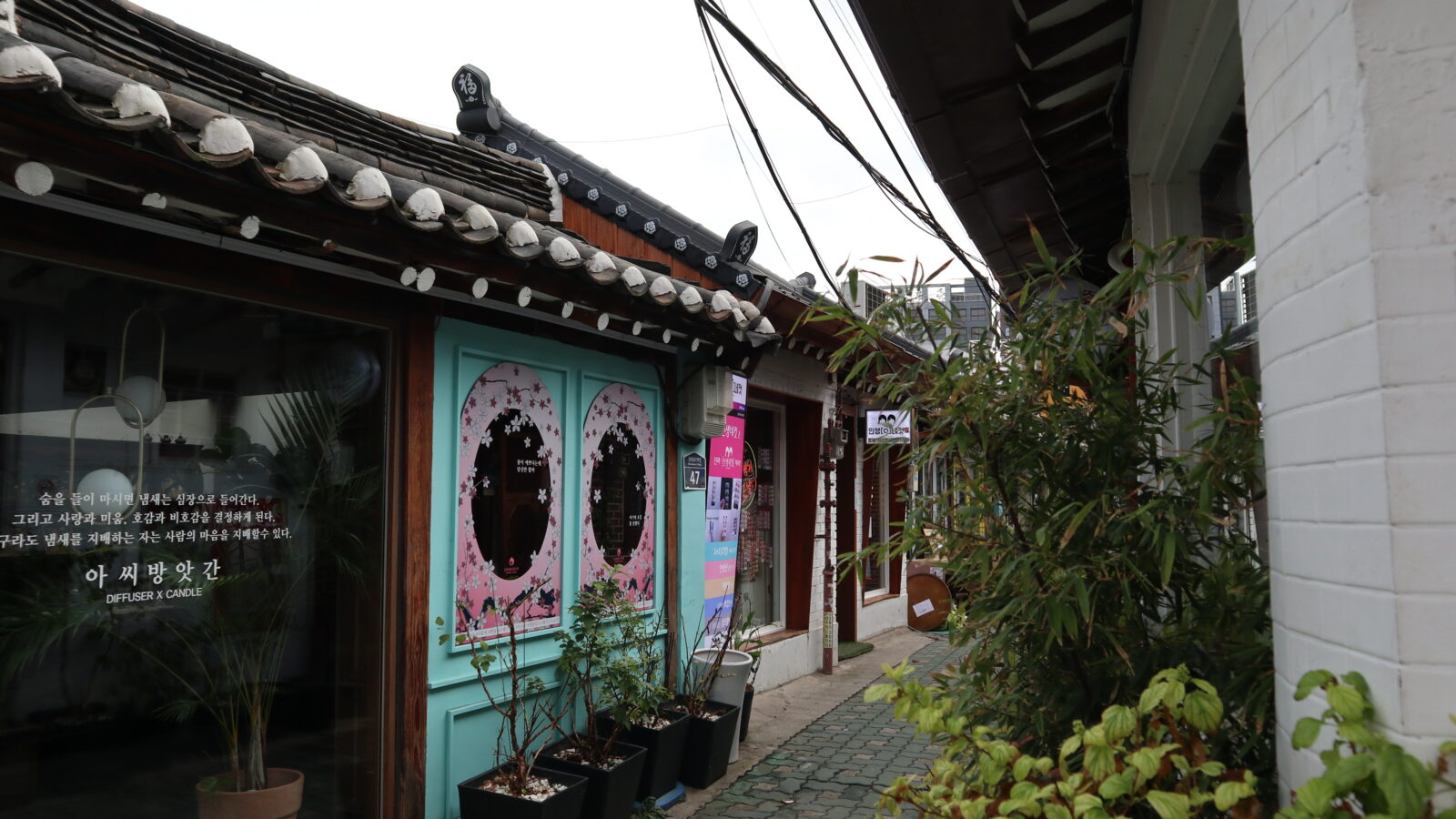

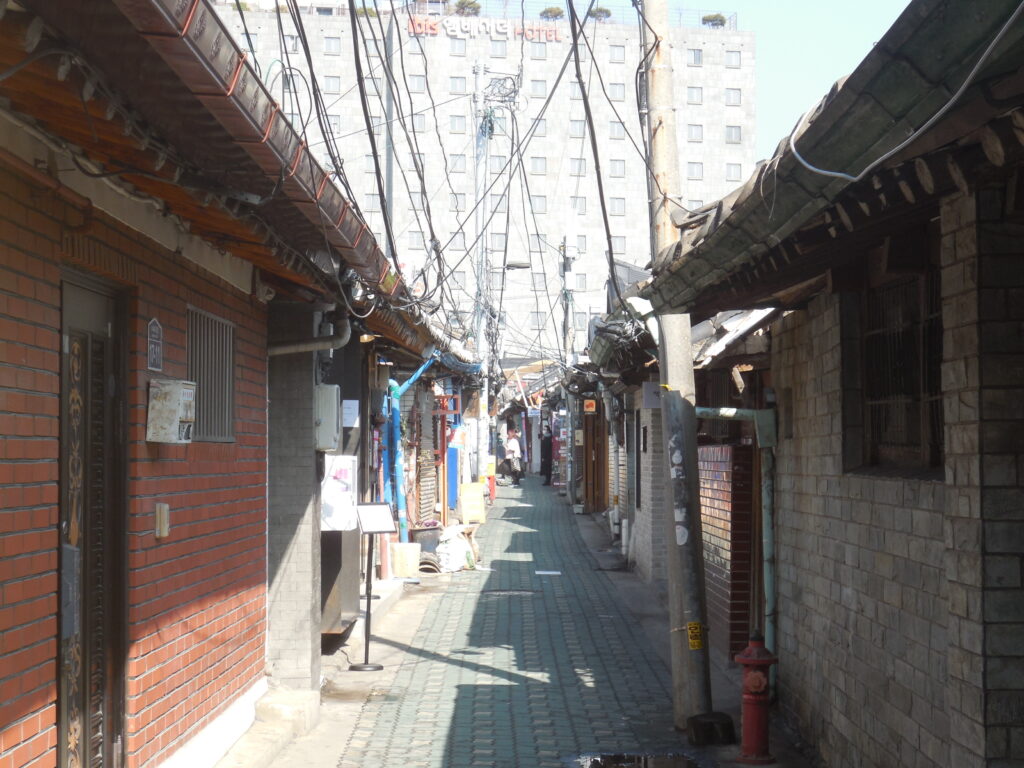
Ikseon-dong (익선동) packs Seoul’s densest cluster of old tile-roofed hanok houses into a few hundred meters of two-meter-wide alleys, right in the dead center of the old city. The hook is the contrast: tiny 1920s houses and twisty lanes wrapped around modern, design-forward cafes, dessert bakeries, restaurants and bars. You can walk the whole thing in an afternoon, but the point isn’t to cover ground — it’s to get lost on purpose, coffee in hand. This guide covers what the neighborhood actually is, how to navigate the maze, where the cafe-and-restaurant scene sits, how to get there, and what to pair nearby.
What Ikseon-dong Is
Ikseon-dong is a small dong (a legal-status neighborhood) in Jongno-gu, just north of Jongno — the main east-west avenue — and immediately east of Insadong. It’s widely billed as Seoul’s oldest planned urban-hanok residential district: a deliberate grid of very narrow alleys lined with low, traditional Korean tile-roof houses, laid out in the late 1920s and early 1930s. That “planned” detail is what sets it apart from older but unplanned hanok pockets, and from grander, hillier Bukchon or the artists’ quarter of Seochon west of Gyeongbokgung. Ikseon-dong is flatter, tighter and more commercial — a hanok-cafe alley district rather than a residential museum-piece.
As of a 2018 count, roughly 119 hanoks remained here — among the highest hanok densities in central Seoul, denser than Bukchon or Seochon — though only a few dozen were still lived-in. After decades of decline, the area was revived from around 2014 to 2015 into one of central Seoul’s trendiest food-and-drink quarters, the old houses reopening as cafes, bakeries, restaurants, makgeolli and craft-beer bars, and small boutiques, often styled with a 1920s–1930s “newtro” (new-plus-retro) nostalgia. (Those figures are several years old and have likely shifted since.)
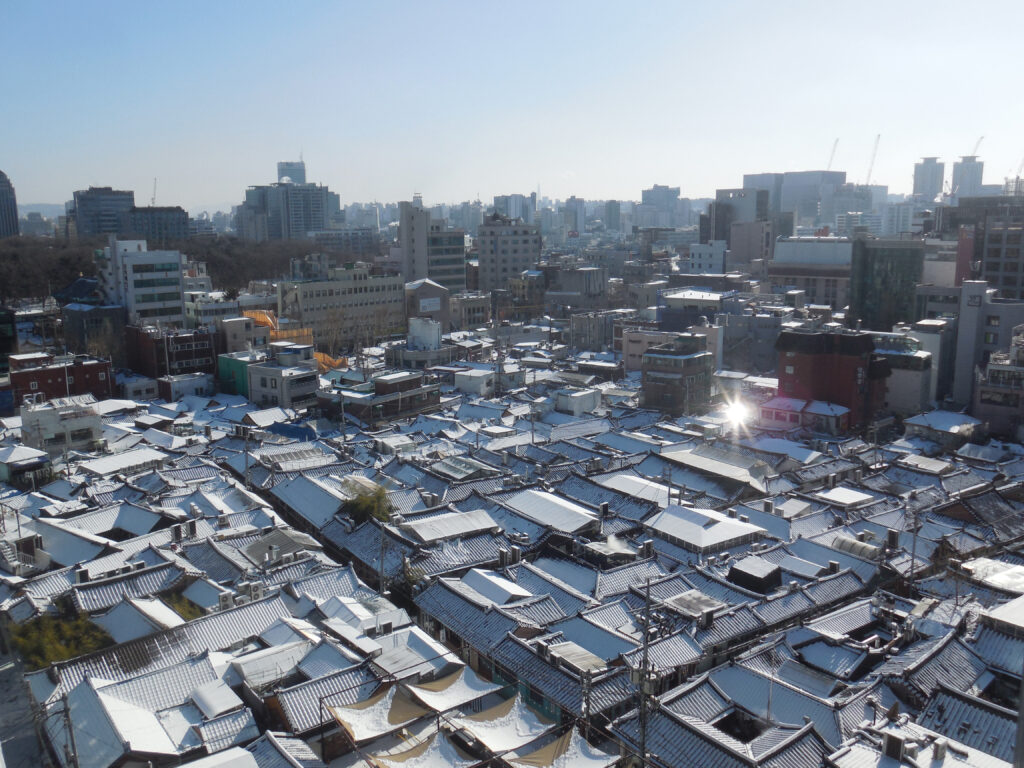
A Quick History
Ikseon-dong took its modern shape under Jeong Se-gwon (정세권), one of Korea’s first modern real-estate developers, working through his company Geonyangsa. During the Japanese colonial period he bought up large estates, subdivided them, and built clusters of small, affordable “improved” urban hanoks (도시한옥) — compact modern adaptations of the traditional Joseon house, designed to fit dense city lots and sold, often on installment, to ordinary Koreans, helping keep the land in Korean hands. Jeong was also a nationalist and independence activist. One academic study credits him with only about 53% of Ikseon-dong’s hanoks, so he’s best understood as the leading figure rather than the sole builder.
The area later had a mid-century heyday as an entertainment quarter — by 1969 several of Seoul’s top-taxpaying yojeong (gisaeng restaurants) operated here — then faded from the 1980s as money shifted to Gangnam. In the 2000s it was slated for redevelopment, but the plans stalled amid a preservation push: Seoul’s planning committee rejected a redevelopment scheme around 2010, and the redevelopment zone was finally lifted around April–May 2018, replaced with a district-unit plan meant to preserve the hanoks. It’s a preservation-over-demolition success story, though now shadowed by gentrification — rising rents, displaced longtime residents, and renovations that critics call invasive to the old structures.
How to Wander the Alley Maze
The heart of the experience is the central alley maze: roughly two-meter-wide flagstone lanes between hanok walls, lined wall-to-wall with cafes, restaurants and shops. It feels labyrinthine, but it’s small — the lanes branch every few meters, and if you walk in any direction long enough you’ll hit a main road. The right move is to wander freely rather than navigate. Don’t try to find a specific shop by map; drift, and let the courtyards and storefronts pull you in.
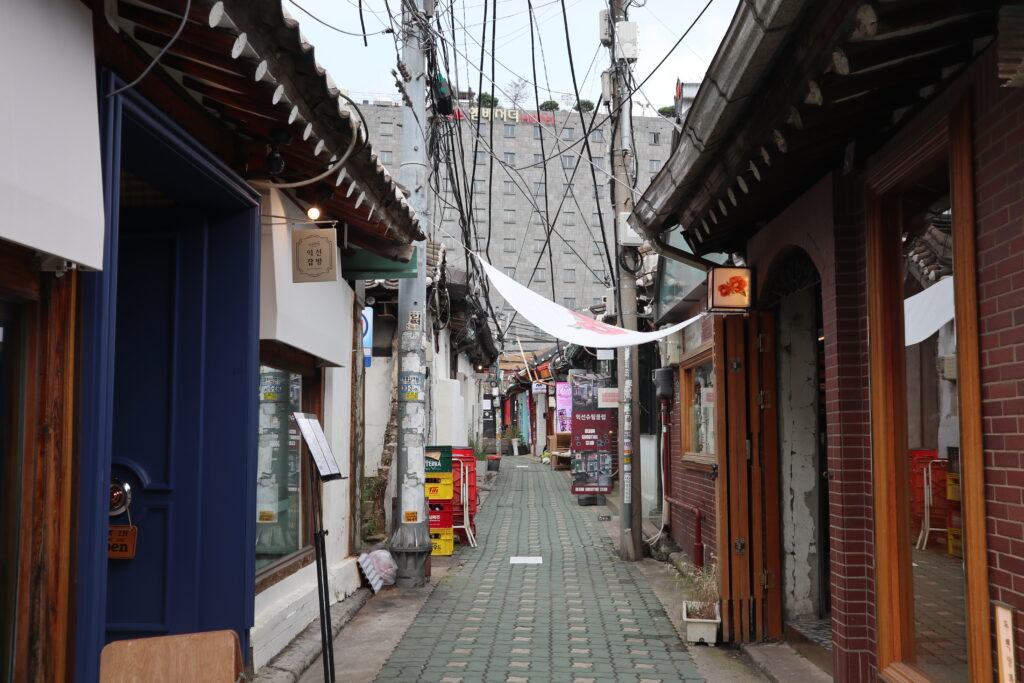
A few things to look for as you go:
- Hanok courtyards. The most photographed, daytime-busy lanes are the ones where old houses with little ponds, bamboo and tiled roofs have been converted into cafes and bakeries. This is the signature Ikseon-dong look.
- The restaurant and bar lanes. Stretches of fusion and modern-Korean eateries, hotpot and shabu spots, a grill (“gogi”) run, makgeolli houses and craft-beer bars. These are quiet by day and come alive after dark.
- Boutique and retro-shop lanes. Modern-hanbok shops, vintage and secondhand boutiques, accessories, plus retro novelties like arcade games and caricature artists, all mixed in among the food.
The Cafe and Restaurant Scene
Ikseon-dong’s scene breaks into three layers. First, the hanok cafes and dessert bakeries — the signature draw, a traditional house with a small courtyard or pond serving coffee, castella and soufflé-style cakes, salt bread and the like, very photo-oriented and busiest by day. Second, sit-down restaurants spanning modern-Korean and fusion, hotpot and shabu, and Korean BBQ. Third, a lively night side of makgeolli (rice-wine) houses and craft-beer and cocktail bars tucked into the same little hanoks.
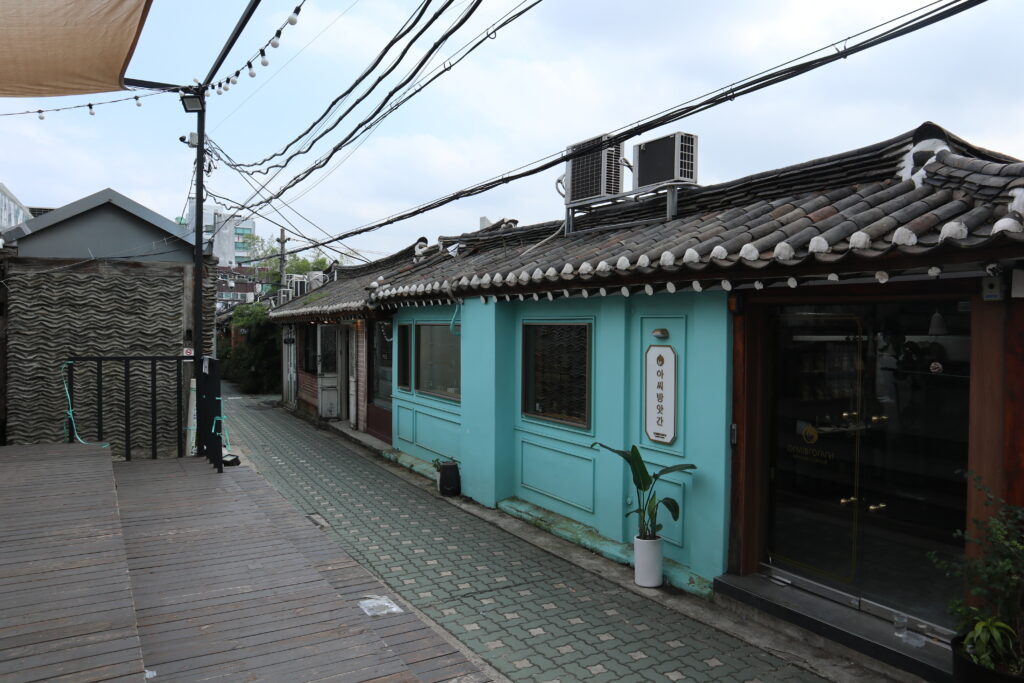
Practical expectations: queues at the most-hyped bakeries, small rooms, and reservation-or-wait dynamics at popular dinner spots. The single most important caveat is that shops in a district this trendy open, close and change hands fast. Treat any one blogger’s or vlogger’s specific picks — even a self-funded crawl through eleven spots — as a snapshot, not a fixed list of institutions. Before you set out for a particular cafe or restaurant, verify it’s still there on Naver Map or Kakao Map.
Getting There
By subway, take Line 1, 3 or 5 to Jongno 3-ga Station (종로3가역) — it’s a transfer station on all three lines, so it’s easy to reach from almost anywhere in the city. The handiest exits for Ikseon-dong are Exit 4 or Exit 6, with Exit 3 also working; from the exit it’s only about a one-to-three-minute walk north into the alleys, or five to ten minutes at an easy pace. Exit 6 takes you past Nakwon Arcade and the Tteok (rice cake) Museum on the way in.
On foot, you can also stroll over in a few minutes from Insadong, which adjoins Ikseon-dong to the west past Nakwon Arcade, or walk down from Changdeokgung Palace in about nine or ten minutes. Once you’re in the neighborhood, navigate with Naver Map or Kakao Map rather than Google Maps, whose walking directions are limited in Korea — and the lanes here are unmarked and maze-like, so you’ll want a local app even to orient yourself.
When to Go
Daytime — roughly late morning into the afternoon — is best for the hanok cafes, the bakeries and photography, with shorter lines earlier in the day. Evening brings a different energy: the makgeolli houses, grill restaurants and bars fill up, and the lanes glow with lantern and string lighting. Most cafes and restaurants open around 11 a.m. and run busy until about 10 or 11 p.m.
Weekdays are noticeably calmer than weekends, when the narrow alleys get very crowded. Spring and autumn are the most pleasant for wandering on foot; the lanes are tight and largely uncovered, so summer heat and rain and winter cold are all felt directly. If you can, come on a weekday late morning for the cafes, then linger into the evening to catch the lanes lit up — you get both faces of the neighborhood in one visit.
What to Pair Nearby
Ikseon-dong sits in the densest cluster of central Seoul’s heritage sights, so it’s easy to build a half-day around it:
- Insadong — traditional crafts, tea houses and galleries, directly adjoining to the west. The natural walk-over, past Nakwon Arcade.
- Changdeokgung Palace and its Secret Garden (Huwon) — a UNESCO site about a nine-to-ten-minute walk north.
- Jongmyo Shrine — the UNESCO royal ancestral shrine, roughly six minutes east.
- Gwangjang Market — the classic street-food market, about a kilometer (10–15 minutes’ walk, or one stop on Line 1) east.
- Tapgol (Pagoda) Park and Jogyesa Temple — a historic park tied to the 1919 March 1st Movement just south near Jongno, and a major Buddhist temple about twelve minutes away.
The easy combination is Changdeokgung in the morning, Ikseon-dong for a hanok-cafe lunch and a wander, then Insadong or Gwangjang Market as the afternoon winds down. However you sequence it, give Ikseon-dong itself unhurried time — the whole appeal is the slow drift through the lanes, not a checklist.
All those hanok cafes run on one thing — dessert. Here’s what to order: a guide to Korean hanok-cafe desserts, from bingsu to yakgwa.



Leave a Reply