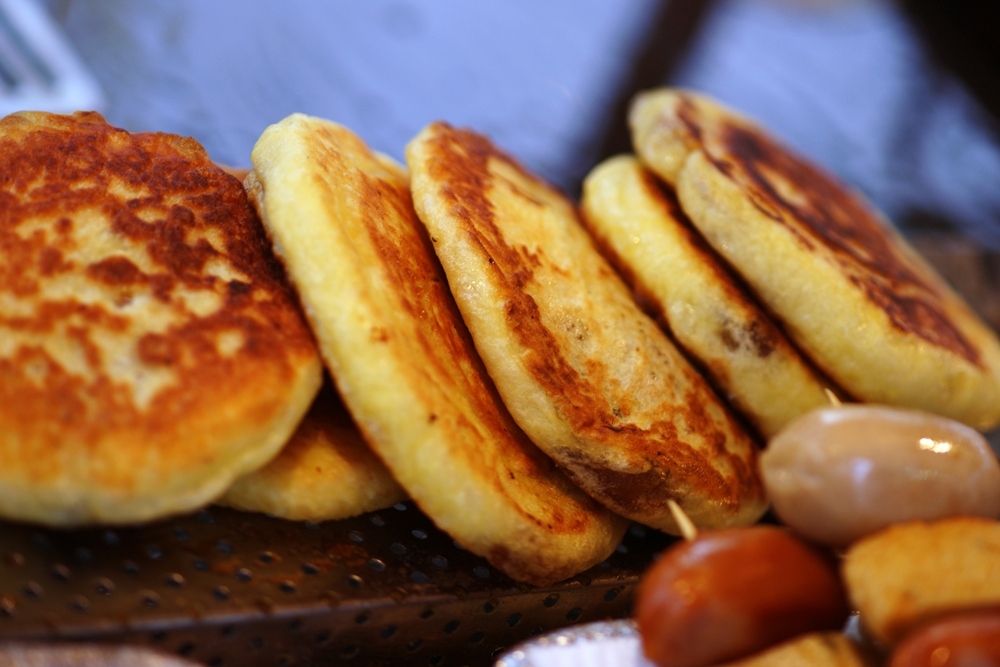
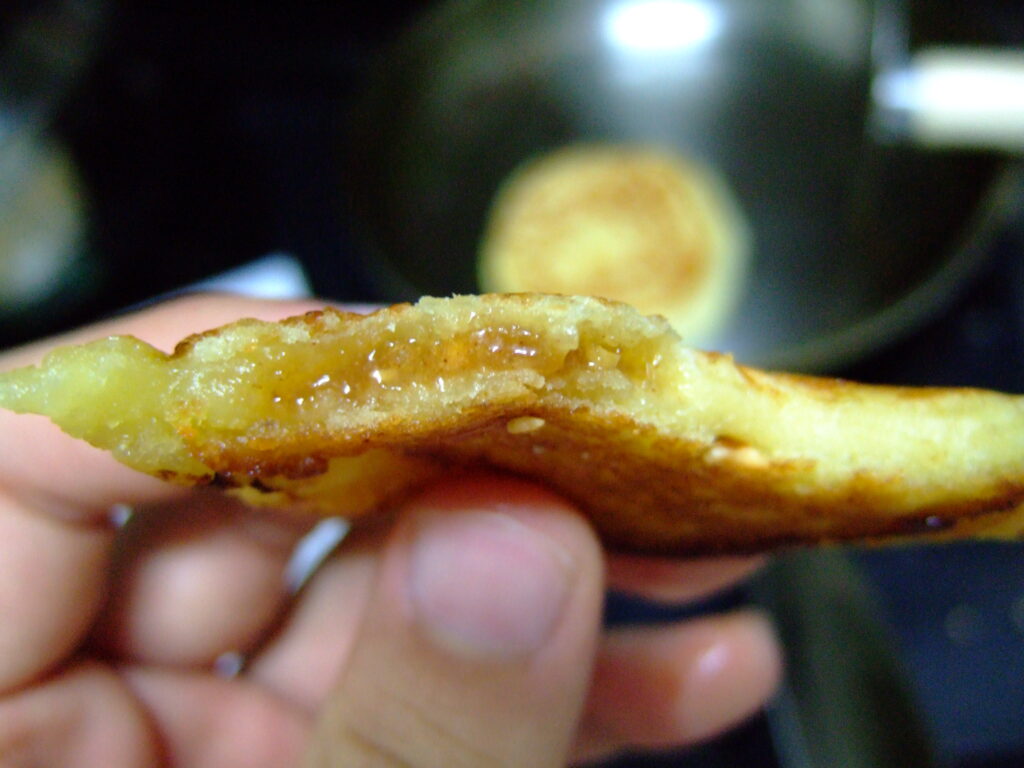
The whole appeal of hotteok (호떡) is the contrast: a chewy, pan-fried shell that goes crisp at the edges, wrapped around a filling of brown sugar and cinnamon that melts into hot syrup the moment you bite in. It’s Korea’s quintessential winter street snack, sold from carts where vendors press each one flat with a steel disc so the inside turns molten. You don’t need a cart to get that result at home; you need a yeasted dough, a sticky brown-sugar filling, and a hot oiled pan. This recipe makes about 8 to 10 pancakes.
One tip up front that matters more than any technique: a little glutinous-rice flour (찹쌀가루) blended into the wheat dough is what gives street hotteok its signature chew. You can skip it and use all wheat flour for a softer, bread-like version, but if you want the 쫄깃 (chewy) bite, keep it in.
A quick note on where it comes from, because the name tells the story. Hotteok descends from 호병 (胡餠), bread foods that traveled the Silk Road, and the 호 (胡, “foreign”) character is still sitting in the name. It’s generally believed to have entered Korea around 1882 with Qing-dynasty Chinese (화교) merchants, for whom selling hotteok was a common trade. So this is a snack with a few centuries of road behind it.
Ingredients
For the dough (chewier version):
- 2 cups (240g) all-purpose or bread flour
- 1/2 cup sweet rice flour (찹쌀가루, glutinous-rice flour) — for chew; omit for an all-wheat dough
- 1 Tbsp sugar
- 1 tsp salt
- 2 1/4 tsp (1 packet) active dry yeast (이스트)
- 1 Tbsp cooking oil, plus more for frying
- About 1 to 1 1/4 cups warm milk or water (100–110°F / 38–43°C)
For the filling:
- 1/2 cup brown sugar (흑설탕) — dark brown or turbinado gives deeper flavor
- 1 tsp cinnamon (계피) powder
- About 5 Tbsp finely chopped walnuts or peanuts (땅콩) — chopping them keeps the syrup from running out and adds crunch
How to make it
- If you’re using active dry yeast, bloom it first: stir it into a little warm water with a pinch of sugar and leave it about 10 minutes until foamy. (Skip this for instant yeast.) Sift the flour, 찹쌀가루, sugar and salt together in a large bowl.
- Add the yeast, oil and warm milk or water. Mix, then knead into a soft, sticky, stretchy dough. It will feel wetter than bread dough — that’s right. The longer you knead, the chewier the hotteok.
- Cover the bowl and keep it somewhere warm for about 1 hour, until the dough has doubled. Punch it down to release the gas, then let it rest another 10 to 30 minutes.
- While it rests, mix the brown sugar, cinnamon and chopped nuts in a small bowl.
- Oil your hands so the dough won’t stick. Pull off a golf-ball-size piece, flatten it into a disc in your palm, spoon about 1.5 Tbsp of filling into the center, then pinch the edges tightly shut into a sealed ball. Seal it well — any gap is where the syrup escapes.
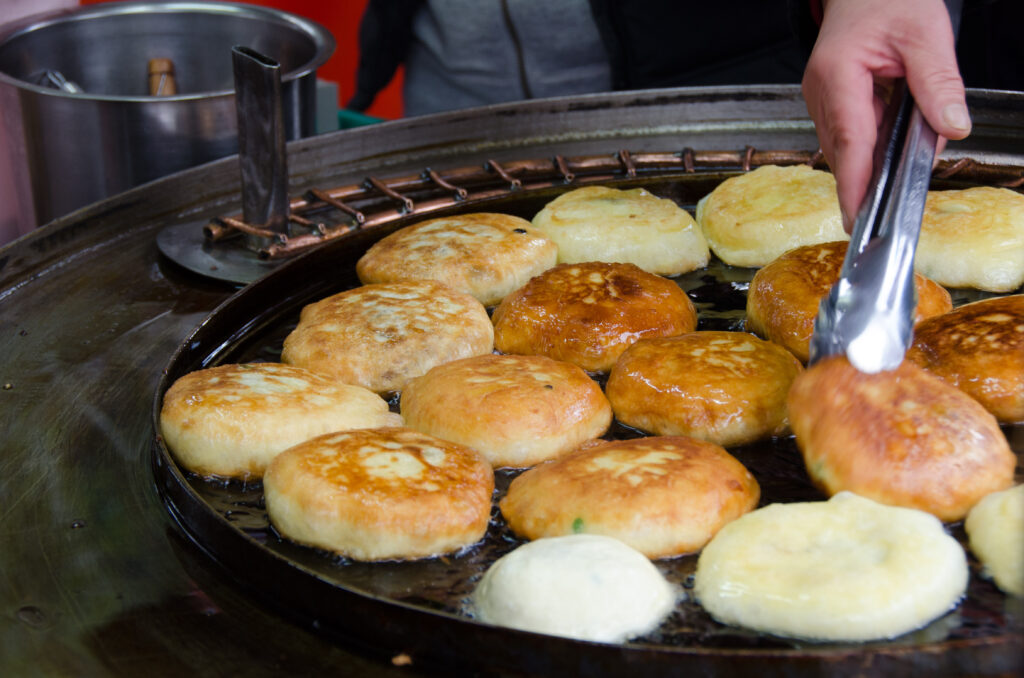
- Heat about 2 Tbsp oil in a skillet over medium. Place the ball seam-side down. After about 30 seconds, flip it and press it flat with a hotteok press or the back of a spatula into a round about 4 inches (10 cm) across.
- Fry, flipping once or twice, a few minutes per side until both sides are golden brown and crisp and the sugar inside has melted to syrup. Serve hot.
The most common first-timer mistake is a leaky pancake — sugar bleeds out and burns in the pan. It’s almost always an incomplete seal in step 5, or pressing too hard too soon in step 6. Give it that first 30 seconds before you flatten.
Variations worth knowing
Hotteok has more relatives than the basic sweet version. 씨앗호떡 (seed hotteok) is the famous one — a Busan Nampo-dong (남포동) signature from the 1980s. The key difference is the order: it’s fried first as a plain hotteok, then the vendor slits one edge open and stuffs the pocket with a big spoonful of mixed seeds and nuts (sunflower, pumpkin seed, peanut, sometimes raisins), served folded in a paper cup. 야채호떡 is a savory version filled with stir-fried vegetables and glass noodles, japchae-style, instead of sugar. There’s also 찹쌀호떡 (made almost entirely with glutinous-rice flour for an extra-chewy bite), 녹차호떡 tinted with green-tea powder, and fusion takes like 피자호떡 and 김치호떡. If you want the no-yeast shortcut, a packaged 호떡믹스 or even pancake mix (핫케이크가루) gets the dough together in 5 to 10 minutes.
How to eat it
Eat it fresh and hot off the pan — that’s the entire point of a winter street snack. Hold it in a folded paper cup or napkin and bite a small corner first. One real safety note: the molten brown-sugar filling turns into near-boiling syrup and is extremely hot. It clings, and it can cause serious mouth, lip and finger burns. Let it cool a moment, take small bites, and be especially careful handing one to a child. Seed hotteok is a little more forgiving since the seeds go in after frying, but the sugar pocket is still very hot. Leftovers freeze well — reheat them in a toaster oven or air fryer to bring back the crisp shell.
If you’re chasing the real-deal 씨앗호떡 rather than the home sweet version, that’s a Busan thing specifically — the Nampo-dong street stalls are where it was born. Make the plain version here tonight, and if Busan is on your travel list, our Busan in 2 Days guide points you to the Nampo-dong stalls for the authentic seed hotteok.



Leave a Reply