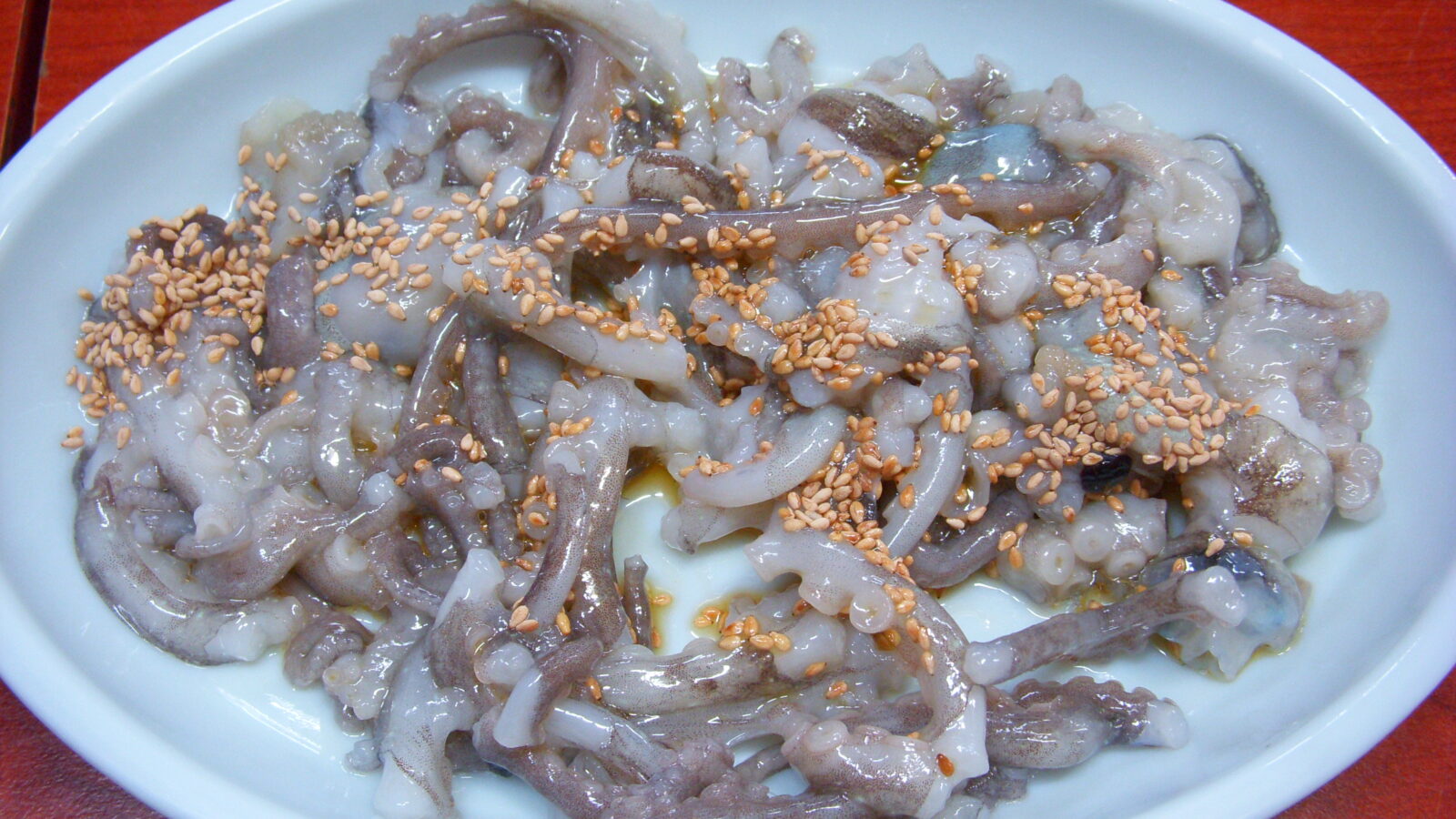
Few Korean dishes are as instantly notorious as 산낙지 (san-nakji) — small octopus, freshly cut and served while the pieces are still moving on the plate. It is a striking sight: the arms keep wriggling, and the suckers cling to the dish, your chopsticks, and even your tongue. But behind the spectacle is a genuine food with a long coastal history, a specific texture-driven appeal, and a safety story that deserves to be told honestly rather than as a dare.
What san-nakji actually is
San-nakji is a type of 회 (hoe), Korean raw seafood, made from 낙지 (nakji) — the long-arm octopus, Octopus minor. This is a small, slender species. It is often mistranslated as “baby octopus,” but that is wrong: nakji is its own adult species, and the small, plump octopus people sometimes picture is actually a different animal, 주꾸미 (jjukkumi). Keeping that distinction straight matters if you want to order the right thing.
The whole appeal of san-nakji is texture and the live “experience.” The flesh is springy and chewy, faintly sweet and briny, and the still-active suckers give a mouthfeel you simply cannot get from anything cooked. That movement is a reflex, not a sign the animal is suffering through it consciously: about two-thirds of an octopus’s neurons sit in its arms, so cut pieces keep reacting to salt and touch even after the animal is dead.
How it is prepared and served
San-nakji is a fresh-handling dish, not a cooked recipe — quality is almost entirely about freshness. A cook starts by scrubbing the live octopus with coarse salt (소금), or sometimes flour (밀가루), for a couple of minutes to strip off the slippery slime and grit, then rinses it clean. Many cooks rinse only briefly and avoid long soaking in tap water, since fresh water can dull the flavor and add a fishy note. The head is cut and the innards and beak are removed, and the body is sliced into small pieces.
From there you will see a few common forms:
- 산낙지 (basic, cut): the octopus is cut into bite-size pieces and tossed with 참기름 (sesame oil) and toasted 통깨 (sesame seeds). The dressing seasons it and also makes the suckers move more.
- 낙지탕탕이 (nakji tang-tang-i): the octopus is finely chopped on a board — the name mimics the tang-tang sound of the knife — and seasoned with sesame oil, sesame seeds, and sometimes garlic or chili. This is the most common restaurant form, and the friendlier one for first-timers.
- 통낙지 (tong-nakji, whole): a small whole octopus eaten in one go, often wound around the chopsticks. This is the highest-risk form and is not recommended for novices.
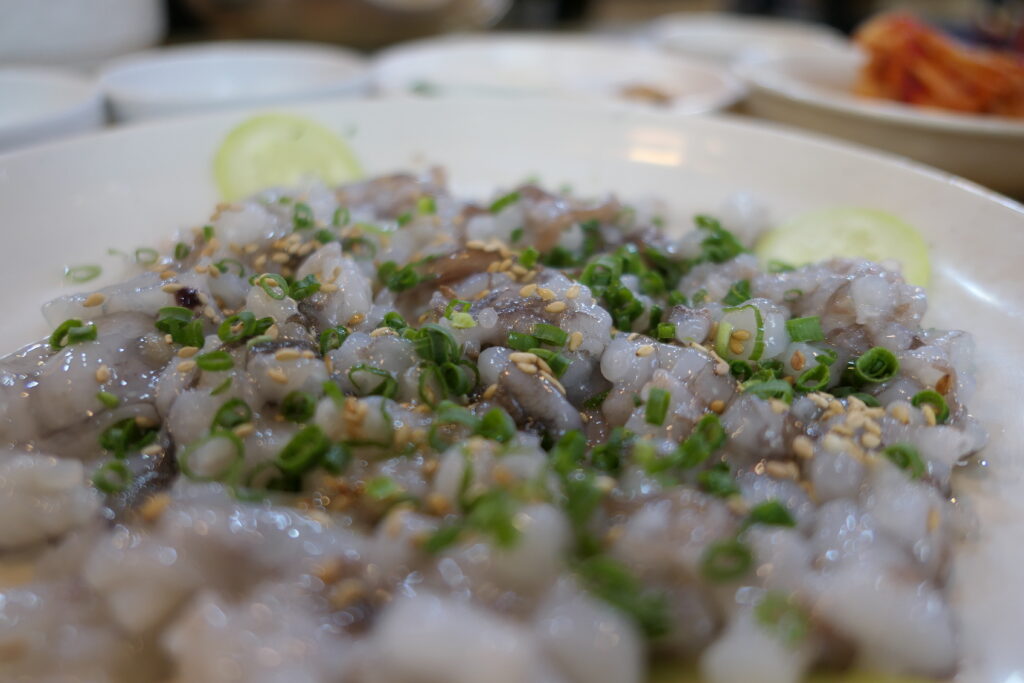
To eat, pick up a small piece and dip it in 기름장 (gireumjang, sesame oil with salt) or 초장/초고추장 (chojang / chogochujang, a sweet-tangy vinegared chili-paste dip). It pairs traditionally with soju — though, as below, alcohol is exactly where the danger lies. If you want the live experience with less risk, choose finely chopped 탕탕이 over whole 통낙지.
The safety note — read this before you try it
This is not a gimmick warning. The real danger of san-nakji is choking. Octopus suckers keep their gripping power even on cut pieces and can latch onto the throat, epiglottis, or airway. There have been real fatalities. In South Korea, several deaths have been recorded over the years — per Seoul fire authority data, three deaths between 2007 and 2012, with further deaths in 2013 and 2019; and in October 2023, an 82-year-old man in Gwangju died after san-nakji lodged in his throat. A 2018 medical case study linked two choking deaths to alcohol intoxication and pre-existing heart disease, with suckers found stuck in the laryngeal inlet.
The practical rules are simple and worth following every single time:
- Keep the pieces small. Risk rises sharply with larger pieces, and especially with whole 통낙지.
- Chew thoroughly and slowly. Never swallow in a hurry, and never gulp.
- Go easy on alcohol. Intoxication is a major aggravating factor and impairs your swallow and gag reflexes.
- It is not suitable for everyone. Avoid serving it to young children, the elderly, or anyone with swallowing difficulty or impaired consciousness.
- Treat choking as an airway emergency. Use back blows or the Heimlich maneuver and call emergency services — the suckers can re-grip.
It is worth noting that san-nakji is banned or restricted in some countries on safety and animal-welfare grounds. There are also minor heavy-metal (cadmium, copper, zinc) accumulation findings in octopus organs, though studies concluded that normal consumption poses no adverse human health effect.
Where to find it — and the cooked alternatives
San-nakji is a market and coastal-region experience, most associated with seafood markets and the southwest coast, especially the 무안·목포 (Muan / Mokpo) area, which is famous for its nakji. Eating it fresh at a hoe restaurant or market stall, where the octopus is dressed simply with sesame oil and seeds to let the texture shine, is the classic way to try it.
If raw is not for you, the same octopus shines cooked. 낙지볶음 (nakji-bokkeum) is a fiery gochujang stir-fry, and 연포탕 (yeonpotang) is a clear, mild octopus soup — both are the natural “same ingredient, cooked instead of raw” companions. Nakji also appears in 낙지호롱, 낙지전골, and 낙지비빔밥. Whichever way you meet it, nakji is one of Korea’s most distinctive seafood ingredients — and san-nakji is its boldest expression.





Leave a Reply