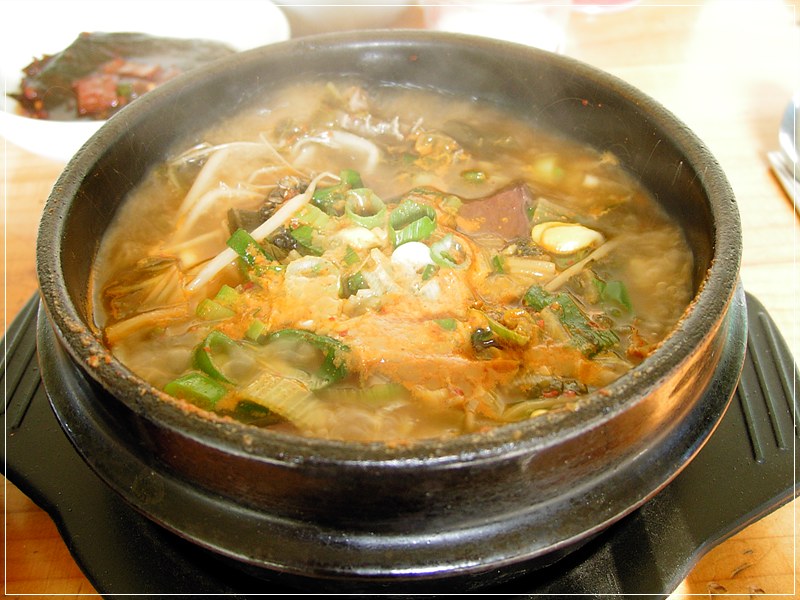
Few Korean dishes sound as alarming to newcomers and as comforting to locals as seonjitguk (선짓국) — a steaming, brick-red soup built around seonji (선지), the gently congealed blood of an ox. If that makes you hesitate, you are not alone. But seonjitguk is one of Seoul’s most beloved haejang-guk (해장국), the broad family of “soup to chase away a hangover,” and once you taste it, the squeamishness usually gives way to curiosity. This is honest, frugal, deeply restorative food.
What Is Seonjitguk?
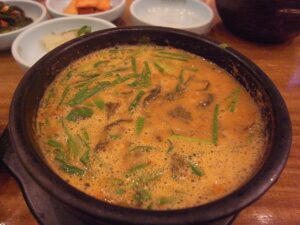
Seonjitguk is a spicy beef-bone soup whose signature ingredient is seonji: ox blood that has been simmered until it sets into soft, slippery cubes. The word seonji is thought to derive from a Mongolian root for “blood,” a reminder of how old this dish’s lineage is. The blood is cooked into wobbly, tofu-like blocks, then dropped into a broth seasoned with doenjang (된장, soybean paste), gochugaru (고춧가루, red chili flakes) and sometimes a touch of gochujang (고추장).
Around the seonji you’ll find a generous tangle of vegetables: napa cabbage (배추), plump soybean sprouts (콩나물), sliced radish (무), and especially siraegi (시래기) — dried radish greens that give the broth its earthy, country-style depth. Chunks of beef and, in heartier versions, yang (양, tripe) round it out. It is almost always served as gukbap (국밥), with a bowl of rice either on the side or tipped straight in.
Taste and Texture
The broth is savory, faintly spicy and clean rather than heavy — Cheongjin-dong cooks are known for keeping it siwonhada (시원하다), that bracing “refreshing” quality Koreans prize in hot soup. The seonji itself is the surprise: it is remarkably mild, with no strong iron tang when properly prepared. The texture is the draw — silkier and more delicate than tofu, melting on the tongue. Soybean sprouts add crunch, radish greens add chew, and the chili gives a slow, warming heat that genuinely seems to clear a foggy morning head.
Cheongjin-dong: The Home of Seoul-Style Haejang-guk
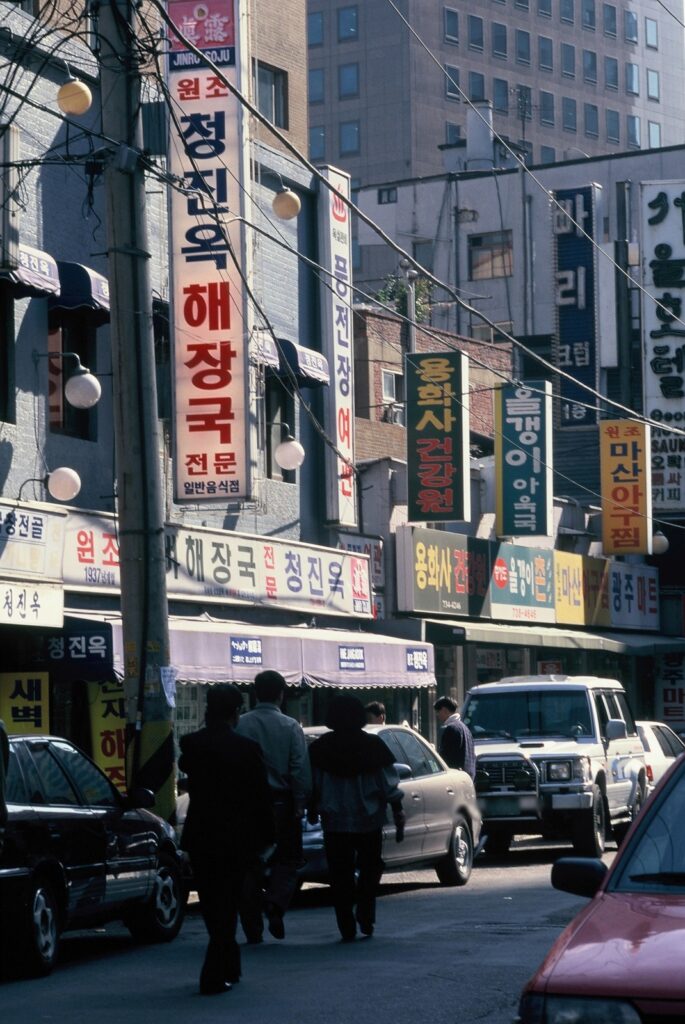
To eat seonjitguk in its spiritual home, go to Cheongjin-dong (청진동) in Jongno, central Seoul. Gukbap houses began clustering there in the 1930s, forming a celebrated “Haejang-guk Alley.” After the Korean War, cooks enriched the soup with seonji and tripe, and the Cheongjin-dong style — soybean paste melted into rich beef-bone broth, then seonji and dried radish greens simmered for hours — became the Seoul benchmark. Though the alley was reshaped by 2010s redevelopment, several historic establishments carry the tradition on, serving bowls at dawn to night-shift workers and the previous night’s revelers alike.
How to Make Seonjitguk at Home
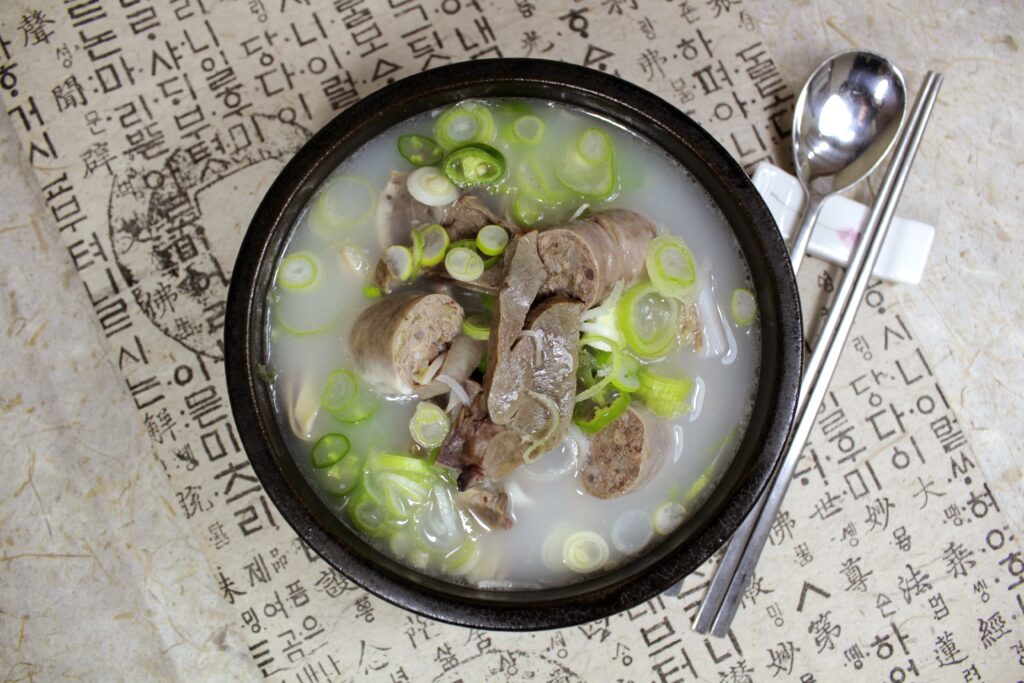
The hardest part outside Korea is sourcing the seonji. Look for it frozen or refrigerated in vacuum packs at Korean grocers (labeled 선지 / “ox blood” / “beef blood”). It is sold pre-cooked and congealed, so you are reheating rather than handling raw blood — see the cautions below. The rest is a forgiving, one-pot affair.
Method overview
- Build a beef-bone or brisket broth and skim it well.
- Melt in doenjang, then bloom gochugaru and aromatics.
- Simmer the soybean sprouts, radish and rehydrated radish greens until tender.
- Add the seonji last and warm it through gently — never a hard boil, or it toughens and crumbles.
- Serve over or alongside hot rice, with kimchi.
See the full ingredient list and step-by-step instructions below.
Honest Cautions
- Buy cooked seonji from a reputable source. Blood is highly perishable. Reputable retail seonji is already cooked and set; keep it cold, use it by the date on the pack, and reheat thoroughly. Do not attempt to source or process raw ox blood at home unless you have a trusted, food-safe supplier.
- Handle gently. Seonji breaks apart easily — slide it in near the end and avoid vigorous stirring.
- Iron-rich. Seonji is notably high in iron, which is part of its folk reputation as a restorative. Those advised to limit iron intake should be mindful.
- If you use tripe (yang), clean and parboil it first to remove any off-odor before adding it to the pot.
A Note for the Adventurous Eater
Seonjitguk asks for a small leap of faith and rewards it generously. It is humble, nourishing and woven into the rhythm of Seoul mornings. Whether you ladle a bowl in a Cheongjin-dong alley or simmer your own at home, you’re tasting a dish that has comforted Koreans through hard winters and harder mornings for the better part of a century.
Where to eat 선지해장국 (seonji-haejangguk, ox-blood hangover soup) in Seoul
This humble bowl of clear ox-bone broth, congealed ox blood (선지), and tender tripe is Seoul’s classic morning-after cure, and a handful of long-running houses do it better than anyone. Here are three places that have been ladling it out for decades.
- 청진옥 (Cheongjinok) — Jongno-gu, Cheongjin-dong; nearest station Jonggak (종각역), Line 1, Exit 1, about a 5-minute walk. Order the 선지해장국 (seonji-haejangguk). Founded in 1937, this is Seoul’s oldest surviving haejangguk house, a designated Seoul Future Heritage site and Michelin Guide-listed; its no-chili, clear sagol broth is the textbook reference for the dish.
- 어머니대성집 (Eomeoni Daeseongjip) — Dongdaemun-gu, Yongdu-dong; nearest station Sinseoldong (신설동역), Line 1/2, Exit 3, about a 5-minute walk. Open since 1967 and now run by a third generation, it’s routinely named one of Seoul’s “3대 해장국” (three great haejangguk), with a clean, hearty sagol-based 선지 soup. Honest note: it moved to a new building in 2020, so it’s modern inside rather than a dingy old shop.
- 중앙해장 (Jungang Haejang) — Gangnam-gu, Samseong-dong; nearest station Samseong (삼성역), Line 2. A 24-hour institution that tops Seoul’s big-data 선지해장국 rankings, also loved for its tripe hotpot. Honest note: it sits in Gangnam rather than the historic Jongno old-shop belt, so come for the quality and consistency more than vintage atmosphere.
Hours, prices, and break times change often, so check the latest before you go (some open 24 hours with a mid-afternoon break or a weekly closing day).



Leave a Reply