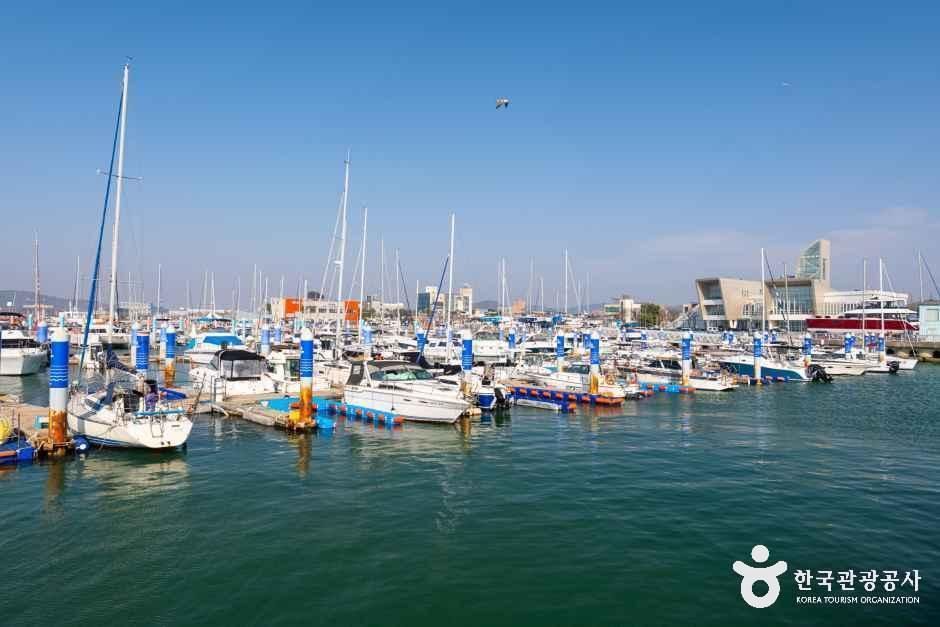

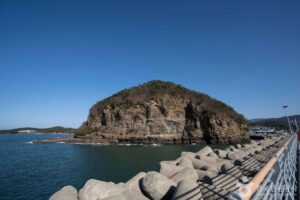
Jeongok Port (전곡항) in Hwaseong just got one of the easiest scenic walks on the West Sea. In May 2025 the city opened the Jeongok Port Stratified Tuff Sea Observation Walkway (전곡항 층상응회암 해상관찰로), a 531-meter deck that runs out over the water and mudflats, threading past Cretaceous volcanic-tuff sea cliffs. It’s flat, it’s about 50 minutes from Seoul by car, and you can pair it with a cable car ride and the Jebudo coastal walk to make a proper day trip. The catch is the tide — get the timing right and this is one of the best low-effort treks near the capital.
The walkway: walking out over the sea
The deck opened on May 30, 2025, alongside Hwaseong’s 15th Boating Festival. The official numbers: 531 meters long, 2 meters wide, built for roughly 4.57 billion won. It sits right over the sea and tidal flat, immediately beside the Seohaerang Jebudo Maritime Cable Car, and it was designed as a kind of living natural classroom — a place to look closely at mudflats and rock that the tide covers and uncovers through the day. Night landscape lighting was planned to extend it into an evening attraction.
What makes it genuinely easy is that it’s level. The video that put this place on the map flags it as having “not a single stair,” and the deck is indeed a flat, over-the-sea boardwalk consistent with that. One honest caveat: I couldn’t find an official Hwaseong document formally certifying the walkway itself as a barrier-free or wheelchair-rated facility, so treat it as “flat and effectively stair-free” rather than a certified accessible route. What is officially documented as barrier-free is the cable car — every cabin is built to take a wheelchair or a stroller.
The geology you’re looking at
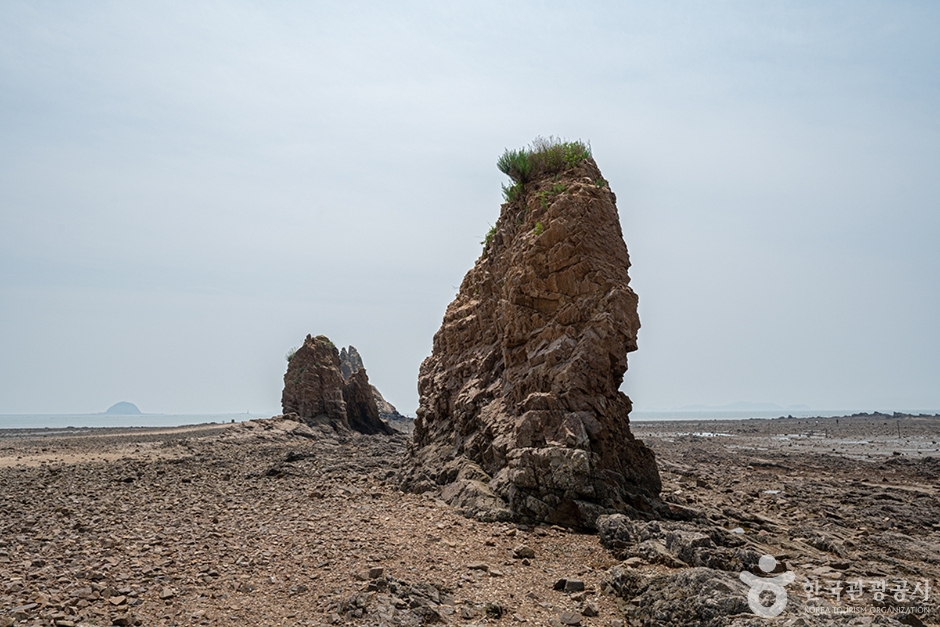
The cliffs here are stratified (layered) volcanic tuff, around 100 million years old, from the Cretaceous period. They formed when volcanic ash settled and hardened, which is why you’ll see distinct horizontal banding running through the rock. The zone packs a lot of geology into a small stretch — sedimentary rock, tuff, faults, sea cliffs, and wave-cut platforms — and it’s one of the geosites of the Hwaseong National Geopark, which earned national geopark certification in 2024 as Korea’s 16th. If you want context before you walk, the Jeongok Port Travel Station runs geopark interpretation Tuesday to Sunday, 10:00–17:00 (closed Mondays).
What to walk, beyond the deck
The deck is the headline, but the area rewards a longer loop. The source video mentions a “Gosan loop trail” and a rock called Maebawi (매바위) that reveals its full form at low tide. Be aware that I couldn’t verify either name in official Hwaseong, geopark, or news sources — both appear to be local or creator-supplied names, so don’t go looking for official signage by those exact words. (Note too that nearby Goryeomsan is a different place; don’t conflate it with “Gosan.”) What’s solid is the general truth behind them: this is a high-tidal-range coast, and at low tide the retreating sea exposes mudflat, layered rock, and tidal features that are hidden at high water. For a named regional walk, the area sits on the Gyeonggi Dulle-gil Hwaseong courses 47/48 (Gungpyeong Port to Jeongok Port, about 18 km).
Jebudo and the sea-parting road
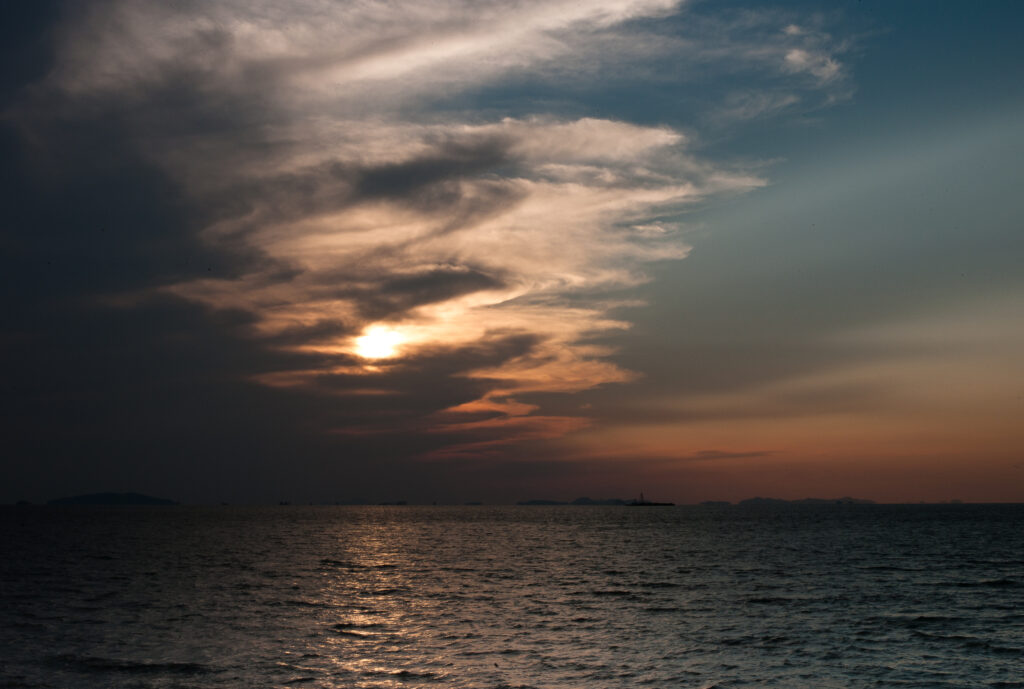
From Jeongok Port you can reach Jebudo (제부도) two ways, and the difference comes down to the tide. The classic route is the 2.3-kilometer tidal causeway from Songgyo-ri, a sea-parting road that surfaces at low tide for cars and walkers and floods at high tide, turning Jebudo back into an island. Access is strictly tide-dependent — outside the posted window, you cannot drive or walk across. The all-tide backup is the Seohaerang Jebudo Maritime Cable Car, which runs from the Jeongok Port side to the island in about 10–12 minutes regardless of the tide. Once on Jebudo, there’s a coastal walk and the West Sea sunset it’s famous for.
Tides: the one thing to plan around
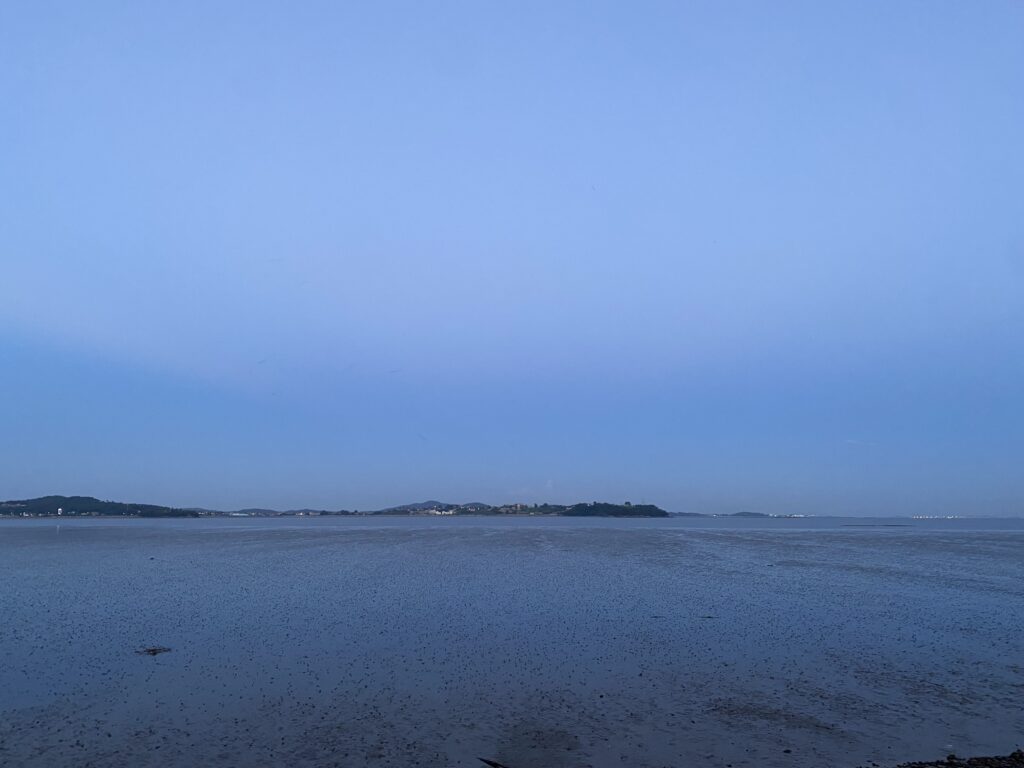
Tide timing is the single most important planning step here, and it cuts two ways:
- For the deck and the rocks: low tide (썰물) is the dramatic window, when the sea retreats and the tuff base and tidal flat are exposed. At high tide the deck is simply over open water.
- For driving to Jebudo: the sea-parting causeway is only passable during the posted low-tide window. Miss it and the road is underwater.
Check the crossing schedule before you go — Hwaseong City publishes a Jebudo passing-time table (hscity.go.kr), and posted windows can shift by roughly half an hour with the weather. The honest tip: plan the causeway for low tide, and keep the cable car as your tide-proof fallback. The ideal day is to arrive near low tide for the deck and the exposed rocks, cross or cable-car to Jebudo, and stay for the sunset.
Getting there
By car, Jeongok Port (Seosin-myeon, Hwaseong) is about 50–70 minutes from Seoul; the video markets it as “50 minutes from Seoul,” which is realistic from the southern and western edges of the city outside heavy traffic. The marina has ample parking and, thanks to the Tando seawall that created its sheltered bay, operates 24 hours regardless of the tide. Park once and you can combine the deck, the cable car, and Jebudo from the same lot. Public transit is weaker — there’s no rail to Jeongok, so the usual approach is a bus toward the Seosin/Sagang area and then a local bus or taxi. A car or an organized tour is far easier.
One West Sea food note
This stretch of coast is shellfish-and-crab country. Around Jeongok Port and Jebudo you’ll find bajirak-kalguksu (clam knife-cut noodle soup), blue crab (꽃게, as soy-marinated gejang or in a spicy stew), raw fish, and — the natural companion to a West Sea trek — jogae-gui, grilled shellfish cooked over charcoal at your table. It’s the same West-coast dish you’d eat down at Daecheon; if you want to know how to order and eat it like a local, see our jogae-gui guide.
Brand-new, flat, and quick to reach, the Jeongok walkway is the rare West Sea outing that asks almost nothing of your legs and a lot of your timing. Check the tide table, arrive near low water, and let the deck, the cable car, and the sunset do the rest.
Where to eat near Jeongok Port and Jebudo (Hwaseong)
Hwaseong’s West Sea coast is clam-and-shellfish country. Around Jeongok Port, Gungpyeong Port, and the tidal road to Jebudo, the local specialties are baby-clam knife-cut noodle soup (바지락칼국수), grilled shellfish (조개구이), wild sashimi, and, in autumn, salt-grilled king prawns (대하). These are a few representative spots locals and bloggers point to.
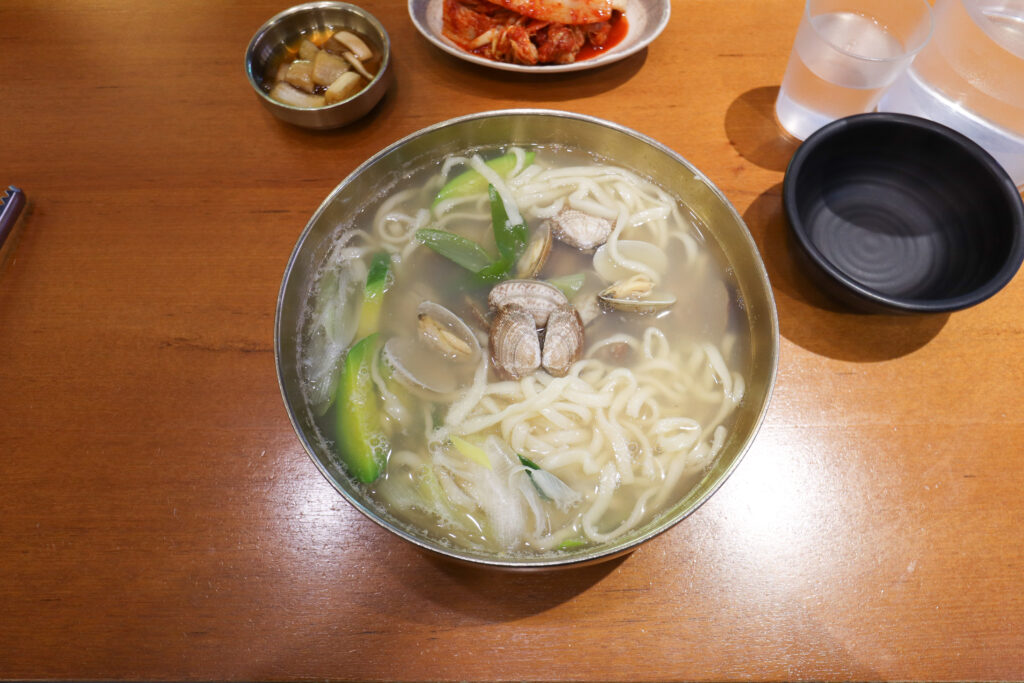
- 전곡어촌푸드 (Jeongok Eochon Food) — Jeongok Port. The dish to order is the 바지락칼국수 (bajirak kalguksu), a clam knife-cut noodle soup known here for unusually large, plump clams and big portions; grilled shellfish is the natural add-on. A solid, no-frills first stop right by the harbor.
- 등대횟집 (Deungdae Hoetjip) — Jeongok Port. A long-recommended raw-fish house where the draw is thick-cut 자연산 회 (wild sashimi) finished with a칼칼한 매운탕 (maeuntang, spicy fish stew); expect harbor prices, but reviewers say the freshness and cut sizes earn it.
- 새우파는남자 (Saeu Paneun Namja) — Gungpyeong Port, a short drive south. Best in autumn for 왕새우 소금구이 (salt-grilled king prawns / 대하), a frequently name-checked prawn spot with fresh shrimp and roomy parking.
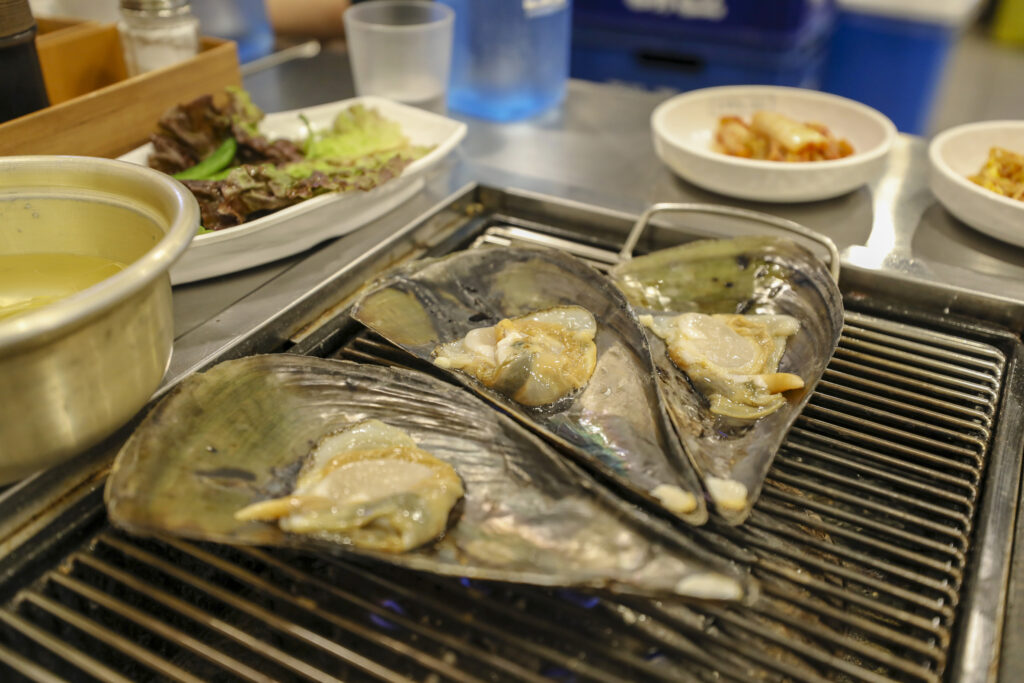
A quick caveat: these are small, family-run coastal eateries, so menus, prices, and especially opening hours and closing days change with the season and the catch. Please verify hours and whether they’re open before you make the trip.
Leave a Reply