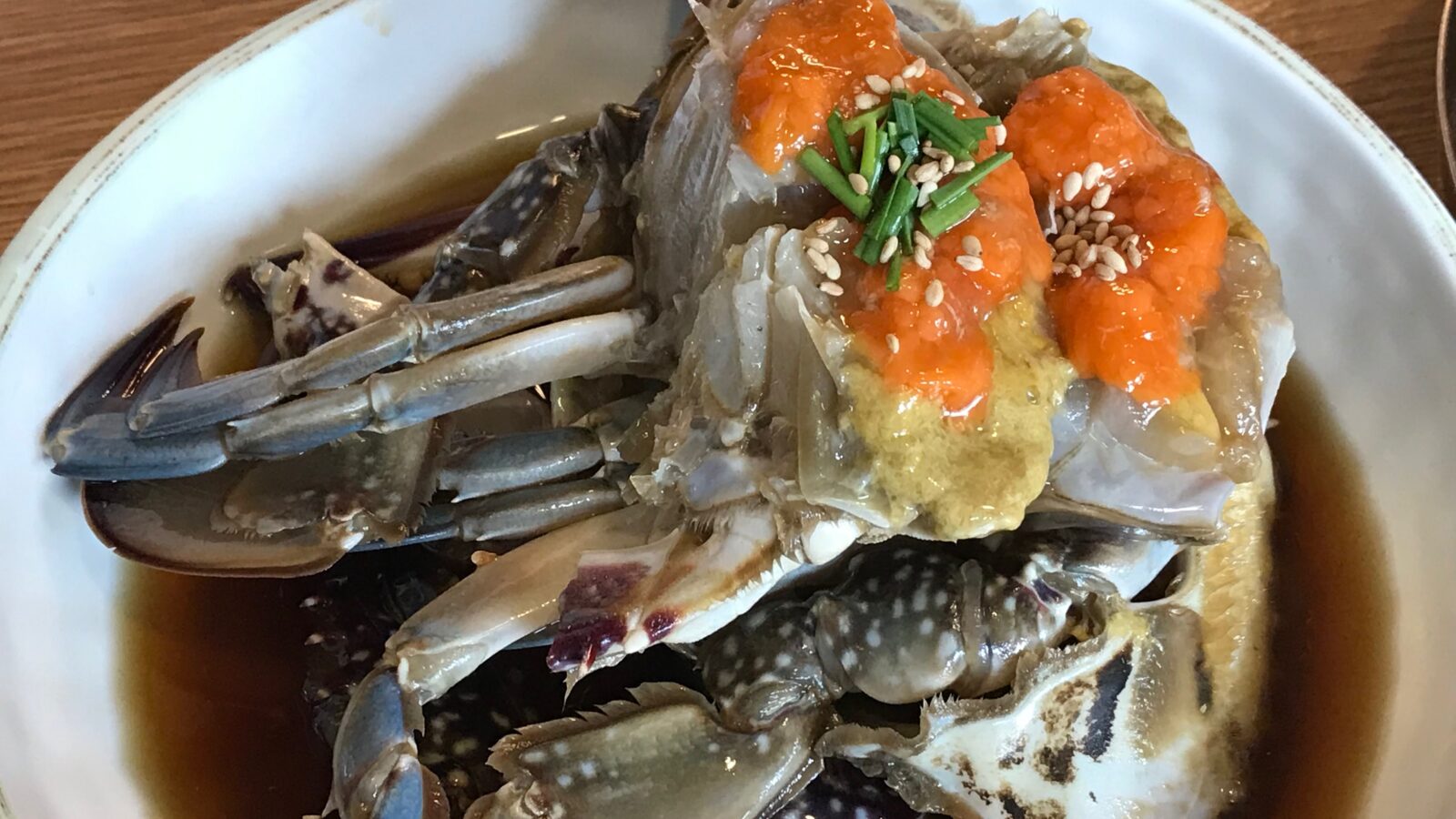
Koreans have a word for a dish so good it makes the rice vanish from your bowl: 밥도둑 (bap-doduk), literally “rice thief.” Ganjang-gejang (간장게장) is the original one. It’s raw crab cured in a cooled, soy-sauce brine until the salty, briny, deeply savory meat and the rich orange roe practically demand a second bowl of rice. The crab is never cooked — you eat the cold, glossy, slippery flesh straight from the shell, and the prized roe inside the top shell gets mixed with hot rice and eaten right out of it. It’s one of the defining dishes of Korea’s West Sea coast, and once you understand it, it’s hard to forget.
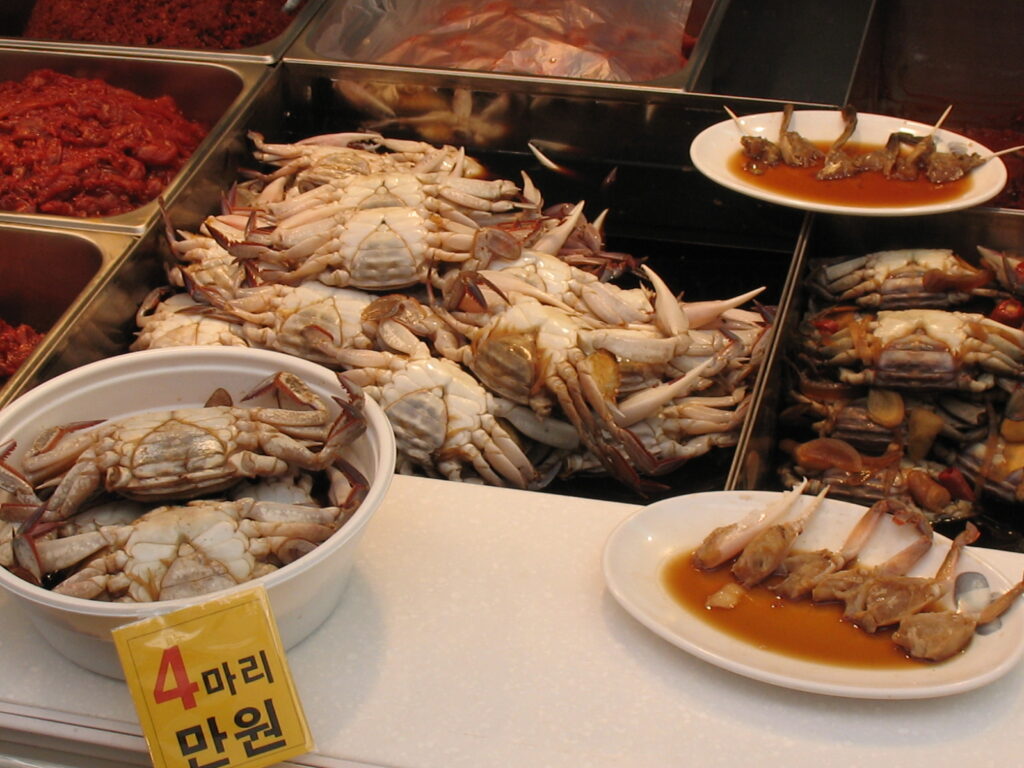
What it is — and how it differs from yangnyeom-gejang
Whole fresh crab is cleaned, submerged in a cold soy brine spiced with aromatics, and refrigerated so the soy slowly penetrates the still-raw flesh. The two crabs of choice are 꽃게 (kkotge, the blue swimming crab — sweet, meaty, the most common) and 참게 (chamge, a freshwater mitten crab — traditional and intensely savory).
Its spicy sister is 양념게장 (yangnyeom-gejang). “양념” means “seasoning,” so instead of a clear soy brine it uses a thick red paste of gochugaru (chili powder), garlic, ginger, onion, ground pear, sesame seeds and sesame oil (often gochujang too). The differences matter: ganjang-gejang is dark, salty-savory, and lets the crab’s natural sweetness come through; yangnyeom-gejang is sweet-spicy and bold. Ganjang-gejang marinates the whole crab submerged in liquid and cures over days; yangnyeom-gejang has the crab cut into pieces and tossed in paste, eaten soon after mixing. Both are rice thieves — yangnyeom is the newer of the two, rooted in the spicy-condiment traditions of Chungcheong and Jeolla.
The brine and aromatics
The base is soy sauce and water at roughly 1:2 to 1:3 (a common ratio is about 2 cups soy sauce to 6 cups water), plus a splash of rice wine or mirin and a little sugar or rice syrup to round off the salt. Into that go the aromatics: a square of dried kelp (다시마, dasima — pull it out after about 10 minutes so it doesn’t turn slimy), ginger, garlic, sliced onion, a few whole dried red chilies (for fragrance, not heat), black peppercorns, a bay leaf, and a slice of apple or Korean pear (배) for natural sweetness.
Ingredients
- 4–6 small fresh live blue crabs (꽃게), or properly frozen crab
- 2 cups soy sauce
- 6 cups water
- 1/4 cup rice wine or mirin
- 2–3 tablespoons sugar or rice syrup (조청/물엿)
- 1 square dried kelp (다시마), about 5 x 5 cm
- 1 thumb fresh ginger, sliced
- 1 head garlic, halved
- 1 onion, sliced
- 3–4 whole dried red chilies
- 1 teaspoon black peppercorns
- 1–2 bay leaves
- A few slices of apple or Korean pear (배)
How to make it
- Put the live crabs in the freezer for 1–2 hours to sedate them. Then scrub them clean under cold running water, remove the apron and gills (아가미), and drain well.
- Combine the soy sauce, water, rice wine, sugar and all the aromatics (add the kelp last). Bring to a boil and simmer about 20 minutes to deepen the flavor — pull the kelp after the first 10 minutes.
- Strain out all the aromatics and cool the brine completely. This is non-negotiable: pouring hot brine on raw crab would part-cook it and ruin the texture.
- Pack the crabs belly-up (so the roe stays in) in an airtight container and pour the cold brine over to fully submerge them. Cover and refrigerate.
- After 1 day, drain the brine off, bring it back to a boil for 3–4 minutes, then cool it completely again and pour it back over the crabs. This re-boil/re-pour is the key traditional step — it deepens flavor and improves keeping. Some cooks repeat it once more.
- Marinate in the fridge. It’s ready after 2–3 days and best within 3–4 days; longer makes it too salty and the meat starts to break down.
An honest note on raw-crab safety
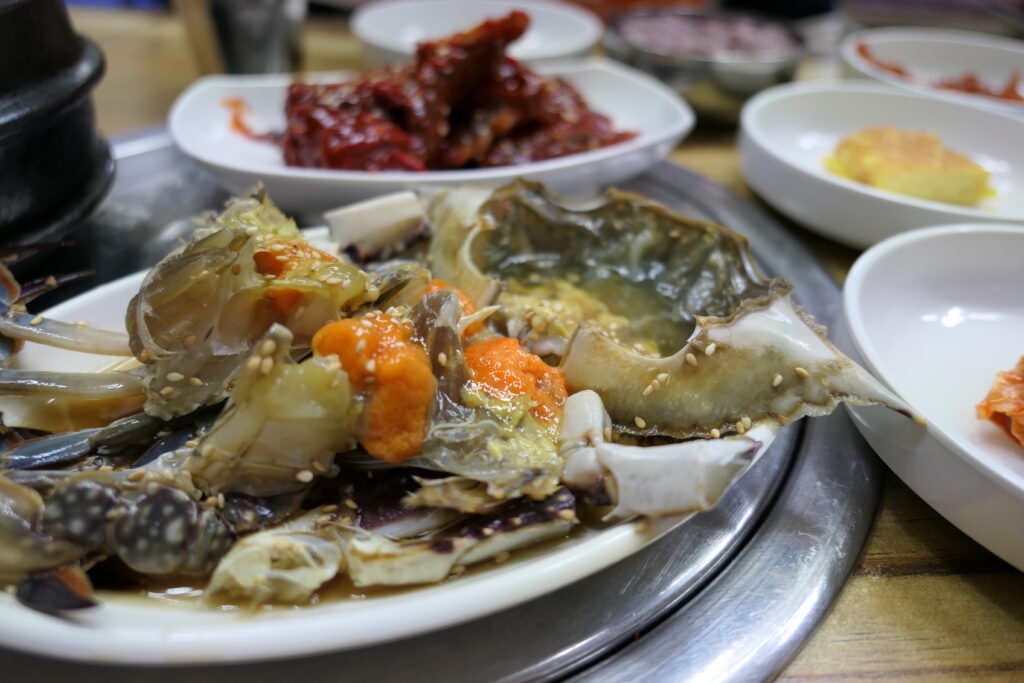
Let’s be straight: this is raw seafood, and there’s real risk if it’s handled carelessly. Use only very fresh, live crabs or properly frozen crab — never one that died unknown. Freezing helps twice over: it sedates the crab and helps reduce parasite risk. Clean obsessively under cold running water and remove the gills and apron, where bacteria and grit concentrate. The real danger in warm months is Vibrio (비브리오) and other food-poisoning bacteria, which multiply explosively at room temperature — Korean food-safety reporting notes bacteria in gejang can roughly double in about 2 hours and grow about tenfold in 6 hours at 20°C. So keep it cold at every stage: chill the brine, refrigerate the crabs the whole time, and serve straight from the fridge. The boil-cool-re-pour ritual was historically treated as a sterilizing step, but modern guidance stresses that fresh crab, thorough washing, gill removal, and constant refrigeration matter more. Eat it within a few days. If you are pregnant, immunocompromised, elderly, or very young, it’s safest to skip raw gejang. (Folk warning, for fun: tradition says not to eat gejang with persimmon (감) — more superstition than science, but it’s part of the lore.)
How to eat it
This is the original rice thief, so eat it like one. Pull a leg or claw and suck and pick out the cold, soy-soaked meat. Then comes the grand finale: the top shell (등딱지), full of orange roe (알) and creamy innards (내장). Scoop a spoonful of hot white rice right into the shell, mix it with the roe and a little of the soy brine, and eat it straight from the shell — salty, rich, ocean-savory rice that disappears in seconds. Drizzle a little of the dark marinade over plain rice too, but go easy; it’s intense. Eat it cold, slowly, with rice and a few side dishes. A little goes a long way.
꽃게 season — when crab is at its best
Ganjang-gejang lives and dies by the crab. Blue crab seasons split by sex, and there’s a saying for it: “봄 암꽃게, 가을 수꽃게” (spring female, autumn male). Spring (roughly April–June, peaking in May) is for 암꽃게 (female), packed with the prized orange roe just before spawning — the very best time for ganjang-gejang, because the roe is the whole point. Autumn (roughly September–November) is for 수꽃게 (male), when they fatten up with firm, sweet, protein-rich meat. For roe-lovers, spring female crab is the classic pick. (Mitten crab, 참게, is traditionally an autumn crab.)
Where to eat it on the coast
Korea’s West Sea (Yellow Sea) is crab country — the same waters that produce the 꽃게 these dishes are built on. If you’re touring the West-coast region around Jeongok Port (전곡항), ganjang-gejang belongs on your “what to eat near the West Sea” list, right alongside our guide to jogae-gui (조개구이), the charcoal-grilled shellfish that’s the other great West-coast seafood meal. Plan a trip around spring crab and you’ll understand exactly why Koreans call it the rice thief.
Where to eat ganjang-gejang in Seoul
Ganjang-gejang (간장게장), raw blue crab marinated in soy sauce, is famously called the “rice thief” (밥도둑) because the briny, roe-rich crab makes you eat bowl after bowl of rice. Seoul has both decades-old institutions and refined modern takes. Here are three reliable places, from the original alley anchor to a Michelin-listed family noseup.
- 프로간장게장 (Pro Ganjang Gejang, 신사본점 / Sinsa main branch) — Jamwon-dong, Seocho-gu, about a 3-minute walk from Sinsa Station (Line 3, Exit 4) in Gangnam. Open since 1980 and widely credited with creating Sinsa-dong’s “gejang alley,” this is the most name-recognized soy-crab house in Seoul, its walls plastered with K-star and athlete autographs. Order the 간장게장 (soy-marinated raw crab) and don’t skip the 게딱지 비빔밥 — rice mixed in the roe-filled crab shell. It is the easy default for first-time visitors, but it is touristy and not cheap (two female crabs run roughly 92,000–114,000 KRW).
- 진미식당 (Jinmi Sikdang) — Gongdeok-dong, Mapo-gu, near Aeogae Station (about a 3–5 minute walk). A mother-and-daughter old-school noseup (노포) repeatedly called Seoul’s benchmark gejang house, selected in the MICHELIN Guide for several years running. There’s no menu board: you order the single fixed 게장정식 / 간장게장 set by headcount (around 45,000 KRW per person), built on female roe crab — one crab per person. The catch is access: it’s phone-only reservation, books out 2–3 weeks ahead, and is closed Sundays, so plan early.
- 큰기와집 (Keun Giwa Jip) — Jaedong, Bukchon, Jongno-gu, about a 5-minute walk from Anguk Station (Exit 2), near Gyeongbokgung. A 40-plus-year hanjeongsik house recognized in the MICHELIN Guide, celebrated for deep, clean house-brewed Joseon ganjang and oversized, roe-packed crab. The 게장정식 (around 59,000 KRW) is the upscale, traditional pick for sightseers already touring the palaces; it’s also known for 갈비찜.
A few honest notes: ganjang-gejang is generally pricey (sets often run 45,000–100,000+ KRW per person), and these popular spots draw queues — Jinmi Sikdang in particular requires a phone reservation well in advance. Hours and closing days change, so always verify before you go, and check whether the crab is female roe crab (암꽃게/알배기) if the roe is what you’re after.


Leave a Reply