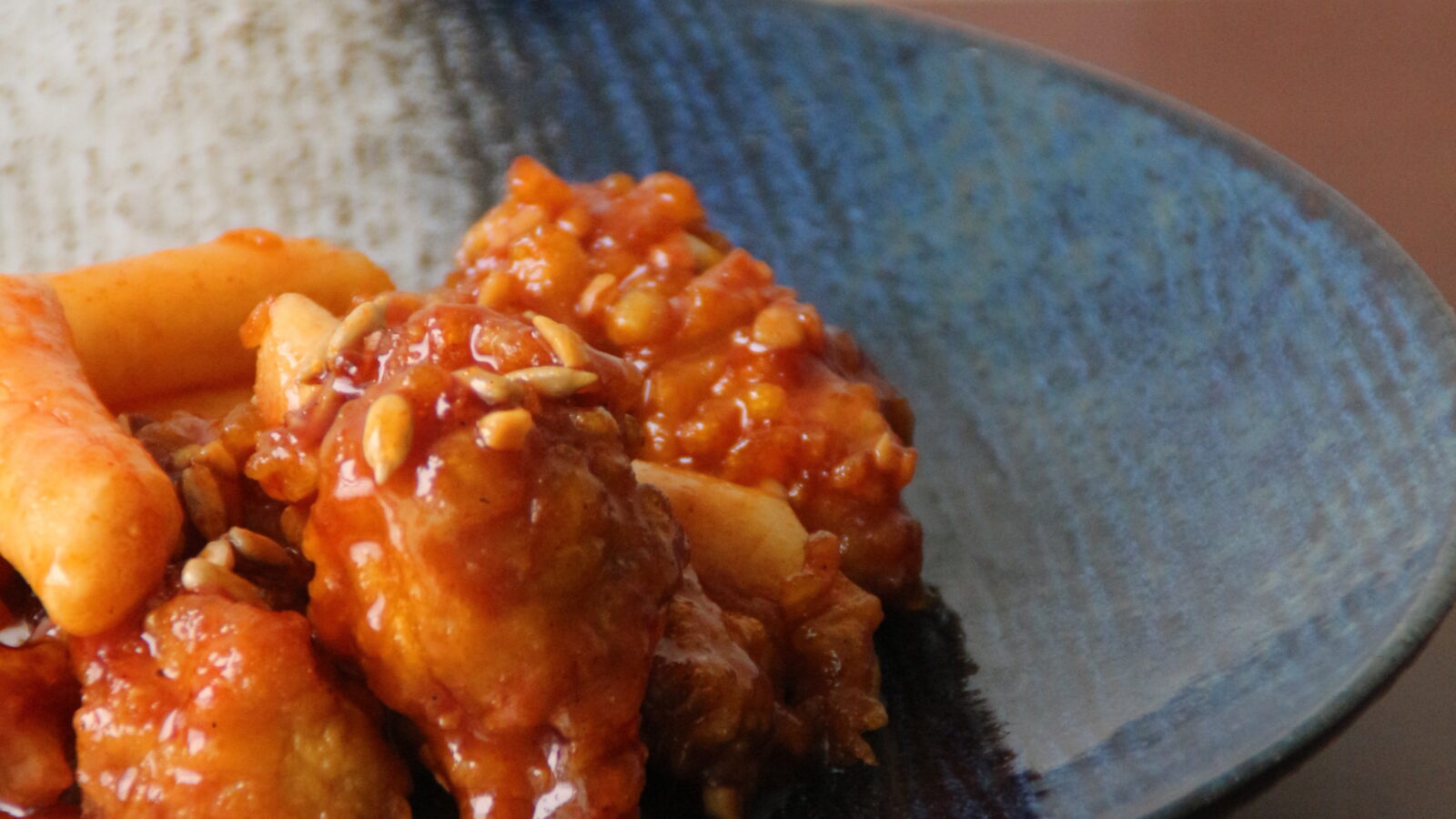
If you have ever stood in a Korean market clutching a paper cup of glistening fried chicken that somehow stayed crunchy the whole walk home, that was 닭강정 (dakgangjeong). It is sweet, savory, garlicky, bite-size chicken that is fried twice until the crust crackles, then tossed in a sticky, glossy glaze and showered with crushed peanuts and sesame seeds. The magic trick is that it does not go soggy. While most saucy fried chicken softens within minutes, dakgangjeong holds its crunch for hours, which is exactly why market shops can ship it across the whole country.
The name tells the story. 강정 is a traditional Korean confection: fried rice-flour crackers coated in syrup and rolled in a topping (고물) of nuts or puffed grain. Treat chicken the same way — deep-fry it, then coat it in a syrupy sauce — and you get 닭 (chicken) + 강정. The defining difference from 양념치킨 (yangnyeom, “seasoned” chicken) comes down to one ingredient: 물엿, Korean corn/starch syrup. Dakgangjeong leans heavier on syrup and sugar, so the glaze dries into a thin, candy-like shell that seals the crust and keeps moisture out. Cooks even sum it up as: less syrup makes yangnyeom sauce, more syrup makes dakgangjeong sauce.
Its most famous home is 속초 중앙시장 (Sokcho’s central market), where shops like 만석닭강정 (sweeter) and 중앙닭강정 (more spicy options) draw visitors from across Korea and deliver nationwide. 인천 신포시장 is famous too, known for a bone-in style rather than the boneless 순살 version most people make at home. The recipe below is that everyday boneless version. It serves two to three as a snack.
Ingredients
- Chicken: 1 lb (about 450 g) boneless, skinless chicken thigh (or breast), cut into bite-size pieces
- Optional soak: 1/2 cup milk (to soak 30 minutes — tenderizes and mutes any gaminess)
- Seasoning: 1/4 tsp salt, a pinch of pepper, 1/2 tsp minced garlic, 1/2 tsp minced ginger (add 1 Tbsp rice wine if you skip the milk)
- Coating: about 1/3 cup potato starch or cornstarch — starch, NOT wheat flour; this is what stays crispy
- Oil: neutral oil for deep-frying (about 1 inch in a deep narrow pot, or 2-3 inches for full deep-frying)
Glaze (the 물엿-forward sauce):
- 3 Tbsp 물엿 / corn syrup (or rice syrup, oligo syrup, or honey)
- 2 Tbsp brown sugar
- 1 Tbsp soy sauce
- 2 Tbsp vinegar (rice or apple cider)
- 1 Tbsp gochujang (optional, for mild heat)
- 1 tsp minced garlic and 1 tsp grated ginger
- 2 tsp sesame oil
- 3 Tbsp cooking rice wine, plus a pinch of pepper
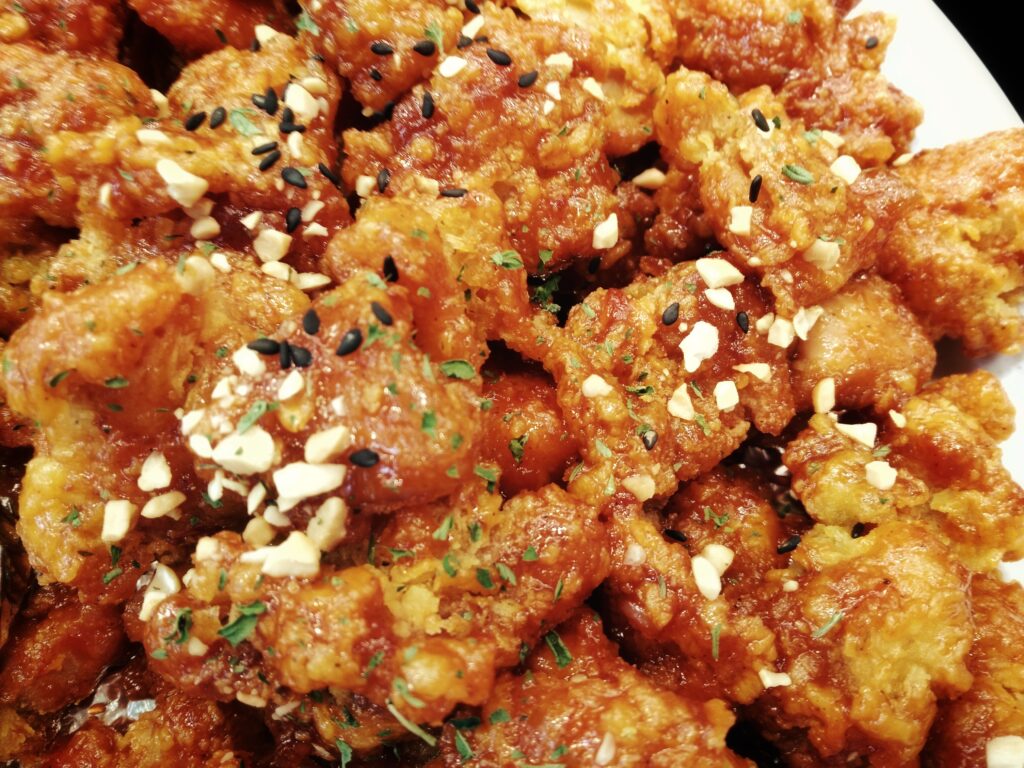
Garnish: 1-2 Tbsp crushed peanuts and/or toasted sesame seeds
How to Make It
- Prep the chicken. Trim and cut into bite-size pieces. Optionally soak in milk for 30 minutes, then drain well. Season with the salt, pepper, garlic, and ginger and rest 20-30 minutes. Pat the pieces dry so the coating clings.
- Make the glaze first. Combine all the sauce ingredients in a pan, bring to a boil, then simmer over medium-low for 3-4 minutes until slightly thickened and glossy. Turn off the heat. The high syrup ratio is what lets it later set into that crunch-preserving shell.
- Coat. Dredge each piece thoroughly in potato starch and shake off the excess.
- First fry — cook through. Heat the oil to about 330°F / 165°C. Add the pieces one at a time, in batches, so the oil does not crowd or cool. Fry until light golden and cooked through, about 3 minutes. (A hotter approach runs 340-350°F / 170-175°C for 4-6 minutes.) Drain on a wire rack.
- Rest a few minutes so surface moisture escapes. This is key to the crunch.
- Second fry — crisp. Reheat the oil to 330°F (350°F for the hotter method) and fry again for 1-2 minutes (3-4 minutes if hotter), until deep golden and very crunchy. Drain. Double-frying is the non-negotiable step for the signature crackly crust.
- Glaze and toss. Gently rewarm the glaze, add the hot chicken, and toss quickly over medium-low just until every piece is shiny and coated. Do not simmer the chicken in the sauce — coat it and pull it off the heat so the crust stays crisp.
- Finish. Transfer to a plate and scatter on crushed peanuts and sesame seeds. (For extra nuttiness, dip the peanuts in the hot oil for about 10 seconds to toast them first.) Serve right away — it also holds its crunch as it cools.
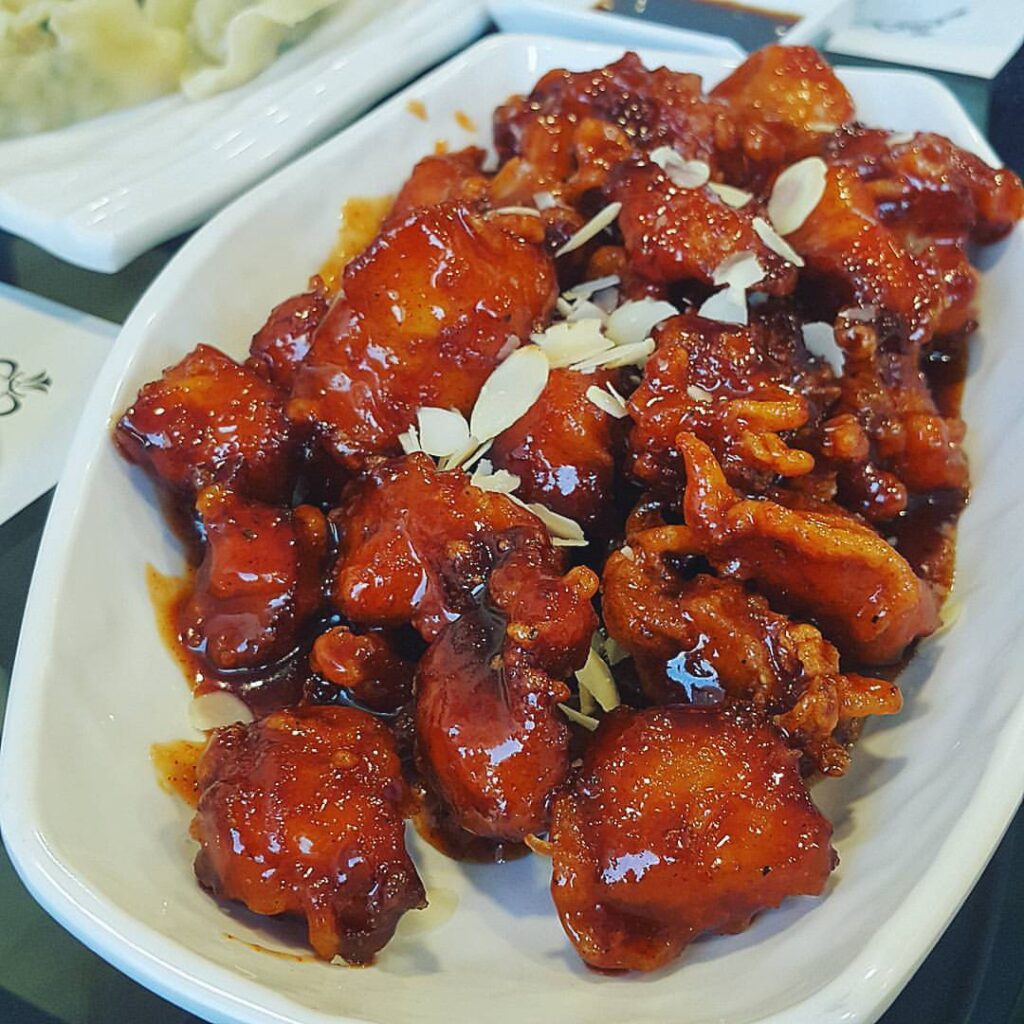
The three things that keep dakgangjeong crunchy: a starch coating instead of wheat flour; double-frying to drive out moisture; and a glaze high in 물엿 and sugar that dries to a thin candy shell. Toss and coat — never braise.
Variations
For a mild, sweet version, skip the gochujang and lean on syrup, soy, garlic, and sesame; a little ketchup gives a kid-friendly tang. For a spicy version, add gochugaru (chili flakes) and even dried red chilies fried in the oil, or candy thin ginger slices right into the sauce. The boneless 순살 form is standard, but 뼈 닭강정 (bone-in) is a regional favorite, notably at 인천 신포시장. Markets also toss fried 가래떡 (rice cake sticks) or fries in the same glaze, and the identical fry-then-glaze method makes a great vegetarian 두부강정 (sweet-crunchy tofu).
How to Eat It
Eat it hot and fresh for peak crunch — but its whole point is that it stays crisp as it cools, so it travels beautifully. This is finger food, not a main: serve it as 안주 (a drinking snack — fried chicken plus beer is the beloved combo 치맥), as party or potluck food, or as a market grab-and-go. Eat boneless pieces by hand or with toothpicks; bone-in by hand. Keep something fizzy nearby since the glaze is sweet and sticky, and a few cubes of pickled radish (치킨무) cut the richness. If it ever softens, a few minutes in an air fryer or oven re-crisps it.
Craving more crispy Korean cooking? Try Jeon, Korea’s family of crackly savory pancakes — another dish that lives or dies on its texture. And for a cozy one-pot night, Kimchi-jjigae rounds out a homemade Korean spread.


Leave a Reply