Jeju cuisine was born of hard ground. On a volcanic island where thin, nutrient-poor soil meant rice barely grew, islanders learned to take what the sea and the pig could give. Two forces shape almost every dish on the Jeju table: the haenyeo (해녀), the women free-divers recognized as a UNESCO Intangible Cultural Heritage, who harvest abalone, sea urchin, and sea snails by hand; and the household pig, which gave the island its prized black pork and the bone broths at the heart of its comfort food. The result is a frugal, sea-forward, ingredient-honest cuisine that tastes distinctly of the island and nothing like the mainland.
This is a guide rather than a single recipe — a map of the dishes you’ll meet on Jeju, and why each one exists.
From the sea and the haenyeo
Cutlassfish is the island’s signature catch. Galchi-jorim (갈치조림) braises it with radish in a spicy-savory sauce, while galchi-gui (갈치구이) is simply salt-grilled. Locals prize Jeju’s eun-galchi (은갈치), the silver hairtail, as fattier and more tender, with the best fish landing roughly September through October.
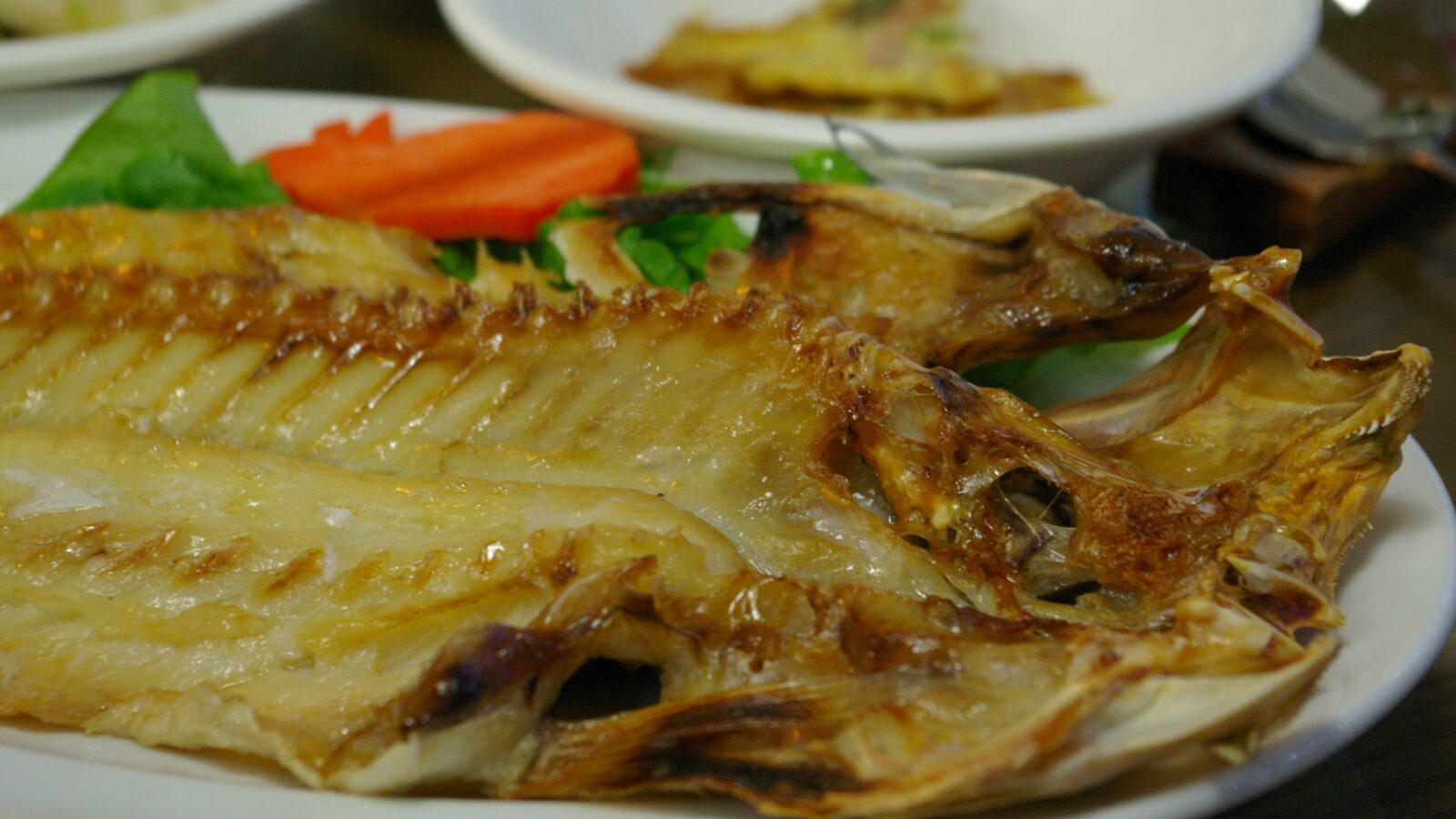
Okdom (옥돔), the Jeju red tilefish, is a delicate white fish found mainly in the island’s waters. Usually salt-dried and then grilled or simmered, it carries a clean, gentle flavor that has long marked it as a special-occasion fish.
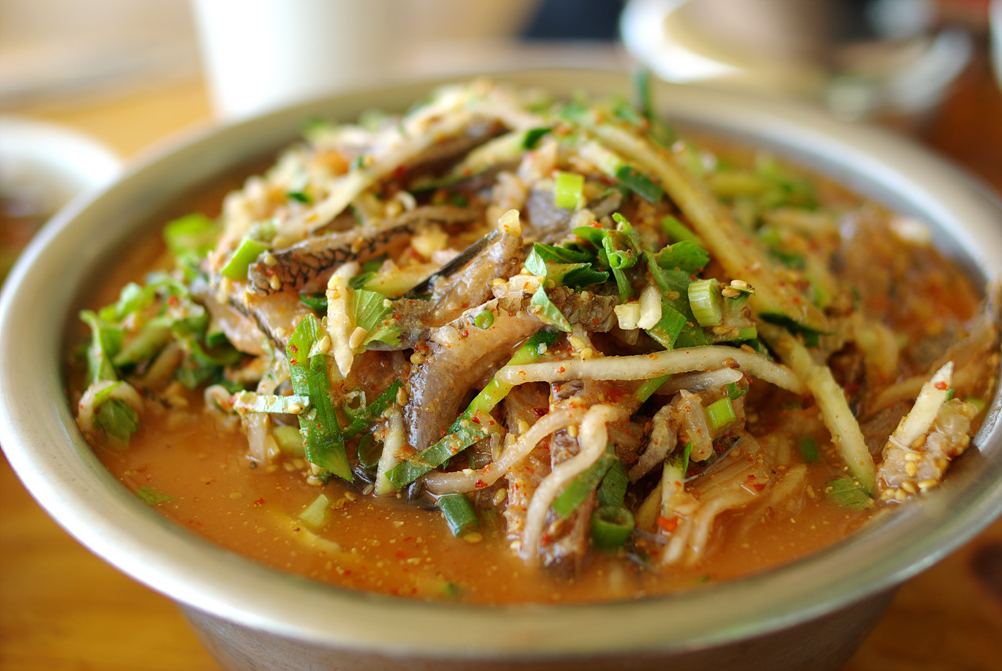
Jari-mulhoe (자리물회) is summer in a bowl: a chilled raw-fish soup made from jaridom (자리돔), a small reef damselfish caught May through August and eaten most around June into mid-July. Traditionally it’s dressed with soybean paste (토장) and vinegar, though many modern versions add gochujang for heat.
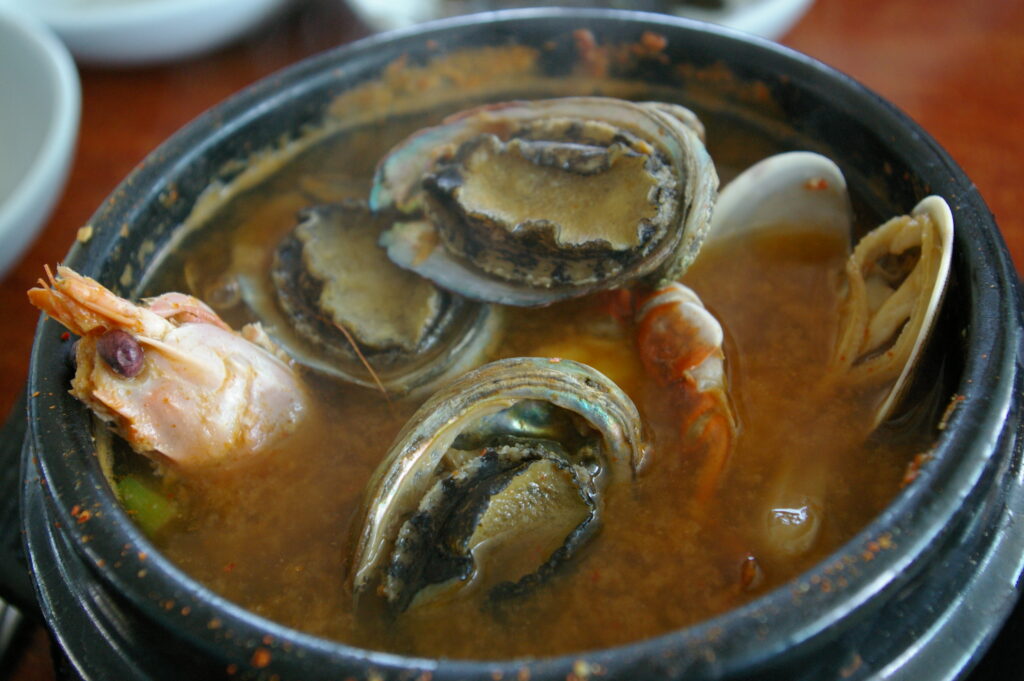
Seonggae-guk (성게국), also called gusal-guk (구살국), simmers sea urchin roe with brown seaweed (미역) into a rich, briny broth. Because urchin can’t be farmed and must be hand-harvested by haenyeo, this soup was historically reserved for honored guests. Wild abalone appears as jeonbok-juk (전복죽) porridge or jeonbok-sotbap (전복솥밥), and top-shell sea snails — bomal (보말) — turn up in bomal-juk (보말죽) porridge or quick stir-fries.
From the pig and the land
The island’s celebrated native breed gives heuk-dwaeji (흑돼지), Jeju black pork, famous for its chewy, deeply flavorful meat. It’s eaten grilled or as dombe-gogi (돔베고기) — sliced boiled pork served straight on a cutting board (dombe is the Jeju dialect word for cutting board).
The pig’s bones do quiet, essential work too. Gogi-guksu (고기국수) sets wheat noodles in a milky pork-bone broth topped with boiled pork (수육), and it has become Jeju’s signature comfort bowl. Mom-guk (몸국) thickens that same pork-bone broth with mom (모자반), a gulfweed seaweed, plus a little buckwheat or rice flour. It began as a warming, restorative dish for haenyeo and as a communal soup cooked when a pig was slaughtered for a village feast (잔치) — nothing wasted, everything shared.
The poor volcanic soil did grow buckwheat, which became bing-tteok (빙떡): a thin, mild buckwheat crepe rolled around seasoned shredded white radish. Humble and lightly sweet-savory, it’s the kind of everyday snack that captures the whole ethos of Jeju cooking — thrift turned into something quietly good.
A taste of the world on screen
If you want to feel the world these dishes come from, watch the 2025 Netflix hit When Life Gives You Tangerines (폭싹 속았수다) alongside this guide. Set on Jeju from the 1950s onward, the multi-decade saga — with IU and Park Bo-gum as the young Ae-sun and Gwan-sik, and Moon So-ri and Park Hae-joon as their older selves — follows a heroine who grows up in a haenyeo household. The sea-diving livelihood and the home-cooked island table (the day’s catch, the bone broths, the frugal village-feast cooking) are woven through the family’s hardships and small joys rather than sitting in the background. Even the global title nods to Jeju’s tangerines, and the Jeju-dialect phrase 폭싹 속았수다 means roughly “thank you for your hard work.”
For a fuller look at the series, see koroute’s feature on When Life Gives You Tangerines — and let this food guide be your companion to the island it portrays.


Leave a Reply