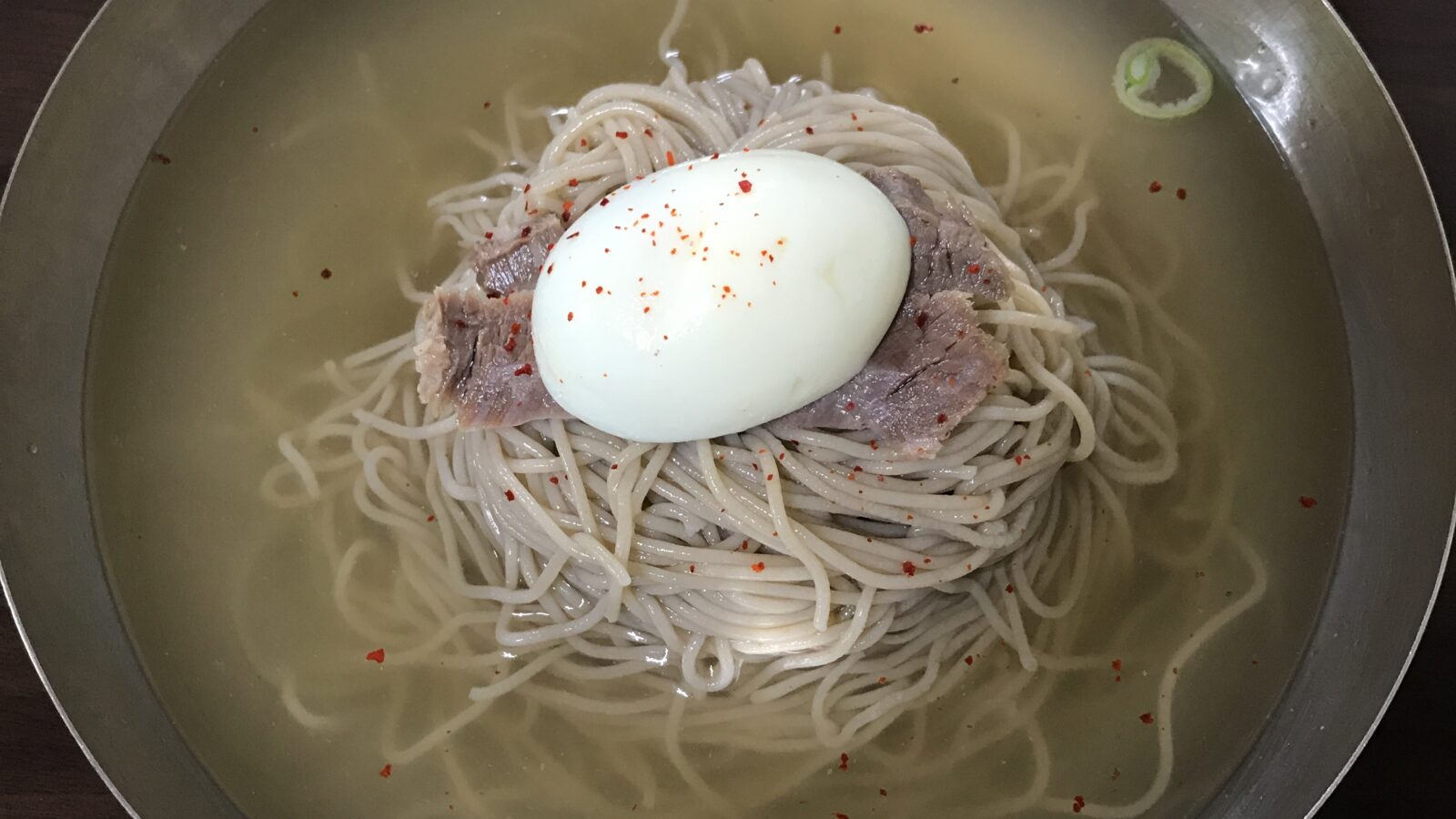
On a brutal Korean summer afternoon, nothing resets you like a bowl of naengmyeon (냉면). Thin, springy, almost defiantly chewy noodles sit in a chilled bowl under a slick of icy broth so cold it has gone slushy at the edges. You taste the savory beef base first, then reach for the vinegar and a small dab of hot mustard, snip the noodles with scissors, and the whole thing turns sharp, clean, and bracing. It is the dish that finishes a Korean barbecue and the one that gets you through August.
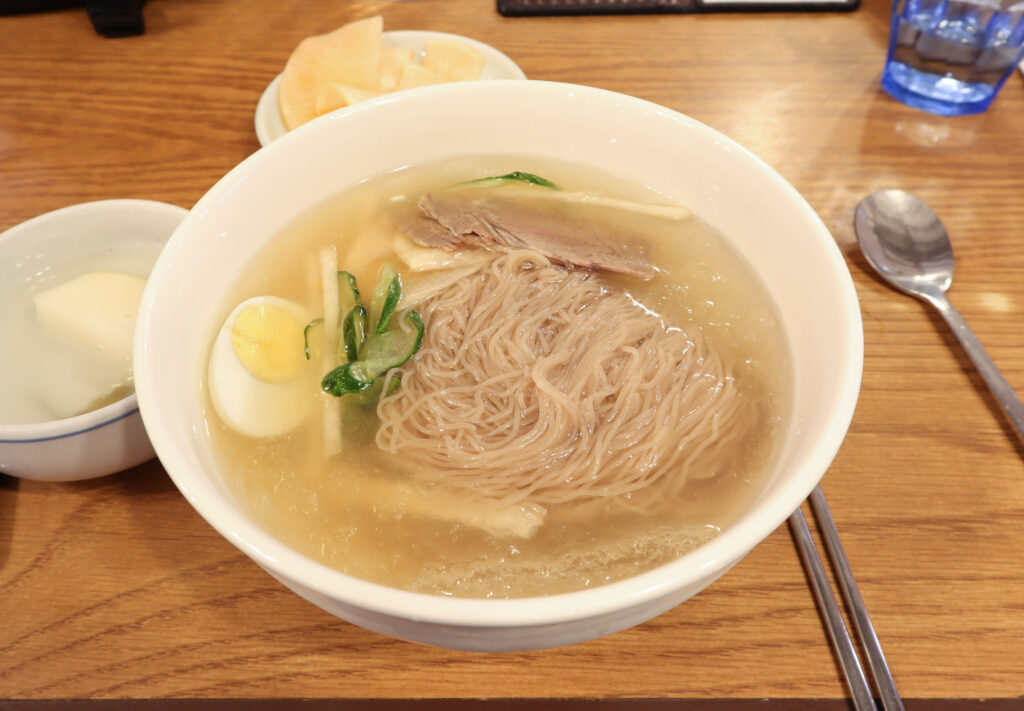
The name simply means “cold noodles,” and there are two great families. Mul-naengmyeon (물냉면) is the soup version: noodles in a chilled, tangy beef-and-dongchimi broth. Bibim-naengmyeon (비빔냉면) skips the broth entirely and tosses the same noodles in a glossy sweet-spicy sauce. The noodles themselves are a blend of buckwheat (memil) and potato or sweet-potato starch, which is what gives them that signature snap. This recipe builds a proper mul-naengmyeon for two, with the bibim version one paragraph away.
One honest note before you start: naengmyeon was historically a winter dish in the north, eaten with icy dongchimi brine straight from the cold cellar. It only became Korea’s summer staple later. Make the broth a day ahead if you can. It needs time to chill, and the flavor settles overnight.
Ingredients
For the broth (yuksu, makes about 10 cups):
- 1/2 lb (about 225 g) beef brisket (yangji)
- 14 cups water
- 6 oz Korean radish, in chunks
- 1/2 onion
- 6 garlic cloves
- 3 slices fresh ginger
- 2 scallion whites
- 1/2 tsp whole black peppercorns
- 2 Tbsp soup soy sauce (gukganjang)
- 1 tsp sugar
- To season per serving: salt, a little sugar, and vinegar to taste; optional pear juice and a pinch of mustard powder; dongchimi brine if you have it
For the pickled radish (mujeorim):
- 1 lb Korean radish, thinly sliced
- 3 Tbsp vinegar
- 2 Tbsp sugar
- 1 tsp salt
Noodles and toppings (2 servings):
- 2 portions dried naengmyeon noodles (buckwheat and starch blend)
- 1/2 cucumber, thinly sliced
- A few thin slices of Korean pear (bae)
- The boiled brisket from the broth, sliced thin for pyeonyuk
- 1 boiled egg, halved
- To serve: vinegar, hot Korean mustard (gyeoja), and kitchen scissors
How to make it, step by step
- Make the broth ahead. Put the brisket in a pot with 14 cups water, the radish, onion, garlic, ginger, scallion whites, and peppercorns. Bring to a boil uncovered and skim off the scum that rises.
- Cover and simmer gently for about an hour, until the beef is tender. In the last 10 minutes, stir in the soup soy sauce and 1 tsp sugar.
- Remove the beef and set it aside for the pyeonyuk topping. Strain the broth, then chill it completely and skim off the solidified fat from the top.
- Season the cold broth. For roughly 2.5 cups per serving, balance with salt, a little sugar, and vinegar until it tastes savory and brightly tangy. For Pyongyang-style depth, blend in dongchimi brine; a splash of pear juice and a pinch of mustard powder round it out.
- Freeze the seasoned broth for 1 to 2 hours, until icy and slushy with ice crystals forming at the edges. This is the whole point. The broth should be painfully cold.
- Make the pickled radish. Toss the sliced radish with the vinegar, sugar, and salt and let it sit until the slices turn translucent and bendy.
- Prep the toppings. Lightly salt the cucumber and let it wilt, then pat dry. Slice the reserved brisket thin against the grain. Cut thin slices of pear. Halve the boiled egg.
- Cook the noodles. Boil them just 2 to 4 minutes, per the package. Drain and immediately plunge into ice water, rinsing hard to wash off surface starch until the noodles are squeaky and very cold. Drain well and coil each portion into a neat nest.
- Assemble. Set a noodle nest into a chilled bowl. Arrange the pickled radish, pyeonyuk, cucumber, pear, and egg on top, then pour the icy, slushy broth around the noodles. Serve at once with vinegar, mustard, and scissors on the table.
The variations worth knowing
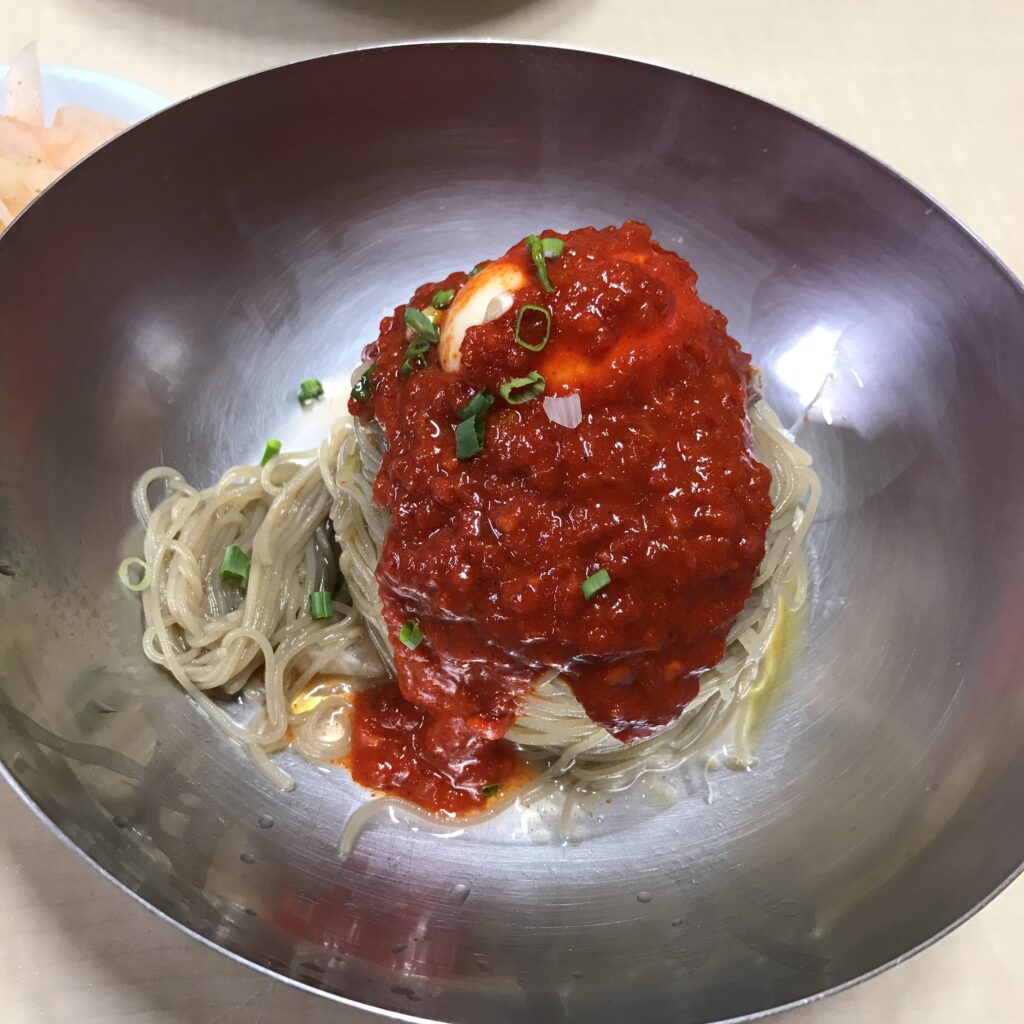
Bibim-naengmyeon uses the same chilled noodles but no broth. Whisk a sauce of 4 Tbsp gochugaru, 4 Tbsp broth or water, 3 Tbsp grated pear or apple, 2 Tbsp sugar, 1 Tbsp corn syrup, 2 tsp minced garlic, 1 Tbsp soy sauce, 1 tsp salt, and a drizzle of sesame oil (many cooks add a spoon of gochujang too). Oil the drained noodles, add the same toppings plus a little ice, spoon the sauce over, and toss hard until every strand is coated.
Regional styles split along the noodle. Pyeongyang-naengmyeon (평양냉면) is the mul archetype: high-buckwheat noodles that are softer and break easily, in a clear, restrained beef broth meant to be tasted plain before you add anything. Hamheung-naengmyeon (함흥냉면) leans on potato and sweet-potato starch for noodles so chewy and elastic you genuinely need the scissors, and it is usually served spicy and mixed. Its signature is hoe-naengmyeon (회냉면): bibim-style chewy noodles crowned with marinated raw skate or ray (gaori-hoe) in a fiery gochujang sauce, a kind of spicy cold-noodle ceviche.
For a weeknight shortcut, frozen bottled yuksu broth packs with packaged noodles get you most of the way there; just boost with extra vinegar, mustard, and ice. Toppings flex too: dongchimi radish, toasted sesame seeds, or extra pear are all welcome.
How to eat it
Serve everything ice-cold, the broth slushy and the bowl chilled. Taste the plain broth first, especially with a Pyongyang-style bowl, so you appreciate the savory base before you change it. Then add vinegar for tang and a small dab of hot mustard, building up gradually rather than dumping it in. The noodles are long and tough, so snip them once or twice with the table scissors. For mul-naengmyeon, alternate bites of noodle with sips of the cold broth; for bibim-naengmyeon or hoe-naengmyeon, toss everything hard until every strand glistens before you take a bite. Work through the cucumber, pear, pickled radish, egg, and sliced beef as you go. The sweet pear and crunchy pickled radish are there to balance the heat and acidity. It is the quintessential hot-weather meal, and the classic way to end a Korean barbecue: after the rich char of grilled samgyeopsal, a cold bowl is the perfect, cleansing finish. The same Korean pear that tenderizes bulgogi shows up here as both a topping and the secret to that mellow, sweet bibim sauce.
Where to eat 평양냉면 (Pyongyang naengmyeon, cold noodles) in Seoul
Pyongyang-style naengmyeon is all about restraint: cold buckwheat noodles in a clear, gently savory broth (Koreans call the taste 슴슴한, subtle and clean) that grows on you sip by sip. Seoul’s old-guard houses are where to taste the real thing. Here are a few of the most reliable.
- 우래옥 (Woo Lae Oak) — Jugyo-dong, Jung-gu (downtown Seoul, near Euljiro); nearest station Euljiro 4(sa)-ga, Lines 2 & 5, Exit 4. The Pyongyang naengmyeon institution, running since 1946 and listed in the Michelin Guide Seoul. Its deeper, beefier broth makes it the easiest entry point if you’re new to the style — and the daily queues prove it.
- 을지면옥 (Eulji Myeonok) — Nagwon-dong, Jongno-gu (relocated from Euljiro in 2024); nearest station Jongno 3(sam)-ga, Lines 1, 3 & 5. A ‘big three’ name from the famed Uijeongbu lineage, prized for its clean, subtle broth. After its old Euljiro home was redeveloped, it reopened in 2024 in a Nagwon-dong building it now owns — same purist bowl, new address.
- 봉피양 (Bongpiyang) — Bangi-dong, Songpa-gu (southeastern Seoul); nearest station Bangi, Line 5, Exit 4, about 200m. The upscale, modern flagship of the Byeokje-galbi group and a repeat Michelin Bib Gourmand pick. Premium buckwheat noodles in a clear brisket broth, plus its own parking — the go-to if you’re south of the river or want a sit-down meal with grilled pork ribs alongside.
A note before you go: these are beloved노포 (old-timers) with limited hours and weekly closing days — Woo Lae Oak closes Mondays, and most close for an afternoon break — so verify the day’s hours and closing day before heading out. Popular spots routinely have lines, especially at lunch and on weekends, so arrive early or off-peak.


Leave a Reply