
Most hanok stays in Korea put you in a quiet old town or a mountain valley. Mangsang Beach Hanok Village (망상해변한옥마을, Mangsang Haebyeon Hanok Maeul) does something rarer: it sets a cluster of traditional timber hanok right on the white sand of an East Sea beach. Open your door in the morning and the first thing you see is the sun coming up over the water. And because the whole thing is run by the city rather than a luxury operator, the price stays surprisingly honest.
Here is the practical picture, kept straight: this is a public hanok lodging village inside the Mangsang Auto Camping Resort (망상오토캠핑리조트) in Mangsang-dong, Donghae, Gangwon State, operated by the Donghae City Facilities Management Corporation (동해시시설관리공단). It is comfortable and scenic, but it is not a five-star hotel, and the booking process reflects that.
The setting: beach in front, black-pine forest behind
The village fronts Mangsang Beach (망상해수욕장), a broad, nationally popular stretch of sand on the East Sea, making it one of the closest hanok stays to the ocean anywhere in Korea. Behind and around the units, a forest of black pine (해송) and dozens of other tree species wraps the grounds, so the view is forest meeting sea rather than parking lot meeting concrete.
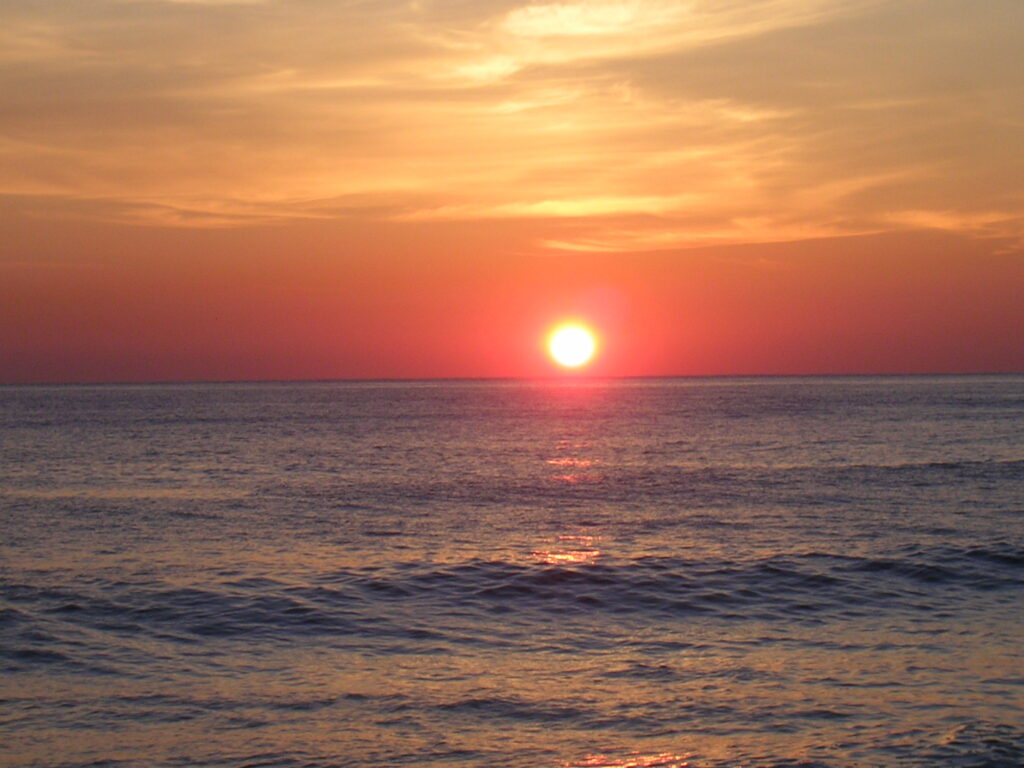
The buildings themselves are built in a traditional Korean timber structure with octagonal roofs (팔각지붕 한식목구조). Inside, parts of the rooms have been modernized for convenience, so each unit has its own bathroom and the practical fittings you would expect, while keeping the hanok feel. The headline draw is simple and real: sunrise. You can catch the East Sea sunrise from the units or the village walking paths, which is exactly the kind of slow, two-night-stay reward this place is built for.
Room types and value
There are four room types across roughly 24 to 25 units (sources differ slightly on the exact count, so confirm on the booking page):
- 4-person studio type (4인실 원룸형) — a single open room.
- 4-person single-story row type (4인실 단층연립형).
- 6-person duplex row type (6인실 복층연립형) — a two-level layout, good for a larger group or family.
- 2-person Donghaedang type (2인실 동해당, 東海堂形) — the smallest, for couples.
So you can place anywhere from two to six people, and every unit has its own bathroom. The value here comes from a specific combination — a publicly operated facility sitting directly on the beach — rather than from amenities. Compared with private hanok stays, a city-run rate on this kind of beachfront is genuinely good. It helps that the place is fairly new, too: the resort was destroyed in the major April 2019 East Coast wildfires, then rebuilt and reopened in December 2021 as a safer, better-organized facility.
How booking works (read this part)
Reservations are made online through the public camping and resort reservation portal, campingkorea.or.kr (look for Mangsang Auto Camping Resort). The system generally opens bookings about 30 days before your stay — Mangsang Auto Camping Resort opens its slots at 11:00 a.m. — and allows stays of up to three nights. Booking windows and night limits can change, so check the portal before you commit.
Two things to set expectations honestly. First, you do not go straight to your room: check-in happens at the resort’s Community House front desk first. Second, basic toiletries (toothbrush, razor, towels and so on) are not provided, so bring your own. Rates vary by room type and season, running roughly from the low 110,000-won range on off-peak weekdays up to around 280,000 won on peak-season weekends — treat those as ballpark figures and confirm the exact price in the reservation system. For questions, the facility line is 033-539-3600~2.
Getting there
The address is 6370 Donghae-daero, Mangsang-dong, Donghae, Gangwon State (망상오토캠핑리조트). By car it is about two and a half hours from Seoul, and given that a hanok stay usually means luggage, driving is the most comfortable option — there is parking on site.
By rail, take the Gangneung-line KTX-Eum from Seoul Station or Cheongnyangni to Donghae Station (about two hours), then connect by local bus or taxi toward Mangsang Beach. There is a Mangsang Station (망상역) on the Yeongdong Line near the resort, but passenger trains effectively no longer stop there, so plan around Donghae Station rather than Mangsang. A Mugunghwa train runs from Cheongnyangni toward Gangneung as well, but it takes considerably longer.
Nearby Donghae sights
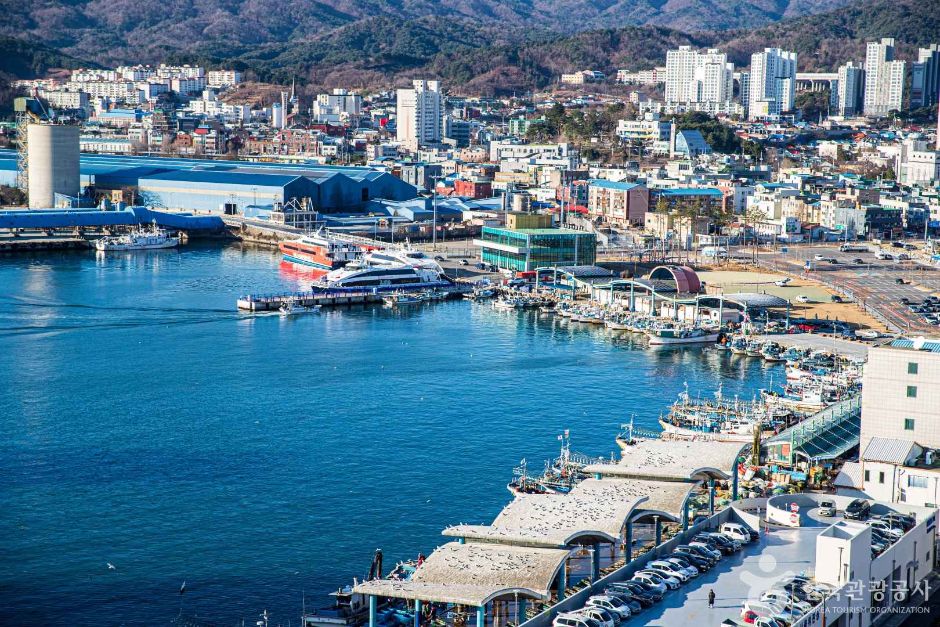
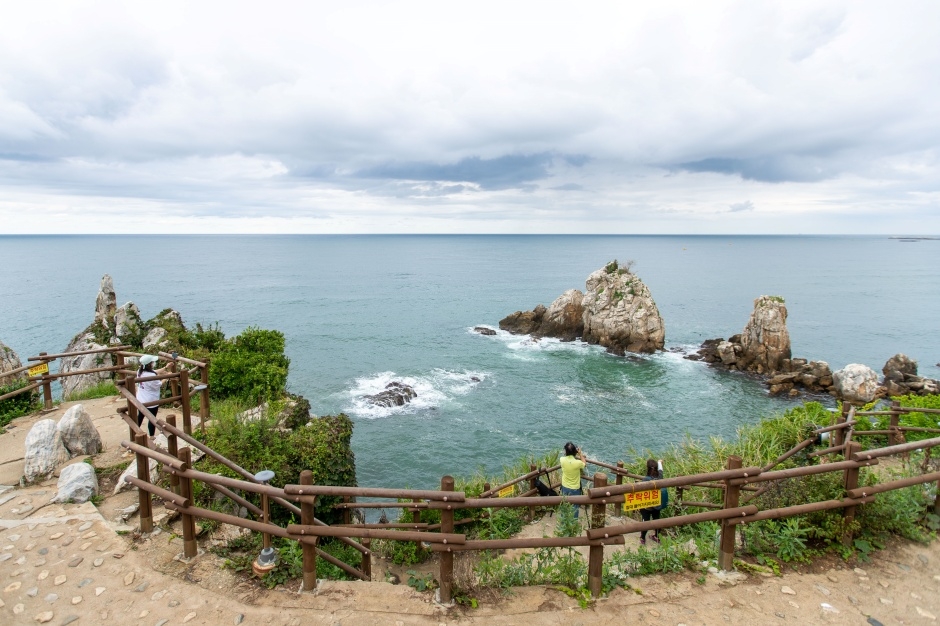
You do not have to go far for the area’s best scenery. Chuam Chotdaebawi (추암 촛대바위, Candlestick Rock) is a short drive away — a dramatic sea stack famous as the backdrop in the opening of the Korean national anthem, and one of Donghae’s signature sunrise spots. Mukho Port and its Nongoldam-gil (논골담길), a hillside lane of murals climbing to the Mukho Lighthouse, offer harbor-village atmosphere and ocean views. And Mangsang Beach itself, right at your door, gives you the wide sand and sunrise without going anywhere. A simple loop — Mangsang Beach to Mukho Port and Nongoldam-gil for a meal and a walk, then Chuam Chotdaebawi for sunrise — keeps all three within about two hours of driving.
One Donghae food note
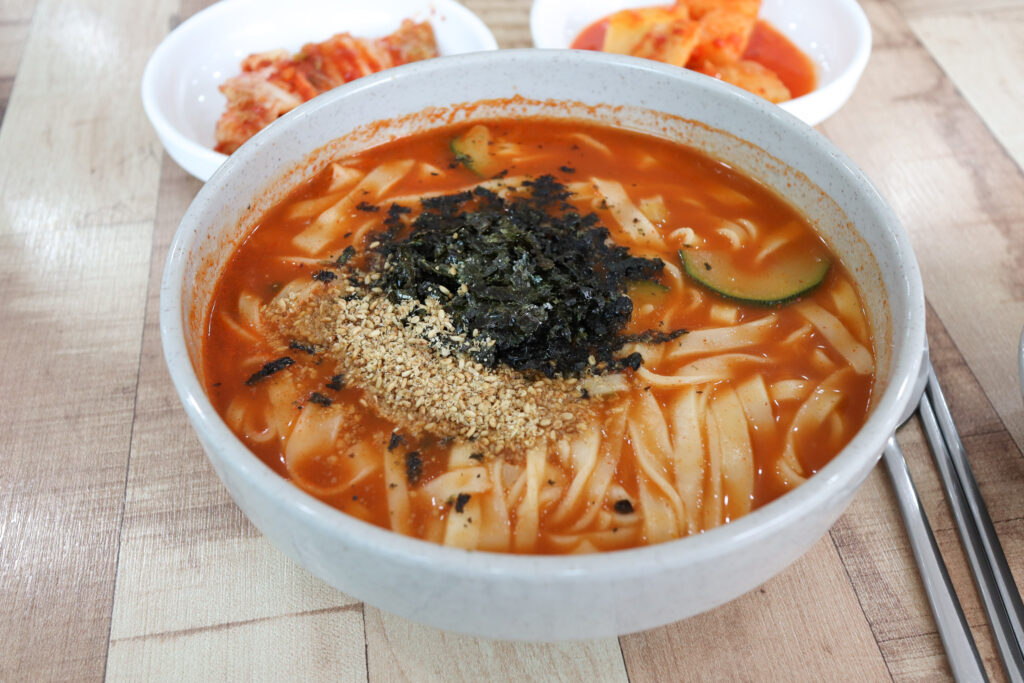
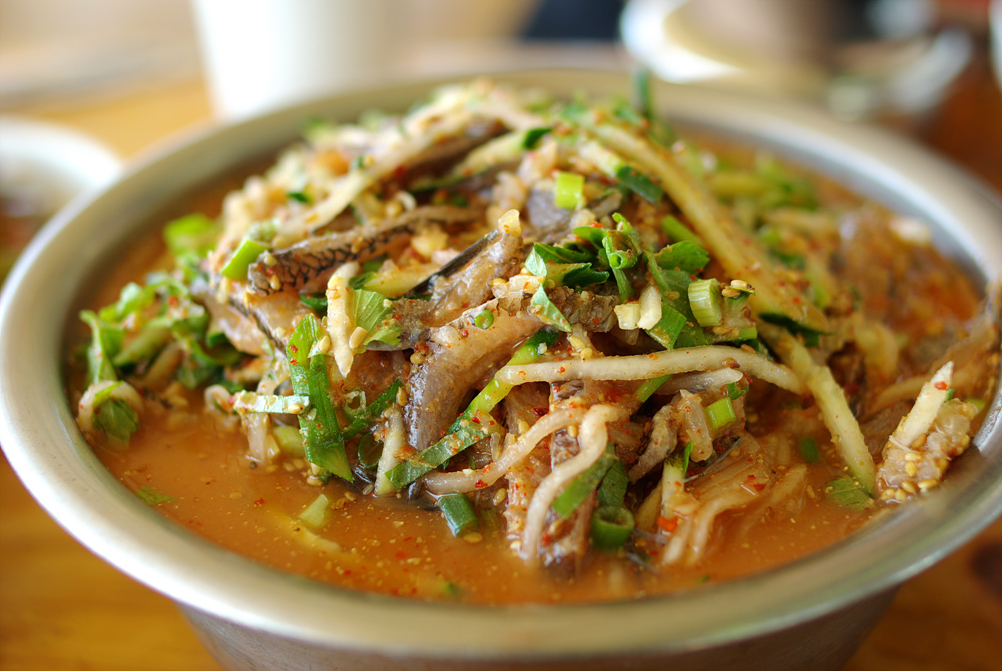
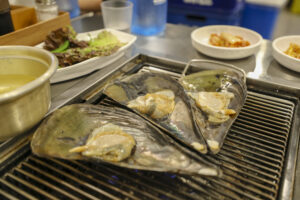
The nearby Mukho Port and Mukho Market are the area’s eating hub. Local specialties to look for include gomchi-guk (곰치국, a clear, bracing snowfish soup that doubles as a hangover cure), mulhoe (물회, a cold raw-fish soup that shines in summer), jang-kalguksu (장칼국수, a spicy soybean-and-chili-paste knife-cut noodle soup), and seasonal sandfish (도루묵). You can sample these around the Mukho Port and market area. If you want a beachside seafood-grill experience to round out the trip, our piece on jogae-gui (grilled shellfish) captures the same East-Sea-by-the-water mood.
Mangsang Beach Hanok Village will not pamper you the way a resort spa might, and the booking system asks for a little patience. But the trade is a real one: a genuine timber hanok, the sound of waves through black pines, and a sunrise over the East Sea that you can watch from your own doorway — all at a public-facility price.
Details such as room count, rates, booking-open timing, night limits, and the no-toiletries policy can change by season and policy. Verify on campingkorea.or.kr before you travel.
Where to eat near Mukho and Mangsang Beach
The Mukho harbor stretch in Donghae is one of Gangwon’s great seafood corners, famous for cold-cure fish soups, icy mulhoe, and gutsy gochujang noodles. A few spots near the port and the Kkamakbawi coast are local institutions worth the short hop from Mangsang Beach.
- 동해바다곰치국 (Donghae Bada Gomchiguk) — Signature: gomchiguk (물곰탕), a clear, hangover-friendly snailfish soup simmered with aged kimchi. Right by Mukho port, it’s a reliable, no-frills place that serves this regional specialty all year rather than only in winter.
- 대우칼국수 (Daeu Kalguksu) — Signature: jang-kalguksu, knife-cut noodles in a deep, spicy gochujang broth. This tiny, decades-old shop run by an elderly couple (a short walk from the port) is treated as one of Donghae’s defining jang-kalguksu spots, so expect a wait and a very short menu.
- 부흥횟집 (Buheung Hoetjip) — Signature: mulhoe (cold raw-fish soup) and fresh sashimi. Set in the Kkamakbawi (까막바위) raw-fish strip along the Mukho coast toward Mangsang, it’s a representative pick for just-landed catch with an ocean view.
These are small, family-run eateries, so menus, prices, and hours shift with the season and the day’s catch — several close on a fixed weekday (for example, Tuesdays). Always verify opening hours and closing days before you go.
Leave a Reply