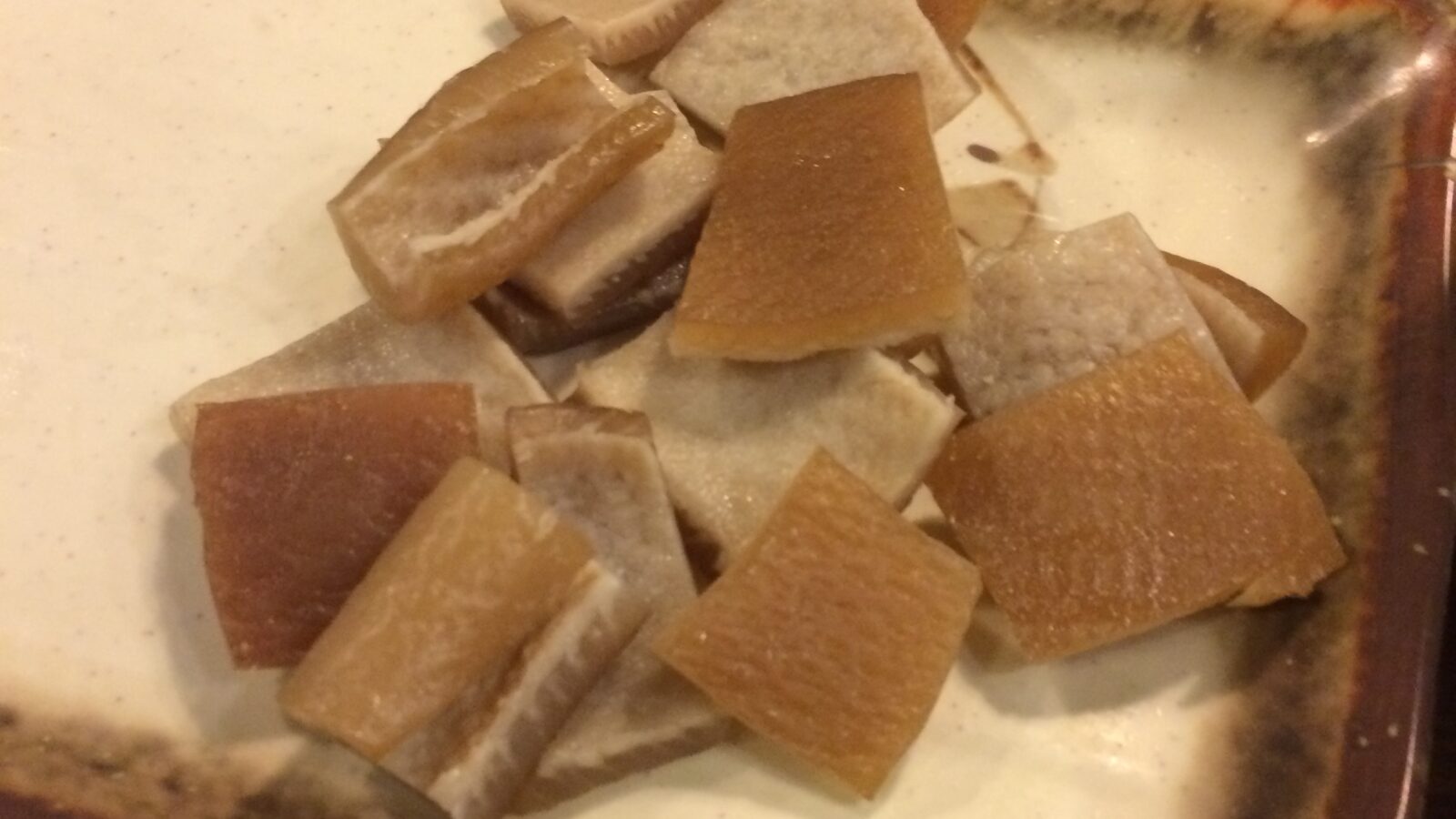
If you have spent a late night in a smoky Korean pub watching a slab of skin curl and blister over glowing charcoal, you have met dwaeji-kkeopdegi (돼지껍데기) — grilled pork skin, one of the most distinctive and affordable items in Korea’s drinking-food canon. The name simply joins dwaeji (돼지, pig) and kkeopdegi (껍데기, skin or shell). Grilled, it is often written kkeopdegi-gui (껍데기구이). It is humble, nose-to-tail eating turned into a genuinely craveable bar snack, and it has a devoted following among Koreans who would happily skip the pricier cuts to get to it.
What exactly is it?
Dwaeji-kkeopdegi is the skin (rind) of the pig, trimmed of most of its fat, cut into squares or strips, and grilled — usually right at your table over charcoal or a gas burner, just like samgyeopsal. It arrives raw or par-cooked, frequently pre-marinated in a sweet-spicy gochujang (고추장, red chili paste) sauce, though plain and lightly soy-seasoned versions are common too. Because pork skin is essentially pure connective tissue, it is one of the most collagen-dense things you can order off a Korean grill.
Taste and texture
This is a dish you eat for texture as much as flavor. Properly grilled, the surface crackles, bubbles, and turns a glossy golden-brown while the interior stays soft and springy. The payoff is a satisfying chew — bouncy and gelatinous, with a faint crisp at the edges where the skin has caramelized. The flavor is mild, smoky, and a little nutty on its own; the gochujang marinade pushes it sweet, savory, and gently fiery. It is rich without being heavy, which is exactly why it pairs so well with cold soju (소주).
How it’s eaten
Kkeopdegi is, first and foremost, anju (안주) — food meant to be eaten alongside alcohol. It is rarely a meal on its own; instead it anchors a long, leisurely drinking session with soju, beer, or makgeolli. The grilling ritual is half the fun. Here is the typical flow:
- Lay the skin flat on the hot grill. As it heats, the edges curl inward.
- Flip it and press it flat with tongs so both sides cook evenly.
- Once it firms up, snip it into bite-size pieces with the table scissors and keep grilling until the surface blisters.
- Eat it hot, dipped in ssamjang (쌈장, the fermented bean-and-chili dip) or a simple salt-and-sesame-oil sauce.
Many people wrap each piece in lettuce or perilla leaf with a smear of ssamjang, a sliver of raw garlic, and a slice of grilled chili — the cool, crisp wrap is the perfect foil for the hot, chewy skin. It is also commonly ordered as a side to a larger pork spread, sharing the grill with samgyeopsal.
Cultural and regional notes
Pork skin embodies the Korean nose-to-tail ethic of wasting nothing, and it carries a slightly nostalgic, working-class charm — cheap, generous, and unpretentious. It is a fixture of the pojangmacha (포장마차, street tents) and old-school grill houses where the bill is small and the night is long. In Seoul, the Mapo (마포) district is famous for its concentration of grilled-pork and pork-skin restaurants, a longtime destination for office workers chasing soju and smoke after dark. You will find honeycomb-scored versions (벌집껍데기, beoljip-kkeopdegi) cut in a cross-hatch pattern to increase surface area for an even better chew.
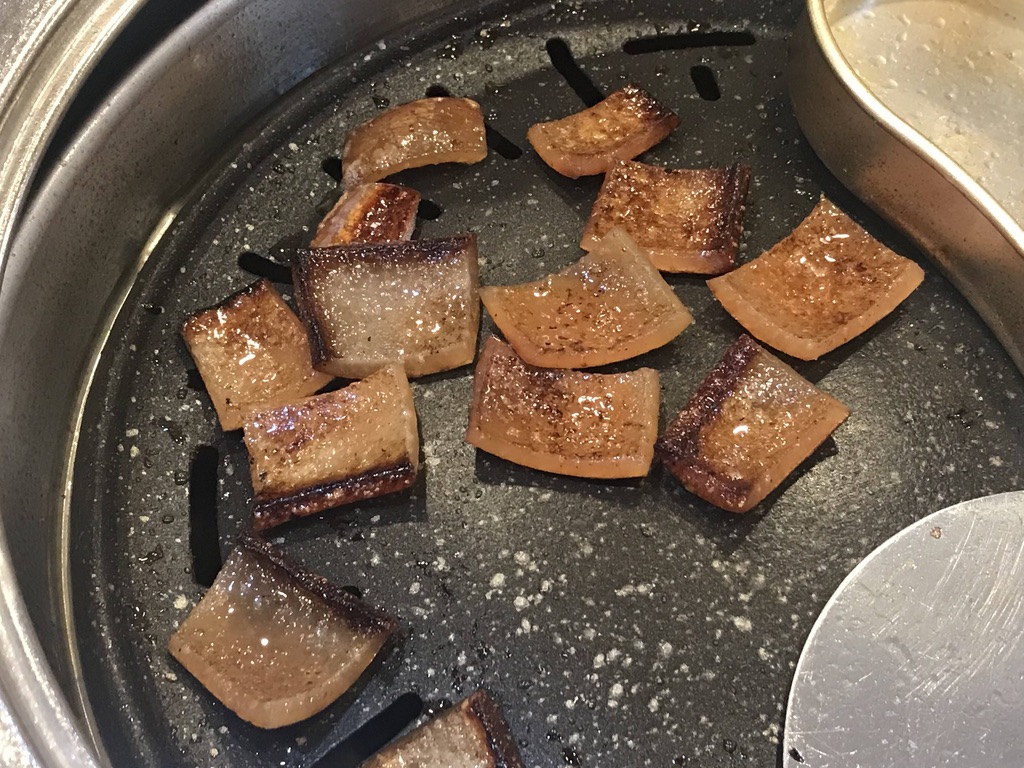
Health, honestly
Kkeopdegi is widely marketed on its collagen content, and it is genuinely rich in it, along with protein, fat, and some vitamin B12. That said, treat the popular “good for your skin” claims with healthy skepticism — dietary collagen is broken down in digestion, and there is no strong evidence that eating pork skin translates into firmer skin. It is more nutritionally interesting than processed snacks, but it is still fatty and best enjoyed as the indulgence it is.
A few honest cautions
- Cook it through. This is pork, so grill until the skin is firm, blistered, and piping hot — never eat it rare. Pre-marinated kkeopdegi can hide its doneness, so go by texture, not color.
- Mind the grease and curl. Hot fat renders and spits as the skin curls; keep pieces flat and use the tongs and scissors rather than your fingers.
- It is rich. The chew and fat add up fast — order it to share, and let the lettuce wraps and drinks do their balancing work.
- Newcomer note: raw skin can look unfamiliar, sometimes with visible texture or stray hair follicles. That is normal; a good restaurant cleans it well, and the grill transforms it completely.
The bottom line
Dwaeji-kkeopdegi is one of the easiest ways to eat like a Seoul local for almost no money: pull up a stool, fire up the grill, pour a round of soju, and let the skin crackle. If you love texture and you are open to nose-to-tail eating, this chewy, smoky, collagen-loaded classic deserves a spot on your Korean food bucket list.
Where to eat 돼지껍데기 (dwaeji-kkeopdegi, grilled pork skin) in Seoul
Grilled pork skin is late-night Seoul comfort food at its most honest: chewy, collagen-rich strips charred over flame, dunked in sesame oil and salt, and washed down with cold soju. Mapo-gu is its heartland, packed with old-school noje (longtime neighborhood joints) where the smoke, the worn tables, and the queues are all part of the ritual. Here are a few spots worth seeking out.
- 원조마포껍데기집 (Wonjo Mapo Kkeopdegi-jip) — Gongdeok, Mapo-gu; about a 10-minute walk from Gongdeok Station (Lines 5/6, Gyeongui-Jungang, AREX), exit 5. A decades-old noje that has been grilling pork skin, ribs, and intestines over charcoal briquettes for roughly 26 years in a wonderfully time-frozen, no-frills room. It even turned up as a filming location for the drama Misaeng, so this is a genuine icon rather than a passing trend. The 껍데기 runs around 8,000 won.
- 한강껍데기 (Hangang Kkeopdegi) — Mangwon-dong, Mapo-gu; roughly a 12-minute walk from Mangwon Station (Line 6 / Gyeongui-Jungang). A famous Mangwon pork-skin specialist near Mangwon Han River Park, where lining up from opening is simply the norm. The signature kkeopdegi is prized for its chewy, savory bite, often served with soybean powder, with 목살 (pork neck) and 삼겹살 (pork belly) rounding out the order.
- 대전해장국 (Daejeon Haejangguk) — old-alley nomae area on the Daeheung/Sinchon side of Mapo-gu; nearest is Gongdeok Station (Lines 5/6, Gyeongui-Jungang, AREX). The signboard says “hangover soup,” but this 30-plus-year noje actually serves only charcoal skewers, and the crispy 돼지껍데기 skewers (about 2,500 won each) pair beautifully with soju and beer. A tiny, well-loved institution with frequent peak-hour waits. Note that chicken skewers (닭꼬치) are the headline dish here, with pork skin as a delicious supporting act.
Hours, closing days, and prices at these small noje can shift without notice, so it’s worth confirming the latest details (a quick check on DiningCode or Naver) before you head over.


Leave a Reply