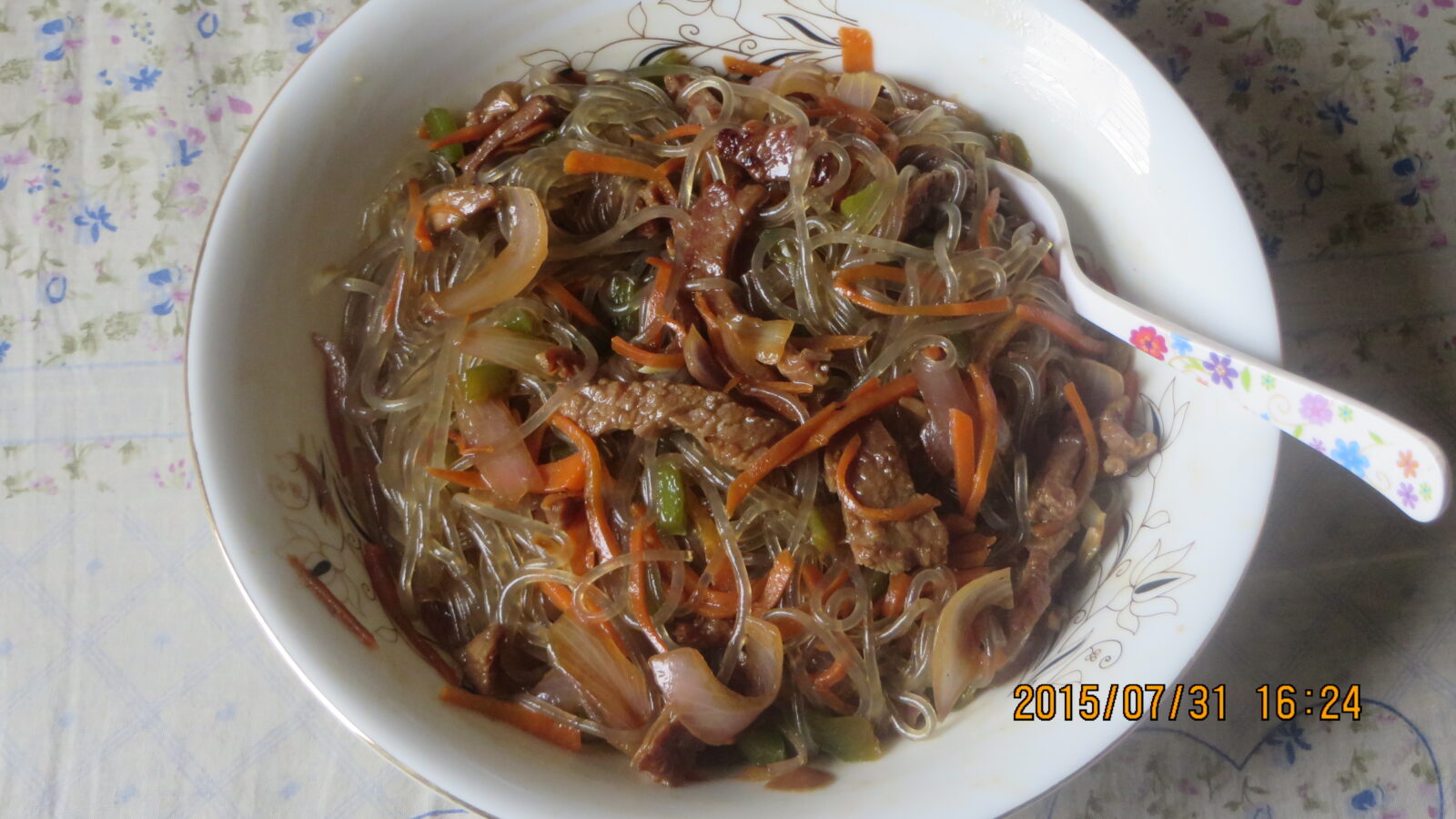
If there is one dish that signals a celebration in Korea, it is japchae (잡채) — a glossy, springy tangle of translucent noodles flecked with jewel-bright vegetables and ribbons of seasoned beef. The name literally means “mixed (잡) vegetables (채),” yet the true star is dangmyeon (당면), chewy noodles made from sweet-potato starch. Tossed with a sweet-savory soy-sesame-sugar sauce and finished with toasted sesame oil (참기름) and sesame seeds, japchae lands somewhere between a salad, a stir-fry, and a noodle dish — sweet, nutty, glossy, and impossibly colorful.
The surprising part: the original japchae had no noodles at all. The dish dates to the 17th-century Joseon court and is famously linked to King Gwanghaegun (광해군). A courtier named Yi Chung (이충) reportedly won royal favor — and high office — with his japchae, made from fresh winter vegetables grown in an early heated greenhouse pit. Jang Gye-hyang’s 17th-century cookbook Eumsik-dimibang (음식디미방) describes japchae of cucumber, mushrooms (석이·표고·송이), mung-bean sprouts, bellflower root, water parsley, fernbrake, and pheasant — “all sorts of mixed things,” exactly as the name promises. Dangmyeon only reached Korea in the late 19th century, and noodle japchae appears in cookbooks only after a dangmyeon factory opened in Sariwon (사리원), Hwanghae-do, around 1919.
Today japchae is the quintessential janchi (잔치, feast) dish, served at weddings, first-birthday tables (돌), and the big holidays Chuseok (추석) and Seollal (설날). It works as a side dish, a party platter, or — spooned over rice — japchae-bap (잡채밥). Crucially, it tastes great hot, warm, or at room temperature, which is exactly why it rules the holiday buffet.
Ingredients
Authentic separate-cook method, serves about 4. The secret to great japchae is cooking each component on its own so the colors and textures stay distinct.
- Dangmyeon (당면, sweet-potato glass noodles) — 200–250 g (7–8 oz)
- Beef — 100 g lean, tender cut (sirloin, ribeye, or chuck), in thin 5 cm strips (pork loin or extra mushrooms can substitute)
- Spinach (시금치) — about 170 g (6 oz)
- Carrot (당근) — 1 small, julienned
- Onion (양파) — 1/2 medium, thinly sliced
- Shiitake mushrooms (표고버섯) — 3–4 fresh, sliced (or dried, soaked); wood-ear (목이버섯) optional for extra bite
- Scallions — 2, cut 5 cm (and/or 부추 / red bell pepper for color)
- 1 egg, optional, for a thin egg garnish (지단)
- Neutral oil for the pan
Sauce (stir until the sugar dissolves):
- Soy sauce — 3.5 Tbsp
- Sugar or brown sugar — 3 Tbsp
- Toasted sesame oil (참기름) — 2 Tbsp
- Minced garlic — 2 tsp
- Toasted sesame seeds — 1 Tbsp
- Black pepper — to taste
Split the sauce: most goes on the noodles, but reserve about 2 Tbsp for the beef and mushrooms.
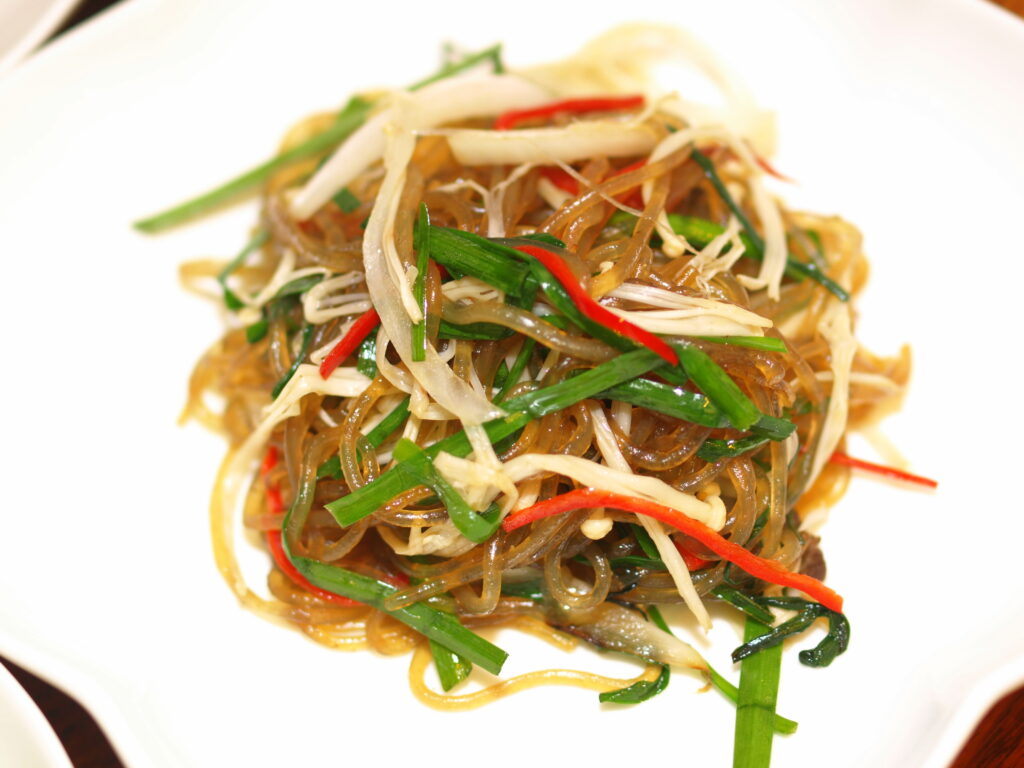
How to Make Japchae
- Make the sauce, stirring until the sugar dissolves. Marinate the beef strips in 1–2 Tbsp of it.
- Blanch the spinach in boiling salted water just until wilted (about 30 seconds), shock in cold water, squeeze dry, then season lightly with a pinch of salt and a few drops of sesame oil.
- Boil the dangmyeon in plenty of water for 6–8 minutes until soft and translucent — not al dente. Drain, rinse briefly under cold water, drain well, then snip a few times with kitchen shears so the noodles are easy to eat. Toss with about 3 Tbsp of the sauce.
- In a lightly oiled hot pan, cook each vegetable separately so colors and textures stay distinct: carrot with a pinch of salt for about 1 minute (keep it crisp); onion until just translucent; scallions, 부추, or bell pepper briefly. Set each aside.
- Stir-fry the sauced noodles for 3–4 minutes over medium-high heat until glossy and slightly sticky, then transfer to a large bowl.
- Stir-fry the marinated beef with the shiitake (and wood-ear) plus the reserved 2 Tbsp sauce until the beef is just cooked, 2–3 minutes.
- Combine everything in the big bowl — noodles, all the vegetables, spinach, and beef. Toss by hand for the most even coating, then taste and adjust with a little soy sauce, sugar, or sesame oil.
- Finish with extra toasted sesame seeds and a drizzle of sesame oil. Garnish with sliced egg (지단) if using. Serve warm or at room temperature.
Tips: don’t overcook the noodles; cut them so they aren’t awkwardly long; season component by component for balanced flavor; and toss by hand — it really does coat best.
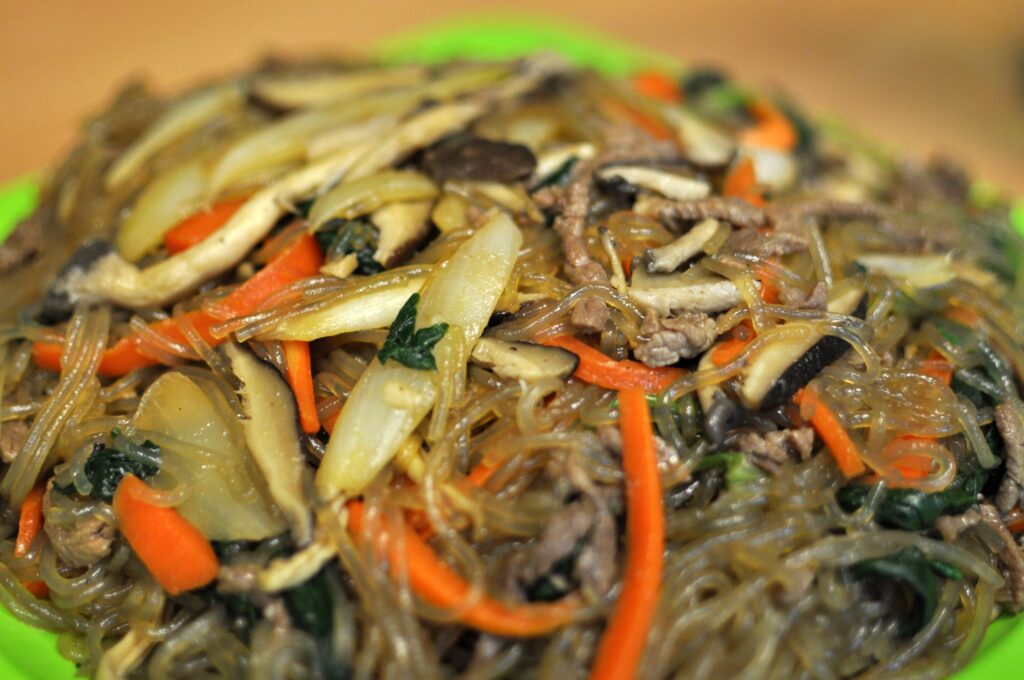
A faster weeknight version
Short on time? Maangchi’s easy method skips boiling: soak the dangmyeon in cold water for about 40 minutes, then layer everything into a cold pan — onion, carrot, mushrooms, and scallions first, then spinach, then the soaked noodles, then the sauce — and cook it all together. Far less washing-up, still tasty, though the textures blur a little compared with the separate-cook method.
Variations worth knowing
Japchae is endlessly adaptable. Gungjung-japchae (궁중잡채) is the royal-court style, made with the finest marinated beef and shiitake and a vivid presentation — historically the noodle-free or noodle-light version. Japchae-bap (잡채밥) serves it over rice, a favorite at Korean-Chinese restaurants. Haemul-japchae (해물잡채) swaps in shrimp, squid, and scallops for the beef. For a plant-based plate, vegetarian japchae (채식 잡채) drops the beef and egg and leans on more mushrooms (표고·목이·느타리) or pan-fried tofu — it’s naturally vegan-friendly. There’s also chive-forward buchu-japchae (부추잡채), budget-friendly kongnamul-japchae (콩나물잡채) bulked with soybean sprouts, and spicy versions seasoned with gochugaru (고춧가루).
How to eat it
Most often japchae is a banchan (반찬, side dish) enjoyed alongside rice and other dishes, or the centerpiece platter at parties and holidays — it is the feast noodle. For a one-bowl meal, pile it over steamed rice as japchae-bap. Unlike soup noodles, it’s just as good at room temperature, making it ideal for buffets, lunchboxes, and leftovers (it keeps 3–4 days refrigerated and reheats well in the microwave or with a quick pan-toss and a splash of water and sesame oil). Eat it with chopsticks, and add a final sprinkle of sesame seeds and a drizzle of sesame oil right before serving to lift the aroma. It pairs beautifully with grilled meats like bulgogi (불고기) — whose soy-sesame-sugar-garlic marinade is essentially the same seasoning — and with vegetable-forward dishes like bibimbap (비빔밥), which shares japchae’s hallmark technique of cooking each vegetable (나물) separately. A side of kimchi cuts the gentle sweetness perfectly.



Leave a Reply